
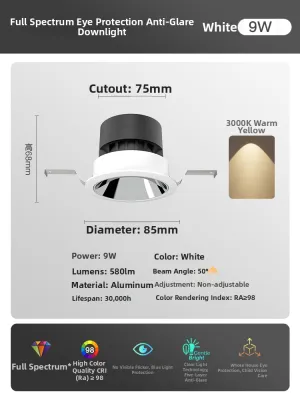
For a standard Singapore HDB flat with a 2.6m ceiling, the most effective downlights are ultra-slim, low-profile LED fixtures with a total recessed depth of under 50mm, or fixtures utilizing remote drivers. Brands that offer dedicated, shallow-recess residential ranges—such as Philips, Megaman, and specialized local lighting suppliers—are highly suited for these spaces. They integrate seamlessly into shallow false ceiling voids without interfering with concrete slabs or structural services, while delivering comfortable, glare-free illumination tailored to lower ceiling heights.
Selecting the right downlights requires balancing physical space constraints with optical comfort and electrical safety. Because a 2.6m ceiling brings the light source closer to eye level, choosing the correct specifications is critical to preventing harsh glare and excessive heat buildup. This guide breaks down the physical, technical, and safety criteria you need to evaluate when sourcing downlights for your HDB flat.
Understanding the 2.6m HDB Ceiling Constraint
The standard floor-to-ceiling height in most Singapore HDB flats is approximately 2.6 meters. When homeowners opt for recessed downlights, they must construct a plasterboard false ceiling to house the fixtures and conceal the wiring. To preserve comfortable living space and comply with guidelines, this false ceiling is typically kept as shallow as possible, creating a void depth of only 100mm to 150mm, and sometimes as little as 75mm in tight areas.
Products mentioned in this guide
![[Local Set] [3 Year Warranty] Philips Meson LED Downlight Ceiling Light 9W/13W Round/Square [Bundle Deal Available]](https://img.lazcdn.com/g/p/d8d02051d9b113c0010c4b1a40161081.png_400x400q80.png_.webp)
Prices are valid at publication and may change. Please refer to the product page for the latest price.
Standard commercial-grade downlights often feature deep, bulky housings that require 120mm to 180mm of vertical clearance. Attempting to install these in a shallow HDB void leads to direct structural conflicts. HDB regulations strictly prohibit hacking or cutting into the structural concrete ceiling slab to accommodate recessed lighting, as doing so compromises the building’s structural integrity, risks damaging steel reinforcement bars, and can cause water leakage issues for the neighbors upstairs.
Furthermore, the ceiling void is rarely completely empty. It must accommodate pre-existing electrical conduits, structural beams, air-conditioning copper pipes, and water drainage lines. These physical obstructions reduce the actual usable depth in specific areas of the ceiling, making compact, low-profile lighting fixtures an absolute necessity.
From an optical perspective, a lower ceiling height of 2.6m significantly changes how light behaves in a room. Because the distance between the light source and the floor is short, the light has less vertical space to spread and disperse. This short throw distance increases the risk of hot spots—intense, distracting pools of light on the floor—and harsh glare that can cause visual discomfort for occupants standing or sitting in the room.
Critical Specifications for Shallow Ceiling Voids
To navigate the physical limits of a shallow ceiling void, you must look past basic brand names and focus on verifiable technical specifications. Understanding these parameters allows you to filter out incompatible fixtures early in your renovation planning.

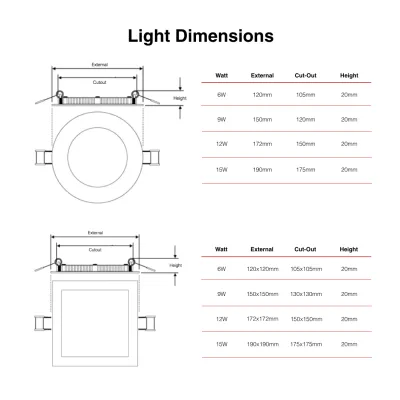
- Recessed Depth vs. Cut-Out Size: The cut-out size refers to the diameter of the hole that must be cut into the plasterboard (typically ranging from 75mm to 150mm). However, the recessed depth is the vertical height of the fixture's housing. For a false ceiling void of 100mm, the downlight's recessed depth should ideally be 50mm or less. This leaves a safe buffer of air space above the fixture to prevent heat traps.
- Slim and Remote Driver Designs: Ultra-slim integrated downlights house the LED driver and light engine in a single, flat chassis, often measuring just 20mm to 30mm in thickness. Alternatively, remote driver designs separate the driver from the physical light fixture, connecting them via a flexible cable. This allows the driver to be tucked flat inside the ceiling void adjacent to the light, minimizing the vertical space required directly above the cut-out hole.
- Lumen Efficacy and Wattage: In a 2.6m ceiling environment, high-wattage downlights are unnecessary and counterproductive. Fixtures rated between 7W and 12W are generally optimal. To ensure bright, energy-efficient illumination, select fixtures with high lumen efficacy (lumens produced per watt of electricity, ideally above 80 lm/W). High efficacy ensures you receive sufficient brightness (600 to 1,000 lumens per fixture) without generating excessive heat in a confined space.
- IP Ratings for Specific Zones: Ingress Protection (IP) ratings indicate how well a fixture resists dust and moisture. While standard IP20-rated downlights are perfectly adequate for dry areas like living rooms and bedrooms, HDB bathrooms and kitchen cooking zones require a minimum of IP44 (splash-proof) or IP65 (jet-proof) ratings. This protection prevents steam, humidity, and grease from penetrating the housing and causing premature electrical failure.
How to Evaluate Down Light Brands for HDB Flats
When sourcing downlights in Singapore, evaluating brands based on HDB-specific utility and local compliance is more practical than relying on generic popularity rankings. A systematic approach ensures long-term reliability and ease of maintenance.
First, assess the brand’s product portfolio to confirm they offer dedicated residential “slim,” “ultra-thin,” or “low-profile” ranges. Some commercial lighting brands focus primarily on deep-recessed architectural fixtures that are physically incompatible with a 100mm false ceiling. Ensure the manufacturer provides detailed technical spec sheets showing the exact physical dimensions, including the total recessed depth and driver dimensions.
Second, prioritize brands with robust local support and distribution networks in Singapore. LED downlights are electronic systems; while the LED chips themselves can last for tens of thousands of hours, the electronic drivers are more vulnerable to wear and power surges. Opting for a brand with local warranty support, dedicated service centers, and readily available replacement parts saves you from having to replace the entire fixture set if a single driver fails a few years down the road.
Third, verify electrical safety certifications. In Singapore, LED drivers and power adapters are controlled goods under the Consumer Protection (Safety Requirements) Registration Scheme. It is vital to verify that the brand’s drivers carry a valid Enterprise Singapore Safety Mark. Uncertified lighting products imported directly from unverified overseas online marketplaces often bypass these safety checks, posing severe risks of short circuits, electrical fires, and compatibility issues with local voltage standards.
Finally, weigh the trade-offs between mainstream global lighting brands and specialized local lighting suppliers. Global brands like Philips (Signify), Megaman, and Ledvance offer mass-market reliability, extensive safety testing, and widespread availability across multiple local hardware stores. Conversely, specialized local suppliers (such as those located in lighting hubs along Balestier Road, Geylang, or Jalan Besar) often provide highly customized architectural downlights. These local options frequently feature specialized anti-glare designs, smart home integration (compatible with local networks), and tailored advice based on extensive experience with standard HDB layouts.
Heat Management and Electrical Safety
Operating electrical fixtures in a confined, unventilated ceiling space introduces distinct thermal and safety challenges. Proper heat dissipation is essential to protect both the building structure and the lifespan of your lighting components.
- Thermal Dissipation: Although LEDs are highly efficient, they still generate heat at the semiconductor junction. In a shallow 100mm false ceiling void, this heat can build up rapidly. High-quality downlights utilize robust aluminum heat sinks to conduct heat away from the LED chip. Cheap plastic housings are poor thermal conductors and should be avoided for higher-wattage applications, as excessive heat degrades the LED chip, causing rapid dimming, color shifting, or total failure.
- Fire-Rated Downlights: Fire-rated downlights feature specialized materials that expand when exposed to high heat, sealing the ceiling cut-out to prevent the spread of flames and smoke into the ceiling void. While not universally mandatory for every standard HDB room, they provide an extra layer of safety, particularly in multi-story residential blocks where preserving the fire barrier of the ceiling plasterboard is a priority.
- Driver Placement Safety: LED drivers are highly sensitive to thermal stress. They must never be buried under thermal or acoustic insulation materials inside the false ceiling. Ensure there is a minimum clearance of 50mm around both the light fixture and the driver to allow for natural air convection and heat dissipation.
- Professional Boundaries: Installing, modifying, or extending electrical wiring in Singapore is subject to strict regulatory oversight. While homeowners can safely perform simple plug-and-play maintenance, any fixed wiring, installation of new electrical points, or modifications to the distribution board (DB box) must be performed by a Licensed Electrical Worker (LEW) to ensure compliance with local electrical safety standards.
Optimizing Light Output and Glare Control
Achieving comfortable lighting in a room with a 2.6m ceiling requires careful consideration of beam angles, anti-glare features, and color temperatures to create a pleasant spatial perception.
Because the ceiling is relatively low, wide beam angles ranging from 60° to 90° are highly recommended for general ambient lighting. A wider beam allows the light to spread quickly over the short vertical distance, creating a soft, overlapping wash of light across the room and eliminating harsh shadows. Narrow beam angles (15° to 36°) should be reserved strictly for accent lighting, such as highlighting a feature wall, artwork, or dining table, as using them for general illumination will result in high-contrast, clinical “spotlight” pools of light on the floor.
To prevent direct eye contact with the bright LED source, look for downlights designed with anti-glare features. These include deep-recessed baffles (where the light source is set back several centimeters inside the fixture housing), dark-light reflectors, or frosted diffusers that scatter the light gently. These designs ensure that the light source remains hidden from your normal line of sight when standing or sitting, significantly reducing eye strain.
Color temperature (CCT) plays a major role in how spacious and comfortable your HDB flat feels. Selecting the right CCT depends on the specific functional zone of your home:
- 3000K (Warm White): Emits a soft, cozy, yellowish light. It is highly recommended for bedrooms and living rooms to create a relaxing, inviting atmosphere.
- 4000K (Cool White): Provides a clean, balanced, neutral white light that enhances focus and visual clarity. It is ideal for kitchens, study rooms, and bathrooms where task lighting is essential.
- 6500K (Daylight): Delivers a bright, bluish-white light mimicking natural daylight. While useful for utility yards or specific task areas, it can feel overly clinical and cold if used as the primary ambient light source throughout a low-ceiling living room.
Pre-Installation and Maintenance Checklist
Taking a structured approach to installation and maintenance prevents costly mistakes and ensures your lighting system remains functional for years to come.
Before any holes are cut into your plasterboard, use a stud finder to map out the location of the metal ceiling joists and support frames. Ensure the planned downlight locations do not overlap with these structural supports or any concealed conduits. Always double-check the physical cut-out template provided by the manufacturer against the actual fixture body before cutting the plasterboard.
When positioning the remote LED drivers inside the ceiling void, ensure they are placed close to the cut-out hole. The driver must remain loose and accessible so that it can be easily pulled down through the hole for replacement in the future. Avoid gluing, taping, or permanently fixing the driver deep inside the ceiling void where it cannot be reached without tearing down the plasterboard.
For ongoing maintenance, clean the external trim of the downlights periodically using a dry, anti-static microfiber cloth. Never spray liquid cleaners or water directly onto or near the fixtures. If a downlight begins to flicker, dim, or fail to illuminate, it is typically a sign of driver degradation rather than a failed LED chip. Address flickering promptly by replacing the driver to prevent electrical instability and protect the connected LED module from damage.
Frequently Asked Questions (FAQ)
Can I install recessed down lights without a false ceiling in an HDB flat?
No, you cannot install recessed downlights without a false ceiling in an HDB flat. Recessing a fixture requires cutting a physical cavity into the ceiling. HDB structural ceilings consist of solid concrete slabs that are strictly protected; hacking or drilling deep cavities into these slabs is prohibited as it damages structural reinforcement steel and compromises building safety.
If you do not want to install a false ceiling, you must use surface-mounted downlights, track lighting, or ceiling-mounted batten fixtures. Surface-mounted downlights feature their own decorative housing that mounts directly onto the concrete surface, concealing the wiring while providing a similar directional light effect without reducing your overall headroom.
Do I need a Licensed Electrical Worker (LEW) to change down light drivers?
Yes, any work involving fixed electrical wiring, including splicing wires, connecting new drivers to the mains power supply, or altering the electrical circuits behind a false ceiling, must be carried out by a Licensed Electrical Worker (LEW) or a qualified electrician in accordance with Singapore’s electrical safety regulations.
While homeowners can safely replace simple plug-and-play LED bulbs or external fixtures that connect via standard plug-and-socket interfaces, hardwired driver replacements pose risks of electrical shock, improper grounding, and fire hazards if wired incorrectly. Engaging an LEW ensures that the installation is safe, compliant, and properly balanced within your home’s electrical distribution board.
Community discussion
Share your experience or ask a question. Comments are reviewed before publication.