
Selecting the right hanging mirror is one of the most effective design strategies for visually expanding a compact Singapore home. While spatial expansion is a psychological illusion rather than a physical change, the visual impact on HDB flats and condominiums is substantial. A well-chosen mirror tricks the eye by reflecting light, extending sightlines, and breaking up the boxy layout of modern apartments. Navigating the market requires understanding how different designs interact with your space and knowing where to source them locally.
To achieve this spatial illusion, homeowners in Singapore have three primary brand directions. Global retailers like IKEA and Courts offer highly accessible, budget-friendly statement pieces. Contemporary design brands such as Castlery and Crate & Barrel provide minimalist, clean-lined options that blend seamlessly into modern Scandinavian or Japandi interiors. For non-standard wall dimensions or unique architectural features, local glass specialists and carpentry workshops offer bespoke, custom-cut solutions that maximize every millimeter of available space.
How Hanging Mirrors Create the Illusion of Space
Size and Proportion
Scale is the most critical factor when using mirrors to expand a room. Many homeowners mistakenly choose small mirrors, believing that a compact room requires small decor. In practice, multiple small, fragmented mirrors break up the wall surface and create visual clutter, making a tight space feel even more confined. A single, large hanging mirror acts as an “optical window,” capturing a broader view of the room and projecting it back to create a sense of continuous depth. To maximize this effect, the mirror should be scaled to cover at least two-thirds of the width of the furniture below it.
Products mentioned in this guide
![[SG Seller]Advanced sense wall hanging mirror/full body mirror/special-shaped wall hanging mirror /bedroom wall mirror](https://img.lazcdn.com/g/p/2b699ea210536fd208d1345ab2ca1523.jpg_400x400q80.jpg_.webp)
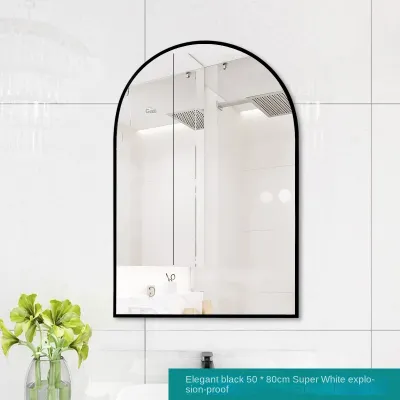
![[SG Seller] READY STOCK Nordic bathroom mirror bathroom mirror hanging wall bathroom mirror arch makeup mirror dressing mirror](https://img.lazcdn.com/g/p/e3ebc6e7d8215972747f2e5ac6ff4cc5.jpg_400x400q80.jpg_.webp)
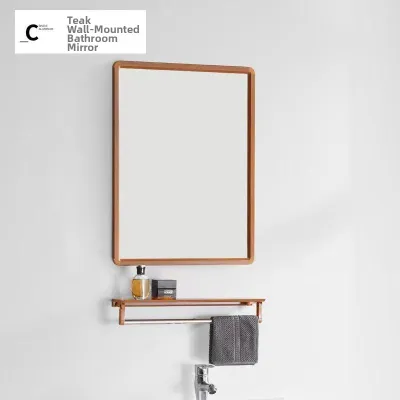
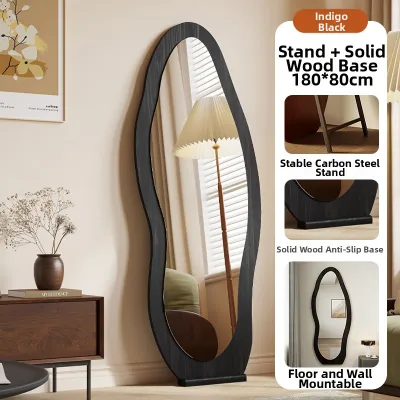
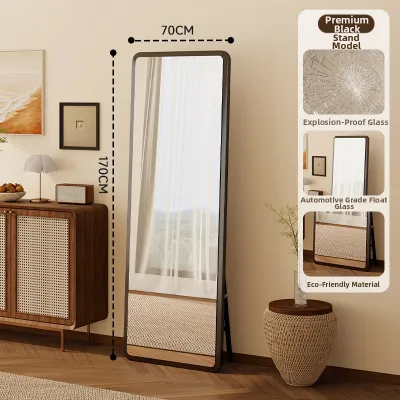
![[Delivered in 1 days]Standing Mirror Full length Mirror Floor Mirror Home Bedroom Large Mirror Hanging Wall Hanging Fitting](https://img.lazcdn.com/g/p/2b3c0b3d64e68bf2de2ea1ee27ce44e1.jpg_400x400q80.jpg_.webp)
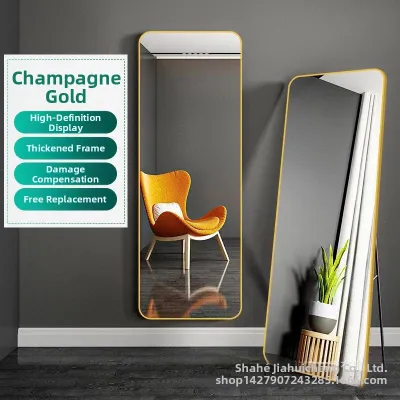
Prices are valid at publication and may change. Please refer to the product page for the latest price.
Shape and Edges
The geometry of a mirror dictates how the eye travels across a room. Standard rectangular mirrors are excellent for mimicking traditional window frames, but they can reinforce the rigid, boxy lines of typical HDB layouts. Curved, arched, or round mirrors introduce organic silhouettes that soften sharp corners and narrow hallways. An arched mirror, featuring a flat base and a rounded top, draws the eye upward toward the ceiling, which visually elevates standard 2.6-meter ceilings. Round mirrors break up the monotony of straight walls, making tight entryways feel more fluid.
Frame Thickness and Visual Weight
A mirror’s frame acts as a visual boundary that defines where the real room ends and the reflection begins. Thick, dark, or heavily ornate frames create a hard stop, drawing immediate attention to the physical limits of the wall. In compact spaces, this heavy visual weight can make the room feel more enclosed. Conversely, ultra-thin metal frames or completely frameless mirrors allow the reflection to blend seamlessly with the surrounding wall. This lack of visual boundary blurs the line between the physical room and the reflected space, maximizing the perceived expansion.
Placement and Reflection Strategy
A mirror is only as effective as the view it reflects. Placing a mirror directly opposite a cluttered storage shelf, a utility yard, or a dark corridor will simply double the visual clutter or darkness. The optimal strategy is to position the mirror where it can capture and bounce natural light. Hanging a mirror adjacent to or directly opposite a window allows it to catch incoming sunlight and disperse it deep into the room. Additionally, aligning a mirror to reflect an open pathway or an adjacent living area extends the visual depth, making the entire floor plan feel more interconnected.
Hanging Mirror Design Strategies and Brand Directions in Singapore
Large Statement Mirrors from Global Home Brands
Oversized statement mirrors are highly effective when placed in main living rooms, dining areas, or spacious entryways of HDB flats and condominiums. These large-scale designs serve as primary focal points, anchoring the room’s layout while bouncing the maximum amount of ambient light. They are particularly useful on large, blank walls that otherwise make a room feel flat and sterile.

These designs typically feature standardized dimensions, lightweight aluminum or thin engineered wood frames, and versatile mounting systems. Many are designed to be either wall-mounted horizontally or vertically, or leaned safely against a wall using anti-tip safety tethers. The focus is on providing a massive reflective surface with minimal structural bulk, keeping the visual weight as light as possible.
For budget-friendly, large-scale options, global home furnishing brands with a strong physical presence in Singapore, such as IKEA or Courts, are excellent starting points. IKEA offers iconic, oversized series like the Hovet or Toftbyn, which provide expansive reflective surfaces without a premium price tag. Courts also provides accessible home decor selections suitable for standard family homes, allowing you to view the scale of the mirrors in person before purchasing.
However, mass-produced mirrors are built to standard dimensions, meaning they may not fit perfectly into unique architectural niches or tight, non-standard wall spaces. Furthermore, the glass used in budget-friendly, mass-market options may exhibit minor optical distortion when viewed from a distance. Because of their sheer size and weight, transporting, unboxing, and mounting these mirrors requires extreme care to prevent shattering or personal injury.
Minimalist and Frameless Designs from Contemporary Furniture Brands
Sleek, understated mirrors are perfectly suited for modern, minimalist, Scandinavian, or Japandi interiors. In these design themes, clean lines and uncluttered surfaces are essential to maintaining an airy, spacious atmosphere. A minimalist mirror enhances this aesthetic by serving its functional purpose without adding unnecessary visual noise.
These designs focus on bezel-less edges, subtle metal frames in finishes like brushed brass, matte black, or satin nickel, and clean geometric or organic shapes. They are designed to sit flush against the wall, minimizing physical protrusion into tight walkways. The minimalist frame ensures that the mirror feels like an integrated architectural element rather than an added accessory.
Contemporary furniture brands with local showrooms in Singapore, such as Castlery or Crate & Barrel, offer highly curated, design-forward minimalist mirrors. Castlery’s collections often feature elegant, thin-framed mirrors designed to complement modern living room furniture, while Crate & Barrel provides premium, clean-lined options that emphasize high-quality glass and sophisticated metalwork. Visiting these showrooms allows you to assess the frame finishes against your existing decor.
Despite their aesthetic appeal, frameless and ultra-thin-framed mirrors are highly delicate. The exposed glass edges of frameless designs are vulnerable to chipping during transport and installation. Additionally, because these mirrors sit very close to the wall, any unevenness or bowing in the plaster or concrete wall can put uneven pressure on the glass when tightened, leading to a warped reflection or, in worst-case scenarios, cracking.
Custom and Textured Framed Mirrors from Local Specialists
Custom mirrors are the ultimate solution for awkward wall dimensions, narrow structural pillars, or recessed niches commonly found in older resale HDB flats or custom-renovated condominiums. When off-the-shelf sizes do not fit, a custom-cut mirror ensures that you can utilize every available inch of wall space to create a seamless, built-in look.
These bespoke options feature tailored dimensions down to the millimeter, with choices for textured solid wood frames, custom-lacquered finishes, antique metallic frames, or elegant beveled edges. Beveled edges are particularly effective in small spaces because they refract light like a prism along the border, adding subtle architectural depth without requiring a bulky frame.
To source these, homeowners should look to local glass and mirror specialists, carpentry workshops, or boutique home decor stores in Singapore. Established local glass merchants and framing shops located in industrial hubs like Defu Lane, Toa Payoh, or Ubi can cut mirrors to exact specifications, apply specialized safety backings, and even handle custom frame fabrication to match your cabinetry.
Bespoke mirrors come with a significantly higher price tag compared to mass-market options. They also require longer lead times, often taking several weeks from measurement to delivery. Precise self-measurement is absolutely critical; even a minor error of a few millimeters can prevent a custom-cut mirror from fitting into a designated recess, resulting in costly re-cutting fees.
Crucial Checks Before Hanging a Mirror in Singapore Homes
Wall Type and Load-Bearing Capacity
Singapore’s residential landscape consists of diverse wall structures. Standard HDB flats typically feature high-strength precast concrete walls (which are structural and load-bearing) or lightweight concrete partition walls. Newer BTO flats and modern condominiums often utilize drywall partitions (plasterboard over metal studs) to separate bedrooms. Before installing a hanging mirror, you must identify the wall type. Concrete walls require a rotary hammer drill and high-quality plastic wall plugs (such as Fischer plugs) to secure the mounting screws. Drywall partitions, on the other hand, cannot support heavy hanging mirrors with standard plugs; they require specialized hollow-wall anchors, such as metal toggle bolts or heavy-duty self-drilling drywall anchors, aligned to the internal metal studs whenever possible.
Hanging Hardware and Weight Limits
The safety of your installation depends entirely on matching the hardware to the mirror’s weight. Common hardware systems include D-rings, French cleats, and picture wire. For heavy decorative mirrors, picture wire is generally discouraged because it places concentrated stress on a single point and can cause the mirror to tilt forward, distorting the reflection. Instead, D-rings mounted directly to wall screws or a French cleat system are highly recommended. A French cleat utilizes interlocking metal or wood brackets, with one bracket secured to the back of the mirror and the other anchored horizontally to the wall, distributing the weight evenly across multiple mounting points. Always check the manufacturer’s maximum weight rating for both the mirror and the hardware, and never exceed these limits.
Environmental and Placement Risks
Singapore’s tropical climate, characterized by high humidity and intense sunlight, presents unique challenges for mirror longevity and safety. Placing a standard mirror in high-moisture zones, such as bathrooms, near kitchen sinks, or adjacent to open-air balcony doors, can lead to “desilvering.” This occurs when moisture penetrates the protective backing of the mirror, oxidizing the silver reflective layer and causing unsightly black spots or peeling edges. For damp areas, ensure you select copper-free mirrors specifically rated for high-humidity environments. Additionally, avoid hanging mirrors where they will receive direct, harsh afternoon sunlight. Intense sunlight can create blinding glare, causing discomfort, and can also lead to heat buildup on the wall and the mirror’s backing materials, potentially degrading adhesives over time.
Professional Installation Boundaries
While hanging a small, lightweight mirror is a manageable DIY project, heavy, oversized, or high-mounted statement mirrors present significant safety risks. If a mirror weighs more than 15 kilograms, is larger than one meter in any dimension, or is being mounted at a height (such as above a sofa, bed, or dining table), you should always hire a qualified handyman or professional installer. Before any drilling begins, ensure that power-isolation protocols are followed to avoid puncturing embedded electrical conduits or water pipes. A professional installer will have the specialized tools, such as wall scanners, rotary hammers, and heavy-duty anchors, to ensure the mirror is mounted safely and securely, preventing catastrophic damage to your property or severe personal injury.
Frequently Asked Questions (FAQ)
How high should I hang a mirror to make a room look bigger?
As a general rule, the center of a hanging mirror should hang at average eye level, which is approximately 140cm to 150cm from the floor. If you are hanging the mirror above a piece of furniture, such as a console table, sideboard, or sofa, position the bottom of the mirror frame about 15cm to 20cm above the top of the furniture. This prevents the mirror from looking disconnected while keeping it low enough to reflect the room’s living space rather than the ceiling. To maximize the illusion of space, ensure the mirror is mounted perfectly flush and parallel to the wall; tilting the mirror downward will reflect the floor, which can make the room feel smaller and more enclosed.
Can I hang a heavy decorative mirror on an HDB drywall partition?
Yes, but you must take strict structural precautions. Standard drywall partitions in HDB flats and condominiums cannot support heavy point loads on their own. Hanging a heavy mirror (typically anything over 5 to 10 kilograms) directly onto the plasterboard using basic plastic plugs will eventually cause the drywall to sag, crack, or fail entirely. To safely mount a heavy mirror on drywall, you must use a stud finder to locate the internal metal studs and secure your mounting screws directly into them. If the placement of the studs does not align with your desired mirror position, you must use heavy-duty hollow-wall toggle bolts, which expand behind the plasterboard to distribute the weight over a larger surface area. If the mirror is exceptionally heavy (over 15 kilograms), it is highly recommended to consult a professional installer or choose a lighter alternative to ensure absolute safety.
Community discussion
Share your experience or ask a question. Comments are reviewed before publication.