
Standard Housing Development Board (HDB) flats in Singapore are constructed with a floor-to-ceiling height of 2.6 meters. Once you account for floor screeding, tiles, vinyl, or laminate finishes, the actual clearance often drops to around 2.55 meters. If you choose to install a false ceiling to conceal electrical conduits or air-conditioning pipes, the vertical clearance can decrease further to 2.4 meters in localized zones. This physical limitation requires a thoughtful approach to lighting design to prevent rooms from feeling cramped.
Bulky, multi-tiered chandeliers or low-hanging pendant lights physically obstruct the path of movement, posing a hazard for taller occupants and making routine tasks like changing bedsheets difficult. Visually, these heavy fixtures draw the eye downward, cutting the room’s volume in half and casting prominent shadows along the upper perimeter of the walls. This creates a dark ceiling zone that makes compact spaces feel claustrophobic. The primary objective of minimalist lighting in a 2.6m HDB space is to maximize headroom, maintain clean sightlines, and distribute light evenly to make the entire home feel open and airy.
What to Look for When Buying Minimalist Ceiling Lights
When shopping for minimalist lighting, evaluating specific technical dimensions and physical properties ensures the fixtures perform well in a low-ceiling environment.
Products mentioned in this guide
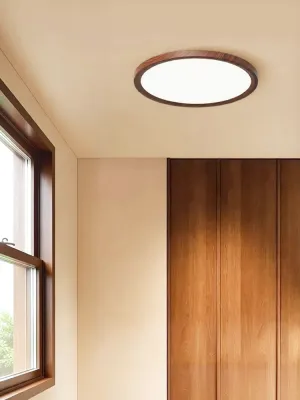
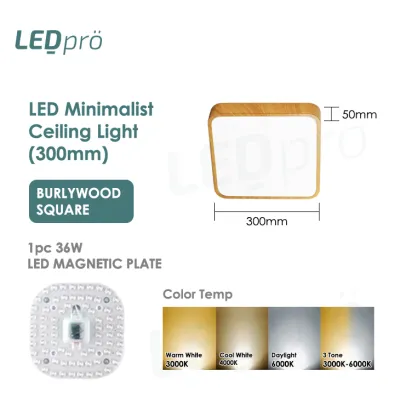
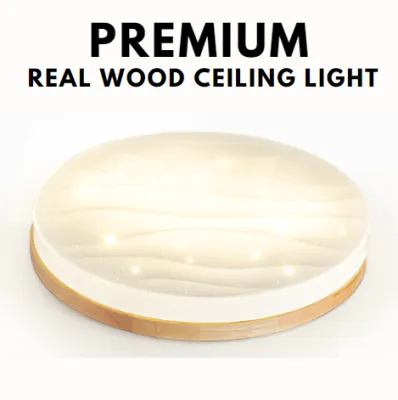
![[OKLIFE®]Wood Simple Ultra-Thin Ceiling LED Japanese Living Room Bedroom Ceiling Lamp R Walnut Wood Grain Ceiling Light](https://img.lazcdn.com/g/p/ef184f44c2084d9ab43b956ef4fff64c.jpg_400x400q80.jpg_.webp)
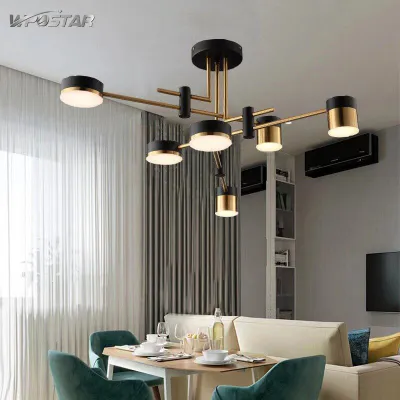
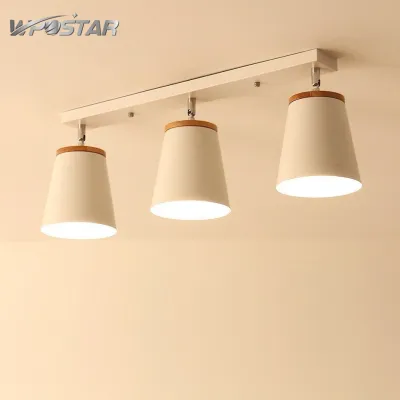
Prices are valid at publication and may change. Please refer to the product page for the latest price.
Profile and Depth The physical thickness of the fixture is your primary consideration. For a 2.6m ceiling, look for ultra-slim flush-mount fixtures with a depth of 5 centimeters or less. A profile of 2cm to 3cm is ideal, as it sits almost flush with the concrete slab, mimicking the look of a recessed architectural light without the cost or height loss of a false ceiling.
Illumination and Glare Control Low ceilings place light sources closer to your line of sight. To prevent eye strain, avoid fixtures with exposed LED chips or clear glass covers. Instead, opt for fixtures featuring high-quality polymethyl methacrylate (PMMA) or polycarbonate diffusers. These materials scatter light evenly across a wide angle, eliminating hot spots and creating soft, uniform ambient illumination.
Color Temperature and Dimmability Singaporean HDB flats are multi-functional spaces where a living room often serves as a home office by day and a relaxation zone by night. Look for fixtures with tunable white capabilities, allowing you to transition from a crisp 6000K daylight for focus tasks, to a neutral 4000K cool white for general activities, and down to a warm 3000K warm white for evening relaxation. Ensure the LED driver is compatible with your dimming system, whether it is a traditional triac wall dimmer, a 0-10V system, or a smart home protocol.
Electrical and Safety Specs Singapore’s domestic mains voltage is 230V AC at 50Hz. Any ceiling light or LED driver you purchase must be rated for this voltage to prevent premature component failure or electrical hazards. Crucially, verify that the product or its driver carries the mandatory Singapore Safety Mark. This certification, regulated by the Consumer Product Safety Office, ensures the electrical component has been tested and approved for safe use in Singapore homes. Standard HDB lighting circuits are typically protected by a 6A miniature circuit breaker (MCB), which easily handles highly efficient LED lighting, but always verify that your total fixture wattage does not exceed the circuit’s rated capacity.
Best Minimalist Ceiling Light Styles for Low Ceilings
Ultra-Slim Flush Mount LEDs
Ultra-slim flush mount LEDs represent the most straightforward and cost-effective solution for standard HDB ceiling heights. These fixtures are typically designed as flat, geometric panels—either circular or rectangular—with an overall thickness ranging from 1.5cm to 4cm. They utilize edge-lit LED technology, where the light-emitting diodes are mounted along the inner frame, directing light sideways into a light guide plate that redirects it downward through a diffuser.

These fixtures are exceptionally well-suited for general ambient lighting in bedrooms, study areas, household shelters, and utility hallways. Because they hug the ceiling surface tightly, they blend into the background, leaving the visual field completely clear.
However, they do have a few limitations. Because the light is highly diffused and spread over a large surface area, edge-lit panels may offer lower directional punch compared to spotlights. To prevent a flat, sterile appearance, select models with a high Color Rendering Index (CRI of 90 or above) to ensure colors in your home appear vibrant and natural. Additionally, choose models with high-quality sealed casings to prevent dust, small insects, and moisture from entering the diffuser over time.
Recessed and Trimless Downlights
For homeowners aiming for a completely seamless, high-end architectural aesthetic, recessed downlights are an excellent choice. Standard recessed downlights sit inside the ceiling cavity, leaving only a thin outer trim visible on the surface. Trimless downlights go a step further; their mounting frames are plastered directly into the ceiling board, leaving absolutely no visible border or flange once painted.
The primary constraint of recessed lighting in a standard HDB flat is the structural requirement. Because you cannot drill or hollow out the structural concrete ceiling slab of an HDB flat, installing recessed downlights requires the construction of a gypsum board false ceiling. A false ceiling typically needs to be dropped by 7.5cm to 10cm to accommodate the height of the downlight housing and its driver. This reduces your overall clearance to approximately 2.5m.
Despite this slight reduction in physical height, recessed downlights can make a room feel taller. By keeping the light source completely hidden within the ceiling plane, they eliminate all visual clutter. They allow you to create clean, localized pools of light, highlighting specific furniture pieces or artwork while keeping the surrounding ceiling area clean and uncluttered.
Minimalist Linear and Magnetic Track Systems
Magnetic track lighting systems offer versatility and a clean, modern aesthetic. These systems consist of a low-profile aluminum track—often surface-mounted directly to the concrete ceiling with a profile thickness of just 1cm to 2cm—coupled with a variety of light modules that click into place magnetically.
The main advantage of a magnetic track system is its modularity. Within a single track, you can combine linear accent lights for general ambient illumination, adjustable spotlights to highlight feature walls, and tiny, minimalist pendant lights over a dining table. This allows you to adapt your lighting layout as your furniture arrangement changes, without needing to run new electrical wires.
However, magnetic track systems require careful planning. They run on low-voltage direct current (typically 48V DC), which means they require an external transformer to convert the 230V mains power. This transformer is relatively bulky and must be concealed in an accessible location, such as inside a nearby distribution board box, a kitchen cabinet, or a false ceiling access panel. Additionally, surface-mounted tracks must be perfectly aligned during installation, as any unevenness in the concrete ceiling slab will be highlighted by the straight lines of the track.
How to Plan Minimalist Lighting for Different HDB Rooms
Living and Dining Areas The living room is the largest space in an HDB flat and requires a balanced, layered lighting scheme to avoid looking flat or clinical. Instead of relying solely on one large, bright central flush mount, combine a slim, low-profile central fixture with directional accent lighting. For example, you can run a surface-mounted magnetic track parallel to your sofa wall to highlight artwork or shelving, and place a minimalist floor lamp in the corner for warm, localized task lighting. This creates depth and visual interest without encroaching on your 2.6m vertical clearance.
Bedrooms In the bedroom, the primary goal is to create a calm, restful environment. Avoid placing bright downlights directly over the head of the bed, as looking up into a direct light source while lying down is highly uncomfortable. Instead, position a dimmable, warm-white (2700K to 3000K) ultra-slim flush mount in the center of the room, or use indirect warm LED strip lighting concealed behind a wardrobe pelmet or headboard to wash the walls with soft, glare-free light.
Kitchens and Bathrooms Kitchens require highly functional, shadow-free illumination for safe food preparation. Opt for high-CRI (CRI > 90) linear LED fixtures or slim surface-mounted panels that provide bright, even lighting across your countertops. In bathrooms, moisture resistance is critical. Ensure any ceiling light installed in or near the shower zone carries an appropriate Ingress Protection (IP) rating, typically IP44 or higher, to protect the internal electrical components from steam, condensation, and water splashes.
Installation Rules and Safety Checks for HDB Ceilings
Before undertaking any electrical work, safety must be your absolute priority. Always turn off the main power supply at your HDB flat’s distribution board (DB) by switching off the relevant miniature circuit breaker (MCB) and the main residual current circuit breaker (RCCB). Use a reliable, non-contact voltage tester at the ceiling wires to verify that the circuit is completely dead before attempting to disconnect or install any fixture.
When mounting fixtures directly onto a standard HDB concrete ceiling, verify the structural integrity of the mounting point. Concrete ceilings require high-quality masonry wall plugs and steel screws to secure the mounting bracket safely. Never attempt to mount a fixture using adhesives or light-duty drywall anchors. If you are installing a light on a false ceiling, ensure you locate the underlying metal framework to anchor the fixture, or use heavy-duty toggle bolts designed specifically for gypsum board.
In Singapore, while simple, direct replacements of existing light fixtures can often be performed by homeowners with basic electrical knowledge, any complex installation requires professional expertise. This includes laying new electrical wiring, adding new lighting points, modifying the distribution board, or installing extensive magnetic track systems. These tasks must be carried out by a Licensed Electrical Worker (LEW) registered with the Energy Market Authority (EMA). Hiring an LEW ensures that your home’s electrical system complies with the Singapore Standard SS 638 (Code of Practice for Electrical Installations), minimizing the risk of short circuits, electrical fires, or warranty voids.

Community discussion
Share your experience or ask a question. Comments are reviewed before publication.