
For a standard 2.6m HDB ceiling, the ideal round LED downlight configuration for general ambient lighting is a wattage of 7W to 9W paired with a wide beam angle of 90° to 120°. This combination delivers sufficient brightness—typically between 500 and 800 lumens per fixture—while spreading the light quickly enough to prevent harsh shadows and high-contrast dark spots. For accent lighting on feature walls or dining areas, a lower wattage of 5W to 7W with a narrower 60° beam angle is more appropriate. Selecting the right balance of these two factors ensures your home remains bright, welcoming, and free from eye-straining glare.
Designing a lighting layout for a standard Housing & Development Board (HDB) flat requires careful attention to physical space. Because the ceiling height is relatively low compared to private landed properties, light fixtures do not have a long distance to project their beams before hitting the floor or eye level. Consequently, choosing incorrect specifications can easily result in a home that feels either like a dim cave or a harsh, over-illuminated commercial office. Understanding how wattage and beam angles interact within this vertical space is the key to creating a balanced, comfortable living environment.
Understanding the 2.6m HDB Ceiling Constraint
The standard 2.6-metre floor-to-ceiling height in HDB flats imposes immediate physical and optical limits on your lighting design. When you install a false ceiling to conceal electrical wiring, run air-conditioning pipes, or create a modern recessed look, this clearance is reduced even further. A typical false ceiling drop ranges from 100mm to 150mm, leaving you with an actual floor-to-ceiling clearance of approximately 2.45 metres. This limited vertical space dictates how light behaves as it exits the fixture and travels downward.
Products mentioned in this guide
Prices are valid at publication and may change. Please refer to the product page for the latest price.
In low-ceiling environments, the distance between the light source and your eyes is significantly shorter than in high-ceiling properties. If a downlight projects a highly concentrated beam of light straight down, anyone walking through the room or looking up will experience immediate, uncomfortable glare. Furthermore, because the light does not have much vertical distance to spread out, narrow-beam fixtures will create small, intense pools of light on the floor, leaving the upper portions of your walls in deep shadow. This high-contrast environment visually shrinks the room, making your HDB flat feel smaller and more cramped.
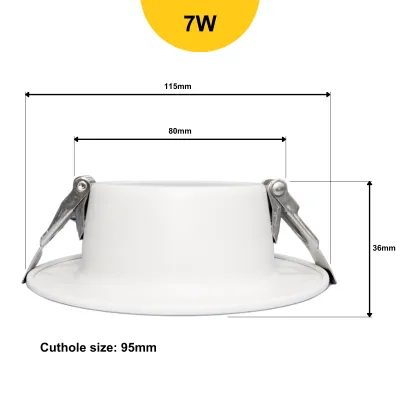
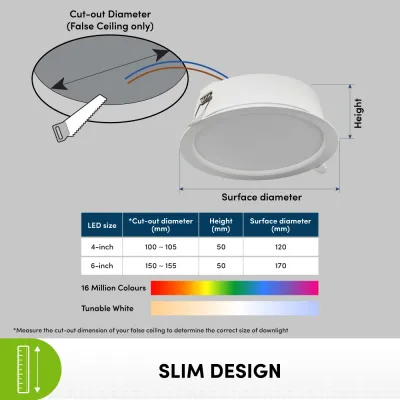
To combat these spatial limitations, the physical profile of the round LED downlight itself must be evaluated. Shallow ceiling cavities offer very little room for bulky housings. Standard deep-can downlights may not fit within a slim false ceiling without hitting the concrete soffit above. Homeowners must look for ultra-thin or compact round LED downlight designs, often referred to as slim panel downlights or shallow recessed downlights. These fixtures typically require a mounting depth of only 30mm to 50mm, making them ideal for tight HDB ceiling cavities while still delivering excellent light output.
Matching Wattage and Lumens to Your Room Size
When planning your lighting, it is essential to distinguish between wattage and lumens. Wattage measures the amount of electrical power a fixture consumes, whereas lumens measure the actual amount of visible light emitted. Because modern LED technology is highly efficient, a low-wattage fixture can produce a substantial amount of light. Relying solely on wattage to judge brightness is an outdated practice that can lead to over-specifying your lights and over-illuminating your home.

To design a comfortable layout, you should estimate your brightness needs based on the primary activities in each HDB room. Rather than adhering to rigid, unverified lux calculations, you can use general lumen guidelines tailored to standard room functions. A living room, which serves as a multi-purpose space for relaxing, socializing, and watching television, benefit from moderate ambient lighting of around 500 to 700 lumens per fixture (typically achieved with a 7W to 9W LED). Bedrooms require a softer, more restful atmosphere, making 5W to 7W downlights (producing 400 to 550 lumens) highly suitable. Kitchens and study rooms require brighter, task-oriented illumination, where 9W to 12W downlights (generating 800 or more lumens) are better suited to prevent eye strain during detailed work.
Calculating the number of downlights required involves analyzing the square footage of your room alongside the lumen output of your chosen fixtures. For example, a standard HDB living room of approximately 15 to 20 square metres can be comfortably lit with six to eight evenly spaced 7W round LED downlights. Spacing the fixtures in a grid pattern ensures that the light levels remain consistent throughout the room, eliminating dark corners without requiring high-wattage bulbs that generate excessive heat and glare.
For ultimate flexibility, consider choosing dimmable round LED downlights. Dimmable fixtures allow you to adjust the light levels to match the time of day, your mood, or specific activities, such as dimming the lights for a movie night or brightening them for cleaning. When selecting dimmable options, always verify the compatibility of your LED drivers with your wall dimmer switches. Mismatched components are the leading cause of flickering, buzzing, and premature driver failure.
Choosing the Right Beam Angle for Comfort
A beam angle is the angle at which light spreads from the center of the light source. It determines how wide or narrow the cone of light will be when it reaches the floor or furniture height. In a standard 2.6m HDB ceiling, selecting the correct beam angle is just as important as choosing the right wattage, as it directly impacts visual comfort and spatial perception.
For general ambient lighting, wide beam angles ranging from 90° to 120° are highly recommended. A wide beam angle ensures that the light spreads outwards quickly after leaving the ceiling, overlapping with adjacent fixtures to create a seamless, even wash of light across the entire room. This wide distribution minimizes harsh shadows, softens the overall look of the space, and significantly reduces direct glare. Because the light is diffused over a larger area, it creates a softer transition between light and shadow, making the low ceiling feel less oppressive.
Narrower beam angles, such as 36° to 60°, serve a different purpose. These are best reserved for accent lighting to highlight specific architectural features, artwork, feature walls, or dining tables. Using a 60° beam angle on a textured feature wall, for instance, creates beautiful vertical patterns of light and shadow that add depth to the room. However, using narrow-beam fixtures for general ambient lighting in a low HDB ceiling is a mistake; it creates a “spotlight” or “flashlight” effect, leaving the room feeling patchy, clinical, and visually disjointed.
To achieve a balanced layout, you must coordinate your beam angle selection with your fixture spacing. In a standard HDB flat with a 2.6m ceiling, spacing your downlights approximately 1.0 to 1.2 metres apart is a reliable rule of thumb. This distance ensures that the light cones from wide-beam (90° to 120°) fixtures overlap at about waist height (around 0.8 to 1.0 metres from the floor), which is the standard height for tables, sofas, and countertops. Proper overlapping prevents dark gaps on the floor and ensures a continuous, comfortable level of illumination throughout the living space.
Installation Clearances and Cut-Out Requirements
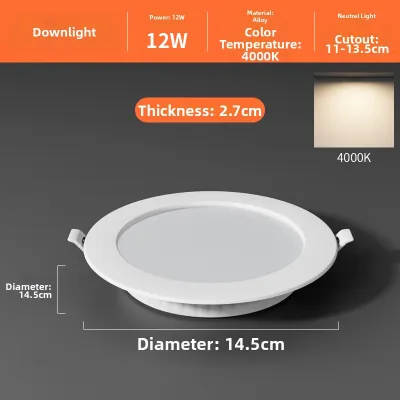
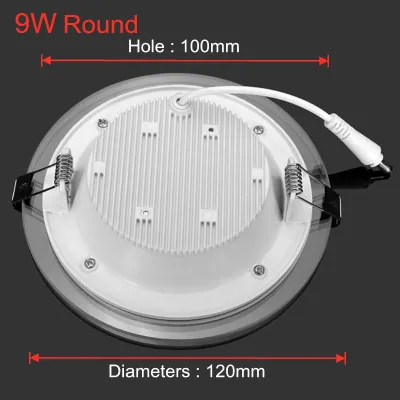
Installing round LED downlights in an HDB false ceiling requires careful physical planning and strict adherence to safety standards. Before purchasing any replacement fixtures, you must measure the existing cut-out hole diameter in your false ceiling. Round downlights are not universally sized; common cut-out diameters include 75mm (3 inches), 100mm (4 inches), and 125mm (5 inches). Purchasing a fixture with a matching cut-out size saves you from the messy, difficult task of patch-working plasterboard or widening existing holes.
In addition to the cut-out diameter, you must verify the available vertical clearance inside the false ceiling cavity. Even slim LED downlights generate heat, which is dissipated through the aluminum heat sink located at the back of the fixture. To ensure the longevity of the LED chips and the external driver, maintain a clear air gap of at least 20mm to 50mm above and around the fixture housing. Never cover the downlight or its driver with thermal insulation or allow them to come into direct contact with wooden framing or electrical conduits, as trapped heat can dramatically shorten the lifespan of the electronics and pose a fire hazard.
Electrical safety must be your top priority during any lighting installation. Before attempting to inspect, clean, or replace a downlight, always isolate the electrical power supply by switching off the corresponding circuit breaker at your home’s main distribution board (DB box). Do not rely solely on the wall switch, as some wiring configurations may still leave live currents running to the fixture. Always check the applied product’s label and the treated item’s manufacturer instructions for specific voltage compatibility, wiring diagrams, and mounting steps. If the manufacturer instructions conflict with your existing setup, or if the wiring is unidentified, stop immediately and consult a professional.
For any complex electrical work, engage a licensed electrical worker (LEW) in Singapore. While simple, like-for-like replacements of plug-and-play downlights can be completed safely by homeowners, tasks such as running new electrical wiring, adding new switch lines, cutting new holes in the ceiling, or modifying the structural framework of a false ceiling require professional expertise. A licensed electrician ensures that all work complies with local electrical safety standards (such as SS 638), protecting your home from electrical faults, short circuits, and potential warranty voiding.
Common Lighting Mistakes in Low Ceilings
One of the most frequent mistakes made in HDB lighting design is installing high-wattage, narrow-beam downlights for general ambient lighting. Homeowners often worry that their flat will be too dark, so they opt for powerful 12W or 15W spotlights. In a 2.6m ceiling, this results in an incredibly harsh, high-contrast environment. The intense light beams create blinding glare when you look up, while casting deep, unflattering shadows on faces and furniture below. It turns a cozy home into a cold, clinical space that causes rapid eye fatigue.
Another common pitfall is placing downlights too close to walls or in tight, clustered groups. When wide-beam downlights are positioned too close to a wall, they create intense semi-circular shapes of light—often called “scalloping”—directly on the wall surface. While this can be a deliberate design choice for feature walls, doing it accidentally across all walls makes the room look cluttered and highlights minor imperfections in the plastering. Keep ambient downlights at least 300mm to 450mm away from walls to ensure a smooth, natural transition of light.
Homeowners also frequently overlook the Color Rendering Index (CRI) of their LED downlights. CRI measures how accurately a light source reveals the true colors of objects, food, and skin tones compared to natural sunlight. Cheap, low-quality LED downlights often have a low CRI (under 80), which can make your home’s interior, furniture, and food look dull, grey, or artificially green. For a vibrant and warm home environment, always look for round LED downlights with a CRI of 90 or higher.
Finally, remember to check the Ingress Protection (IP) ratings for fixtures installed in high-moisture environments. Standard indoor round LED downlights usually carry an IP20 rating, which offers no protection against water or heavy steam. If you are installing downlights in an HDB bathroom, directly above a shower, or close to a kitchen sink where steam and splashing are common, you must select fixtures with an IP44 rating or higher. These moisture-resistant downlights feature protective seals that prevent water vapor from penetrating the housing, protecting the internal electronics from corrosion and short circuits.
Frequently Asked Questions (FAQ)
Can I use smart LED downlights in my HDB false ceiling?
Yes, smart round LED downlights are highly compatible with HDB false ceilings. However, you must verify that the physical depth of the smart fixture fits your ceiling cavity, as the integrated wireless modules can sometimes make the housing slightly deeper than standard LEDs. Additionally, check if the smart system requires a dedicated neutral wire at the wall switch, a specific smart home hub (such as Zigbee or Thread), or a strong 2.4GHz Wi-Fi signal to function reliably.
What is the best color temperature for HDB living rooms?
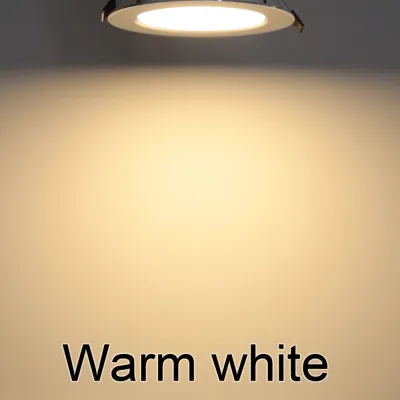
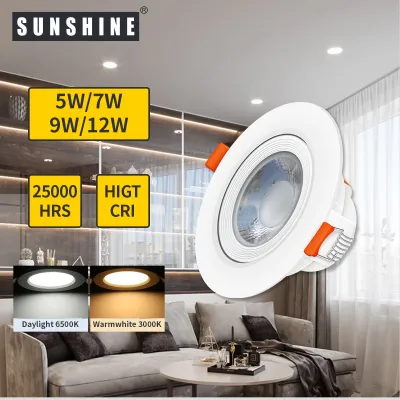
For a standard HDB living room, a warm white (3000K) or neutral white (4000K) color temperature is highly recommended. Warm white creates a cozy, inviting, and relaxing atmosphere that is perfect for winding down in the evening. Neutral white offers a cleaner, brighter look that mimics natural daylight, making it excellent for reading, socializing, and keeping the space feeling open and modern. Your final choice should align with your personal aesthetic preference and your home’s interior color palette.
Do I need an electrician to replace existing round downlights?
If your existing round LED downlights use a standard plug-and-play connector (where the external driver connects to the home’s wiring via a simple plug), you can safely replace the fixture yourself once the main power supply is turned off at the DB box. However, if the replacement requires cutting new ceiling holes, running new wiring, replacing damaged electrical conduits, or altering your home’s fixed electrical circuits, you must engage a licensed electrical worker in Singapore to perform the installation safely and legally.
Community discussion
Share your experience or ask a question. Comments are reviewed before publication.