
Finding the right crystal ceiling light for a Singapore Housing & Development Board (HDB) flat with a standard 2.6-metre ceiling height requires balancing elegance with strict spatial limits. Because a 2.6m ceiling is relatively low compared to private landed properties, choosing an oversized or excessively low-hanging fixture can make a living room or bedroom feel cramped and physically hazardous. The key to successfully integrating crystal lighting into these spaces lies in selecting low-profile fixtures—specifically flush-mount or shallow semi-flush-mount designs—that provide the desired light refraction without encroaching on essential walking clearance. By verifying physical dimensions, weight limits, and electrical compatibility before purchasing, homeowners can achieve a sophisticated look that remains safe and functional.
Key Dimensions and Proportions for Low Ceilings
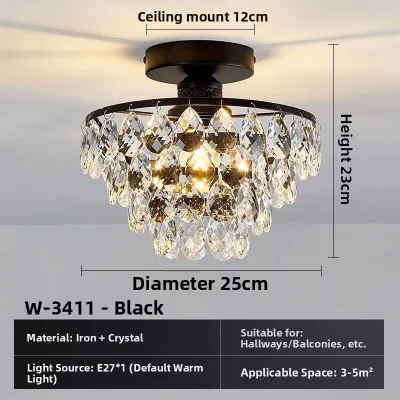
To prevent accidental contact when walking, carrying items, or raising arms, maintain a minimum clearance of 2.1 to 2.2 metres from the floor to the lowest point of the light fixture. In a flat with a 2.6m ceiling, this leaves a maximum allowable vertical drop of 40 to 50 centimetres for the entire fixture, including its mounting bracket, canopy, and any hanging crystal droplets. Measuring this vertical space accurately before purchasing ensures the fixture does not obstruct daily movement.
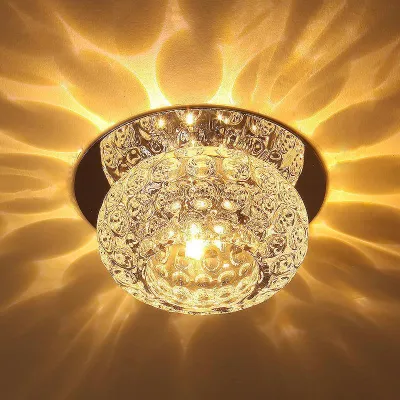
Flush-mount fixtures sit directly against the ceiling surface, leaving no open space between the fixture body and the concrete. This design is highly recommended for main thoroughfares, hallways, and standard living rooms because it maximizes vertical space while still utilizing crystal elements to diffuse light across the ceiling. Semi-flush-mount fixtures, which hang from a short stem or collar, create a small gap that allows light to reflect upward and outward. While semi-flush designs offer a more traditional chandelier-like appearance, they must be selected with extreme care to ensure the total drop does not exceed the 50cm threshold.
Products mentioned in this guide
Prices are valid at publication and may change. Please refer to the product page for the latest price.
A fixture that is too small will look lost, while one that is too large will visually dominate the room and make the ceiling feel lower than it is. To determine an appropriate diameter, homeowners can use a basic proportional guideline: add the room’s length and width in metres, and multiply the sum by a factor of 10 to get a starting diameter in centimetres. For example, a bedroom measuring 3 metres by 4 metres (sum of 7) would pair well with a crystal fixture of approximately 70 centimetres in diameter. Adjust this downward if the room features heavy furniture or built-in wardrobes that reduce the open ceiling area.
Electrical and Safety Checks for HDB Installations
Crystal ceiling lights are significantly heavier than standard plastic or aluminum LED panels due to the density of glass or lead crystal prisms and their steel frames. Standard HDB concrete ceilings are robust, but the mounting method must match the fixture’s weight. Light fixtures weighing under 5 kilograms can typically be secured using standard nylon wall plugs and screws. However, heavier crystal clusters exceeding 10 kilograms require specialized metal expansion bolts (sleeve anchors) drilled directly into the concrete ceiling to prevent structural failure. Never rely on thin plasterboard or false ceiling panels to support a heavy crystal fixture without direct reinforcement to the structural concrete slab above.

Singapore operates on a nominal 230V supply voltage at 50Hz. Homeowners must verify that any imported or locally purchased crystal light is rated for this voltage and carries appropriate local safety certifications to ensure the internal wiring and driver components meet local standards. Additionally, check the maximum wattage limit of the fixture’s sockets. If the fixture uses multiple replaceable bulbs (such as E14 or G9 bases), the combined wattage of the bulbs must not exceed the rating of the internal wiring or the circuit breaker controlling the lighting loop.
While replacing a simple light bulb is a straightforward task, installing a heavy crystal ceiling light involves fixed electrical wiring, working at heights, and handling delicate, heavy components. Homeowners must engage a licensed electrical worker (LEW) or a qualified electrician for all fixed wiring installations and structural mounting. Before any work begins, ensure the main electrical supply at the distribution board (DB box) is fully isolated. A professional installer will also ensure the fixture is properly earthed, which is critical for metal-framed crystal lights to prevent electrical shock hazards.
How to Evaluate Brands and Retailers in Singapore
When shopping for crystal lights, avoid brands that rely solely on stylized marketing images or heavily edited photos. Reputable manufacturers and retailers provide comprehensive technical specification sheets, including precise dimensional diagrams showing the exact height, width, and canopy depth. They should also clearly state the net weight of the fixture and provide detailed installation manuals. Having access to these specifications beforehand allows you to verify compatibility with your 2.6m ceiling and share the details with your electrician for a structural assessment.
Crystal fixtures consist of numerous individual prisms, hooks, and delicate metal pins. During shipping, installation, or routine cleaning, these components can easily chip, break, or go missing. Prioritize brands and local retailers that offer dedicated after-sales support and maintain an inventory of spare parts. A reliable retailer should be able to supply matching replacement crystal prisms and hanging pins, ensuring your fixture does not remain incomplete or mismatched if a single piece is damaged. Clear warranty terms covering the LED drivers, wiring, and metal finishes are also essential indicators of a brand’s quality.
While online marketplaces offer convenience, photos often fail to capture the true scale, weight, and light refraction of crystal fixtures. Visiting physical lighting showrooms in Singapore allows you to observe how the crystals interact with different light sources—such as warm white versus cool daylight—and how the fixture’s scale feels in a simulated room setting. Once you have evaluated the physical quality and refraction in person, you can cross-reference the model numbers and specifications with authorized online stores to find the most competitive pricing and warranty options.
Maintenance and Cleaning Considerations
The humid climate in Singapore, combined with ceiling fans commonly used in HDB flats, can lead to rapid dust accumulation on intricate crystal surfaces. When selecting a fixture, consider how easily dust can settle on the prisms and whether the design features enclosed glass panels to protect the internal bulbs. Low-clearance environments make cleaning more frequent, so choosing a design with easily accessible surfaces or removable crystal strands will significantly reduce the effort required to maintain its brilliance.
To clean a crystal ceiling light safely, always start by isolating the power at the main switch and allowing the bulbs to cool completely. Never spray cleaning solutions directly onto the fixture, as liquid can seep into the electrical sockets or corrode the metal frame. Instead, prepare a mixture of mild dish soap and warm water, or use a specialized, non-abrasive crystal cleaning spray. Dampen a lint-free microfiber cloth with the solution to gently wipe each crystal prism, then immediately dry it with a separate dry microfiber cloth to prevent water spots.
While routine dusting and light wiping can be managed as a DIY task, complex deep cleaning or structural inspections require professional assistance. If your crystal light features intricate, multi-tiered wiring, or if the crystals are suspended by delicate, aging wire ties that show signs of wear, do not attempt to dismantle the fixture yourself. Professional lighting maintenance services have the specialized equipment and training to clean, re-wire, and structurally inspect heavy fixtures safely, minimizing the risk of damage or electrical hazards.
Frequently Asked Questions (FAQ)
Can I install a chandelier instead of a ceiling light in a 2.6m HDB flat?
Yes, but with strict limitations on placement and drop length. A traditional hanging chandelier is generally unsuitable for open walkways or the center of a living room with a 2.6m ceiling, as it will hang too low and create a physical hazard. However, you can safely install a short chandelier directly above a fixed piece of furniture, such as a dining table or a coffee table. Because people do not walk through these areas, the fixture can hang slightly lower—typically maintaining a clearance of 75 to 90 centimetres between the tabletop and the bottom of the chandelier—without compromising safety or headroom.
Do crystal ceiling lights require special dimmer switches?
Yes, achieving smooth dimming without flickering or buzzing depends entirely on matching the dimmer switch to the specific light source used in your crystal fixture. If your fixture uses integrated LED modules, you must use a compatible LED-rated dimmer switch specified by the manufacturer. For fixtures that use replaceable LED bulbs, ensure both the bulbs and the wall dimmer switch are designed for phase-cut dimming (either leading-edge or trailing-edge). Using an incompatible dimmer switch can cause rapid flickering, audible buzzing, and premature failure of the LED driver or bulbs.
Community discussion
Share your experience or ask a question. Comments are reviewed before publication.