
Standard Housing & Development Board (HDB) flats in Singapore typically feature a ceiling height of 2.6 metres. In these compact vertical spaces, selecting the right ceiling light is crucial to maintain comfortable headroom and ensure the room feels open rather than cramped. Philips offers a variety of low-profile LED ceiling lights, flush mounts, and slim panels that are highly suited for 2.6m ceilings, provided you carefully calculate the fixture’s physical dimensions, light distribution, and installation clearances before purchasing. By focusing on ultra-slim profiles and wide-beam diffusers, homeowners can achieve a bright, airy ambiance without sacrificing precious vertical clearance.
Calculating Ideal Fixture Proportions for 2.6m Ceilings
To maintain a safe and comfortable living environment, a minimum clearance of 2.1 to 2.3 metres from the floor to the bottom of the light fixture is generally recommended. With a standard HDB ceiling height of 2.6 metres, this leaves a maximum allowable vertical drop of 30 to 50 centimetres for any ceiling-mounted fixture. For high-traffic walkways and living areas, keeping the fixture drop under 15 centimetres ensures that taller occupants can move freely without any risk of contact.
Determining the ideal diameter of the ceiling light is equally important to prevent the fixture from visually overwhelming the room. A simple guideline for sizing is to add the length and width of the room in metres, then multiply the sum by 10 to get the recommended fixture diameter in centimetres. For example, a typical HDB bedroom measuring 3 metres by 3 metres has a sum of 6, suggesting a fixture diameter of approximately 60 centimetres.
Products mentioned in this guide
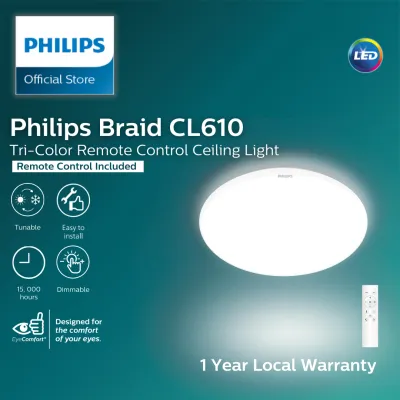
Prices are valid at publication and may change. Please refer to the product page for the latest price.
Before finalizing any purchase, always consult the official product specification sheet to verify the exact physical dimensions. Pay close attention to three key measurements: the overall height, the canopy depth, and the diffuser thickness. Some fixtures may appear slim in promotional images but feature a bulky mounting base that adds unexpected vertical height once installed.
Identifying Low-Profile Philips Design Categories
When browsing the Philips lighting catalogue for 2.6m ceilings, flush-mount LED ceiling lights and ultra-slim LED panels are the most practical choices. Flush-mount fixtures sit directly against the ceiling surface, minimizing the vertical footprint and eliminating the gaps where dust can accumulate. Many modern Philips LED flush mounts feature integrated drivers, allowing for an incredibly slim profile that often measures less than 8 centimetres in total thickness.

Ultra-slim LED panels offer an even lower profile, with some designs protruding less than 3 centimetres from the ceiling surface. These panels distribute light evenly across a large surface area, mimicking the appearance of a natural skylight and making the ceiling feel visually higher. They are particularly effective in HDB kitchens, bathrooms, and utility yards where maximizing vertical clearance is a priority.
In contrast, semi-flush mount fixtures—which hang down slightly from a short stem or canopy—should be approached with caution in a 2.6m environment. While they can add a decorative touch, the gap between the fixture and the ceiling can create a visual break that lowers the perceived height of the room. If you choose a semi-flush design, ensure the total drop does not exceed 20 centimetres and place it over stationary areas like dining tables.
Additionally, always check the design of the mounting bracket and bezel. Some models feature a recessed mounting system where the bracket sits inside the fixture housing, while others use an external bracket that adds hidden vertical bulk. Choosing a bezel-free or slim-bezel design can also reduce the visual weight of the fixture, helping it blend seamlessly into a white HDB ceiling.
Managing Light Distribution to Enhance Room Height
The way a ceiling light distributes its output plays a significant role in how spacious an HDB flat feels. Fixtures equipped with wide-beam diffusers are highly recommended for low ceilings because they scatter light horizontally across the ceiling and upper walls. This wall-washing effect eliminates dark corners and harsh shadows, creating a brighter, more expansive atmosphere that makes the room feel larger than its physical dimensions.
Conversely, highly focused downlights or spotlights tend to cast narrow cones of light directly onto the floor, leaving the upper portions of the walls and ceiling in shadow. This high-contrast lighting pattern can create a cave-like effect, making a 2.6m ceiling feel lower and more oppressive. If you use spotlights, pair them with a central ambient light source to balance the overall illumination.
Selecting the appropriate lumen output is also critical to prevent glare and visual discomfort in low-clearance rooms. Because the light source is closer to eye level in a 2.6m room, excessively bright fixtures can cause eye strain. As a general rule, aim for approximately 300 to 400 lumens per square metre for living areas, and verify if the Philips fixture supports smooth dimming to allow for easy adjustment throughout the day.
Color temperature further influences the perceived height and mood of the space. Cool white (4000K) or daylight (6500K) tones can make utility areas and kitchens feel crisp, airy, and open. For living rooms and bedrooms, a warm white (2700K to 3000K) tone provides a cozy ambiance; choosing a Philips model with adjustable color temperature (such as those with SceneSwitch or smart control features) allows you to transition between functional brightness and relaxing warmth.
Verifying Installation Clearances and HDB Constraints
Before purchasing any new ceiling light, it is essential to assess the structural and electrical conditions of your HDB flat. Standard HDB ceilings are typically made of reinforced concrete, which provides a solid foundation for mounting fixtures but requires appropriate masonry wall plugs and drilling tools. Always verify the weight limit of your existing ceiling junction box; while lightweight LED flush mounts rarely pose a structural risk, heavier fixtures must be securely anchored to avoid hazards.
If you plan to install both a ceiling fan and a ceiling light in the same room, careful spatial coordination is required. To prevent dangerous strobing effects—where the fan blades rotate beneath the light source and cast rapid, flickering shadows—ensure there is adequate horizontal clearance between the fan blades and the light fixture. A safe distance of at least 1.5 metres from the tip of the fan blades to the edge of the light is highly recommended.
Electrical safety must always be the top priority during any lighting installation. Before attempting to mount or replace a fixture, isolate the power supply at the main distribution board (DB box) and verify that the circuit is completely dead using a reliable voltage tester. Always follow the manufacturer’s installation instructions regarding wiring connections, grounding, and maximum wattage limits.
For complex installations, such as running new concealed wiring, modifying concrete ceilings, or installing fixtures in damp areas like bathrooms, stop and consult a licensed electrician certified by the Energy Market Authority (EMA) of Singapore. Professional installation ensures compliance with local electrical codes and guarantees that the fixture is safely mounted and wired for long-term use.
Common Sizing and Fit Mistakes to Avoid
One of the most common mistakes homeowners make is assuming that any fixture labeled as a “flush mount” is completely flat. Many products feature a hidden canopy housing on the back that extends several centimetres upward, which can prevent the light from sitting flush against the concrete ceiling if the junction box is not recessed. Always check the detailed technical drawings on the product packaging or specification sheet to confirm the true mounting depth.
Another frequent error is over-lighting a small bedroom by installing a high-lumen, large-diameter fixture. While a large light might seem like a good way to ensure brightness, an oversized fixture can visually dominate a compact room and create uncomfortable glare due to the low 2.6m ceiling height. Match the fixture’s physical size and lumen output to the actual room dimensions rather than choosing the largest available model.
Lastly, do not ignore the visual weight of dark, thick, or heavily textured bezels. In a room with a 2.6m ceiling, a thick black or metallic frame draws the eye upward and emphasizes the physical boundary of the ceiling, making the space feel more enclosed. Opting for white, frameless, or slim-bezel Philips designs allows the fixture to blend visually with a standard white ceiling, creating a seamless and uninterrupted overhead plane.
Frequently Asked Questions (FAQ)
Can I install a chandelier in an HDB flat with a 2.6m ceiling?
Installing a traditional hanging chandelier in a standard 2.6m HDB flat is generally not recommended for main walkways, as the vertical drop will easily breach the safe clearance limit of 2.1 metres and create a physical obstruction. However, you can safely install a compact chandelier or pendant light if it is positioned directly over a stationary furniture piece, such as a dining table or a kitchen island. In these localized zones, the table naturally prevents people from walking underneath, allowing you to enjoy the decorative aesthetic without compromising safety or headroom.
Do Philips smart ceiling lights add extra thickness to the fixture?
While integrated smart modules, wireless receivers, and LED drivers do require physical space, modern Philips smart ceiling lights (such as those in the Hue or WiZ ecosystems) are engineered to maintain a highly compact profile. Many of these smart models feature specialized, low-profile driver housings that fit entirely within a slim canopy, resulting in a total fixture thickness of only 5 to 10 centimetres. To ensure a perfect fit, always check the product’s specification sheet for the exact driver housing depth and mounting requirements before purchasing, especially if your HDB flat has a flat concrete ceiling without a false ceiling cavity.

Community discussion
Share your experience or ask a question. Comments are reviewed before publication.