
Why Standard HDB Ceiling Heights Dictate Your Fixture Choice
Standard HDB flats, especially Build-To-Order (BTO) units, typically feature a structural ceiling height of 2.6 metres. Once floor screeding, vinyl or tile finishes, and false ceilings are factored in, the actual clearance drops even lower. This physical boundary directly dictates the type of lighting fixtures you can install without compromising safety or spatial comfort.
In a room with a 2.6-metre ceiling, hanging fixtures or deep semi-flush mounts eat into precious vertical clearance. A pendant light dropping 50 centimetres leaves only 2.1 metres of clearance, which can feel claustrophobic or pose a physical hazard to taller occupants. Flush-mount fixtures are the standard recommendation to preserve headroom and maintain an open, uncluttered visual plane.
Low ceilings also fundamentally alter how light behaves. When a light source is positioned close to the ceiling, the angle at which light spreads across the room is much shallower. Using a narrow-beam or poorly diffused fixture concentrates light in a tight cone directly beneath the lamp, creating a harsh ‘spotlight’ effect that leaves the upper corners of the room in shadow.
Products mentioned in this guide
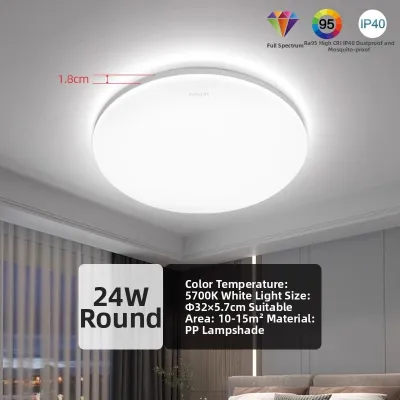
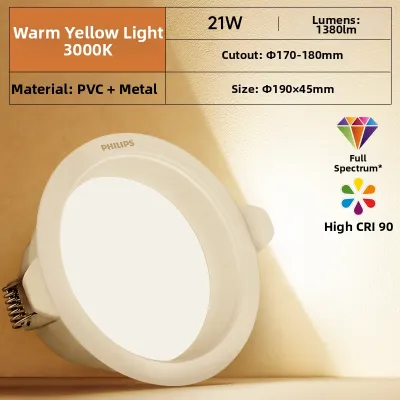
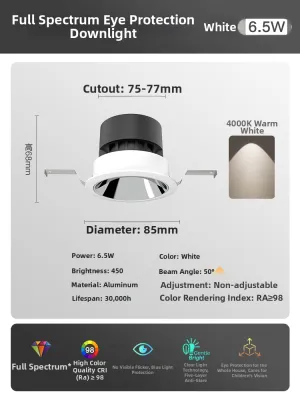
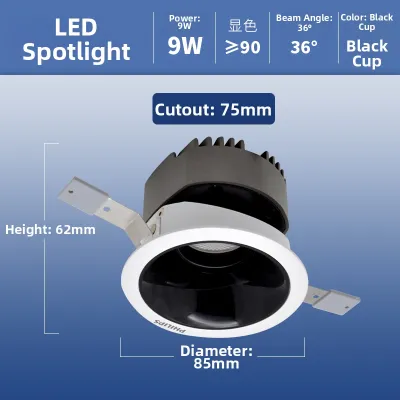
Prices are valid at publication and may change. Please refer to the product page for the latest price.
To counteract this, low-profile fixtures with wide beam angles are essential. They allow light to spread horizontally across the ceiling and upper walls, softening transitions between light and shadow. This even distribution bounces light off vertical surfaces, visually pushing the walls outward and making the entire HDB room feel more spacious and airy.
Choosing a philips full spectrum ceiling light with a low profile helps address these spatial challenges. These fixtures deliver high-quality, natural-feeling light that mimics daylight, enhancing the perception of space. Combining a flat, low-profile physical design with advanced light-scattering optics ensures that your compact HDB rooms feel bright, open, and comfortable.
Key Specifications for Low-Profile Full Spectrum Lights
When shopping for a philips full spectrum ceiling light, relying on the brand name alone is not enough. You must carefully evaluate several technical specifications on the product label to ensure the fixture matches your 2.6m ceiling height and lighting requirements.

Fixture Profile (Thickness): For a 2.6m ceiling, the ideal fixture thickness should not exceed 50 to 80 millimetres. Ultra-slim flush mounts, some measuring as thin as 25 millimetres, are highly recommended because they sit almost flush against the concrete slab. This minimal profile reduces the visual weight of the fixture, making it blend seamlessly into the ceiling plane.
Full Spectrum Metrics: True full spectrum lighting replicates the natural daylight spectrum closely. Look for the Color Rendering Index (CRI), often denoted as Ra. Standard LED lights typically have a CRI of 80, whereas high-quality full spectrum options boast a CRI of 90 or higher (Ra 90+). This high color fidelity ensures that the colors of your furniture, flooring, and wall paint appear vivid and true to life.
Beam Angle and Diffusers: A wide beam angle of 110 degrees or more is critical for low-ceiling environments. Look for fixtures equipped with high-quality frosted acrylic or polycarbonate diffusers. These diffusers scatter the light emitted by individual LED chips, eliminating the harsh ‘hotspots’ or visible LED dots that can cause intense glare when looking up.
Electrical and Certification Standards: In Singapore, all ceiling lights must be compatible with the standard domestic electrical supply of 230V at 50Hz. Ensure that any fixture you purchase is certified safe for use, indicated by the Enterprise Singapore Safety Mark. Additionally, verify the dimming compatibility if you plan to use a wall dimmer, as many full spectrum LED fixtures use specialized digital dimming or smart app control rather than traditional phase-cut wall dimmers.
Matching Light Dimensions and Wattage to HDB Room Types
To achieve balanced lighting across your HDB flat, you must tailor the physical size and light output (measured in lumens) of your fixtures to the specific dimensions and functions of each room. Selecting a single, uniform light size for the entire home often leads to under-lit living areas or overwhelmingly bright bedrooms.
Living Rooms and Open-Plan Areas
- Fixture Sizing: The living room is typically the largest communal space in an HDB flat, requiring a wider distribution of light. For a standard HDB living area, look for flush-mount fixtures with a larger diameter, typically between 400 and 500 millimetres. A larger physical diameter allows the light source to be spread across a wider surface area, which naturally softens shadows and provides more uniform coverage.
- Lumen Requirements: Aim for a target of 150 to 200 lumens per square metre for general living spaces. For instance, a typical HDB living room of 15 square metres would require a total light output of approximately 2,250 to 3,000 lumens. When using a philips full spectrum fixture, this level of brightness provides excellent clarity for social activities or reading without creating a harsh, clinical atmosphere.
- Zoning Strategies: In open-plan HDB layouts where the living and dining areas are joined, relying on a single central fixture can leave the corners dark. Instead, consider zoning your lighting. You can install a primary, large-diameter flush mount in the main seating area and complement it with smaller, low-profile secondary lights or recessed downlights over the dining table. This creates visual layers and allows you to adjust the light levels according to the time of day.
Bedrooms and Compact Study Rooms
- Fixture Sizing: Bedrooms and study rooms in modern HDB flats are highly compact, often measuring between 9 and 12 square metres. In these private spaces, a large, high-wattage fixture can easily overwhelm the room both physically and visually. For these areas, choose smaller flush-mount fixtures with a diameter of 300 to 350 millimetres, which maintain a balanced proportion with the room's footprint.
- Lumen Requirements: The total light output for a bedroom should be lower than that of a living room, typically aiming for 100 to 150 lumens per square metre, which translates to roughly 1,000 to 1,500 lumens overall. This lower brightness level supports a relaxing environment and respects natural circadian rhythms, helping you wind down in the evening. If the room serves a dual purpose as a home office, you can supplement this general ambient light with a dedicated desk lamp.
- Full Spectrum Benefits: This is where the benefits of full spectrum lighting truly shine. Because full spectrum lights provide a more balanced spectral output that mimics natural light, they help reduce eye strain and fatigue during long hours of reading or working on screens. The high CRI also ensures that digital screens and printed materials are easy to read, making your compact study room a much more comfortable environment.
Kitchens and Utility Spaces
- Fixture Sizing: Kitchens and utility yards present unique lighting challenges due to their task-oriented nature. In the kitchen, precise color rendering is essential for food preparation and cooking safely. A high CRI full spectrum ceiling light is highly beneficial here, ensuring that meat, vegetables, and other foods are seen in their natural, accurate colors.
- Lumen Requirements: Because kitchens feature overhead cabinets that can cast deep shadows on countertops, your ceiling light must be positioned strategically. Ensure the fixture's profile is thin enough to clear the swing arc of tall kitchen cabinets and pantry doors. For a standard HDB kitchen, a flush mount with a light output of 1,500 to 2,000 lumens is generally sufficient, provided it is positioned centrally along the main working aisle.
- Moisture Resistance: Additionally, you must consider the ingress protection (IP) rating for fixtures installed near wet zones, such as the kitchen sink or the washing machine area in the utility yard. While standard dry-rated fixtures are fine for most areas, choosing a light with a basic moisture-resistance rating (such as IP44) is highly recommended for utility yards or small kitchens where steam and moisture can accumulate.
Common Sizing and Illumination Mistakes to Avoid
Designing lighting for a low-ceiling HDB flat requires careful planning, yet several common mistakes frequently compromise both safety and aesthetics. One of the most prevalent errors is selecting semi-flush or pendant-style fixtures simply because they look appealing in a showroom. In a 2.6m ceiling environment, these fixtures hang too low, creating physical obstacles that can easily be struck by tall family members or when changing bed sheets.
Another frequent mistake is over-lighting a compact room by installing a fixture with an excessively high wattage or lumen output. Homeowners often assume that more light is always better, but in a small HDB room with light-colored or white walls, excessive brightness causes severe glare. The light bounces off the reflective surfaces, creating a harsh, uncomfortable environment that strains the eyes.
Ignoring the color temperature (measured in Kelvin) can also ruin the effectiveness of your lighting setup. Installing a fixture with a very high, cool white color temperature (such as 6500K) in a small living room or bedroom can make the space feel sterile, cold, and clinical. Conversely, an overly warm yellow light (such as 2700K) in a study or kitchen can make the space feel dim and sluggish. Utilizing a full spectrum light with adjustable color temperature or a neutral white balance (around 4000K) provides the ideal middle ground.
Lastly, many homeowners fail to account for the visual weight of the fixture’s frame or bezel. A ceiling light with a thick, dark, or heavily ornamented frame can draw the eye upward and make the ceiling feel lower and more oppressive. For a 2.6m ceiling, opt for fixtures with white or frameless bezels that blend seamlessly into the typical white plaster ceiling of an HDB flat, allowing the light itself to take center stage.
Installation Clearances and Electrical Safety in Singapore
Before purchasing any ceiling light, it is essential to perform a thorough check of your HDB flat’s existing physical and electrical infrastructure. Start by inspecting the ceiling junction box where the light will be mounted. Ensure the box is securely anchored to the concrete slab, verify its depth, and check that the existing wiring is in good condition without any signs of brittle insulation or heat damage.
Safety must always be your top priority when working with electrical installations. Before inspecting, cleaning, or installing any light fixture, you must isolate the power supply. Go to your flat’s main distribution board (DB box) and switch off the corresponding circuit breaker or the main incoming isolator. Never rely solely on the wall switch to turn off the power, as some wiring configurations may leave the live wire energized even when the switch is in the off position.
While replacing an existing light fixture on a simple, pre-existing loop can sometimes be done as a straightforward task, there are strict boundaries where professional help is mandatory. In Singapore, any work involving the installation of new electrical points, rewiring of older HDB flats, upgrading of electrical loops, or integrating complex smart-lighting systems into your home’s distribution board must be carried out by a Licensed Electrical Worker (LEW). Hiring an LEW ensures that all work complies with the Singapore Standard SS 638 (Code of Practice for Electrical Installations), protecting your home from fire hazards.
Frequently Asked Questions (FAQ)
Do full spectrum LED ceiling lights consume more power than standard LEDs?
No, full spectrum LED ceiling lights do not inherently consume more power than standard LEDs. The term ‘full spectrum’ refers to the quality and spectral composition of the light emitted—specifically its ability to closely mimic natural daylight and render colors accurately—rather than the amount of electrical energy required to run it. When choosing a fixture, you should compare the luminous efficacy, which is measured in lumens per watt (lm/W), on the product label. A highly efficient full spectrum LED will deliver excellent color rendering and brightness while maintaining a low wattage, keeping your household electricity consumption minimal.
Can I mount a Philips ceiling light directly onto an HDB false ceiling?
You should not mount a heavy ceiling light directly onto the gypsum board of an HDB false ceiling without proper structural support. Standard false ceilings are designed to hold very lightweight fixtures, such as small recessed downlights, and lack the structural integrity to support heavier flush-mount fixtures over time. If you plan to install a larger Philips ceiling light, the fixture must be securely anchored to the concrete slab above the false ceiling using appropriate extension rods, threaded rods, or heavy-duty toggle bolts. Always check the manufacturer’s installation instructions for the fixture’s weight, and consult your renovation contractor or a professional installer to assess the ceiling structure before mounting.
Community discussion
Share your experience or ask a question. Comments are reviewed before publication.