
Finding the best clip-on lamp for study use is not about choosing a single universal brand, but rather matching a brand’s design category to your specific desk thickness, joint flexibility requirements, and study habits. A lamp that slips off a thick wooden desk or flickers during a late-night study session fails to provide the necessary utility, regardless of its brand name. To make an informed decision, you must evaluate how different brand tiers handle physical build quality—such as clamp tension and material durability—alongside light quality metrics like lux, Color Rendering Index (CRI), and glare control. This guide breaks down these critical factors to help you select the right category of clip-on lamp for your study setup.
Key Criteria for Evaluating Clip-On Lamp Build Quality
The clamp is the foundation of any clip-on lamp. High-quality brands design clamps with wide jaw openings and robust internal springs or screw-tightening mechanisms. Look for clamps lined with thick, high-friction rubber or silicone padding. This padding serves a dual purpose: it prevents the lamp from slipping under its own weight and protects delicate desk surfaces, such as veneered wood or glass, from scratches and pressure marks. Before purchasing, always measure your desk’s edge thickness and compare it against the manufacturer’s maximum clamp clearance specification.
The adjustable arm—whether a flexible gooseneck or a multi-jointed swing arm—must retain its position over time. Goosenecks made of low-grade plastics or thin metal coils tend to sag after repeated adjustments, causing the light source to droop. Premium options often utilize reinforced metal goosenecks or mechanical spring-tensioned joints with adjustable thumb screws. These mechanical joints allow you to fine-tune the resistance, ensuring the lamp head remains exactly where you position it, even after years of daily use.
Products mentioned in this guide
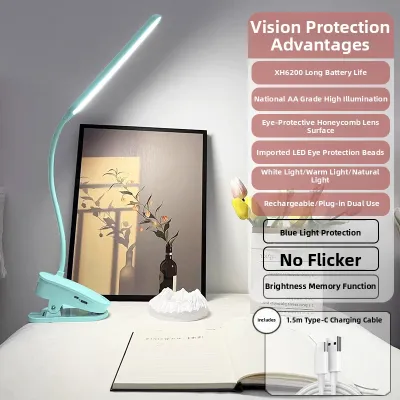
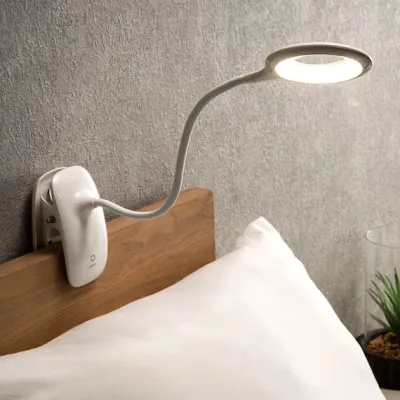
![[SG SELLER] [FREE SHIPPING] Portable Clip On Reading Lights (Type B) Bendable Night Light On The Go](https://img.lazcdn.com/g/p/d9539bff27c468247a79fdc1ad237d65.jpg_400x400q80.jpg_.webp)
Prices are valid at publication and may change. Please refer to the product page for the latest price.
A common design flaw in poorly engineered clip-on lamps is an unbalanced weight distribution. If the lamp head is too heavy relative to the clamp’s gripping force, the assembly will tilt, rotate, or completely slip off the mounting surface. High-quality brands carefully balance the weight of the LED panel, control switch, and arm. When evaluating a lamp, consider where the heaviest components, such as the power transformer or battery pack, are located; keeping these elements close to the clamp base minimizes leverage and improves overall stability.
Assessing Brightness and Light Quality for Extended Study Sessions
Brightness is more than just raw light output (lumens); it is about how effectively that light is directed onto your working surface (lux). For intensive study, reading, or writing, a desk surface requires focused illumination. Look for lamps that provide clear lux specifications at a standard working distance (typically 30 to 40 centimeters). A narrow beam angle concentrates light directly on your textbook or notepad, which is ideal for minimizing spillover light in shared rooms, whereas a wider beam angle provides more uniform coverage across a larger desk area but may reduce overall intensity.

Color quality is vital for reducing eye strain during long study sessions. The Color Rendering Index (CRI) measures how accurately a light source reveals the true colors of objects, with a score of Ra 90 or higher being ideal for reading colored diagrams, textbooks, or artwork. Additionally, adjustable color temperature settings allow you to customize the light to your environment. Cool white light (around 5000K) can enhance alertness and focus during active study, while warm white light (around 3000K) is gentler on the eyes during late-night reading sessions.
Invisible high-frequency flickering from low-quality LED drivers is a primary cause of headaches and eye fatigue. When choosing a clip-on lamp, verify that the manufacturer explicitly certifies the device as flicker-free. Furthermore, glare control is essential when studying with glossy textbooks, tablets, or laptop screens. Lamps featuring asymmetric optical designs or physical diffusers direct light at an angle to illuminate the desk surface without bouncing harsh reflections directly into your eyes.
Comparing Common Clip-On Lamp Brand Categories
Brands in the premium ergonomic tier focus heavily on structural longevity and precise optical engineering. These manufacturers typically construct their lamps using anodized aluminum, zinc alloys, and high-grade composite materials. Their clamps often feature heavy-duty screw clamps rather than simple spring clips, allowing them to mount securely to a wider range of desk profiles. Optically, they offer high-CRI LED panels, step-less dimming interfaces, and advanced diffusion sheets that eliminate hot spots and glare, making them highly suitable for professional drafting, design work, or rigorous academic study.
Budget-focused brands prioritize affordability and simplicity. These lamps are generally constructed from lightweight plastics and utilize standard spring-loaded clamps. While they are highly portable and easy to move, their maximum clamping width is often limited, and the plastic joints may wear down faster under heavy daily adjustment. The light quality typically features standard CRI ratings (around Ra 80) and basic three-step dimming. These options are highly practical for casual reading, secondary lighting, or temporary study setups where high-intensity, color-accurate illumination is not a strict requirement.
Specialty reading brands design products with portability and targeted illumination in mind. These lamps are often compact, lightweight, and powered by rechargeable lithium-ion batteries or USB connections, making them independent of wall outlets. Their clamps are optimized for attaching directly to book covers, headboards, or thin e-reader bezels rather than thick desks. While they offer excellent beam control and warm color temperatures tailored for reading, their overall light output (lux) and coverage area are naturally smaller than those of dedicated desk-mounted models.
Decision Framework: Which Brand Type Fits Your Study Setup?
If your study routine involves spending several hours a day reading fine print, drafting, or working on color-sensitive projects, investing in a premium ergonomic brand is highly recommended. The robust metal construction ensures the lamp survives frequent repositioning, while the superior optical performance protects your eyes from fatigue. This category is also the best choice if you have a heavy wooden or metal desk with a thick edge that requires a highly secure, screw-tightened clamp.
For students or remote workers who need a straightforward, reliable light source for standard desks, a budget-friendly brand offers excellent value. These lamps perform exceptionally well when clamped to standard-thickness desks (typically under 3 centimeters) and used for moderate study sessions. To maximize the lifespan of a budget model, minimize unnecessary adjustments to the flexible arm and ensure the clamp is fully seated on the desk edge before releasing the spring.
Before finalizing your purchase from any brand category, always verify the physical and electrical specifications against your specific environment. Check that the lamp’s operating voltage matches your local power supply and look for recognized electrical safety certifications to ensure the internal driver is protected against short circuits and overheating. If your desk is made of tempered glass, avoid high-tension spring clamps, which can concentrate stress and cause fractures; instead, opt for a screw-type clamp with soft, wide rubber pads to distribute the pressure evenly.
Frequently Asked Questions (FAQ)
Can a clip-on lamp provide enough brightness for a large desk?
A clip-on lamp is primarily designed as a focused task light rather than a primary source of ambient room illumination. While a high-quality clip-on lamp can deliver excellent brightness directly over your immediate working area (such as an open textbook or laptop keyboard), its beam spread is naturally limited by its compact head design and mounting position. For a large desk, a single clip-on lamp may leave the outer edges in shadow. To ensure comfortable, balanced lighting across a wide workspace, check the manufacturer’s lux specifications at various distances and consider pairing the clip-on lamp with soft ambient overhead lighting to reduce high-contrast shadows that strain the eyes.
What desk thickness is required for a secure clip-on lamp mount?
The required desk thickness depends entirely on the specific clamp design of the lamp. Standard spring-loaded clamps typically accommodate desk edges ranging from 1.5 to 4 centimeters, while heavy-duty screw-tightened clamps can often adjust to fit surfaces up to 6 or 8 centimeters thick. To ensure a secure mount, measure your desk’s edge clearance accurately, taking into account any supporting metal frames or decorative bevels underneath the tabletop. Always verify that the clamp’s jaw depth allows it to slide fully onto the desk surface, and ensure the rubber or silicone padding makes complete contact with both the top and bottom of the desk to prevent slipping.
Community discussion
Share your experience or ask a question. Comments are reviewed before publication.