
The primary distinction among azan prayer clocks on the market lies in their dual role: some function strictly as high-accuracy daily prayer alarms, while others serve as comprehensive digital Quran players. When evaluating an azan prayer clock quran features, your decision hinges on whether you require the full 114 surahs with multiple renowned reciters (Qaris) or simply need a reliable device for standard prayer-time reminders accompanied by selected short chapters. For dedicated daily listening, complete Quran memorization support, or family reflection, advanced models with high-capacity storage and superior audio drivers are essential. Conversely, basic models offer a streamlined, budget-friendly approach focused on the daily call to prayer. To make an informed choice, you must carefully assess three critical dimensions: storage capacity, reciter variety, and physical speaker performance.
By understanding these technical variations, you can select a device that fits seamlessly into your household routines. Whether you are looking to create a peaceful background recitation in your living room or need a clear, loud alarm to wake up for dawn prayers, the hardware specifications of the clock dictate its performance. Focusing on these core elements ensures you invest in a device that meets your spiritual and practical expectations.
Core Comparison Dimensions for Quran Features
To choose the right device, you must look past aesthetic designs and focus on the technical capabilities that dictate how the Quran is stored, accessed, and projected. These elements directly impact your daily spiritual routine and the clarity of the recitation in your home.
Products mentioned in this guide
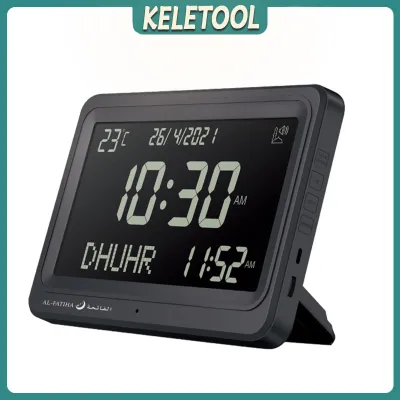
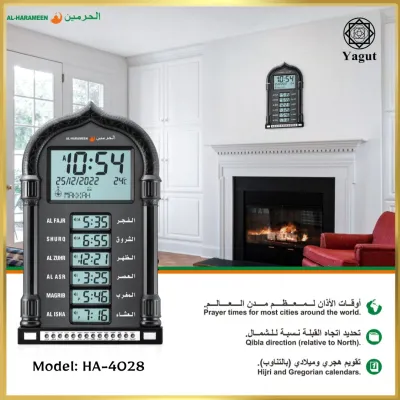
Prices are valid at publication and may change. Please refer to the product page for the latest price.
Quran Storage Capacity and Surah Selection
The storage capacity of an azan prayer clock determines whether you can access the entire Quran or only specific portions. Entry-level models typically feature limited, non-expandable built-in flash memory. This technical constraint means they can only store selected surahs, which are almost always chosen from the 30th Juz (Juz Amma) or consist of standard daily protective chapters like Surah Al-Kahf, Surah Yasin, and Surah Al-Mulk. While this is often sufficient for basic household reminders or teaching young children short chapters, it will not support a daily routine of listening to the complete Quran.
Advanced models, on the other hand, are engineered to store the full 114 surahs. These devices utilize larger internal solid-state storage or include external media slots, such as MicroSD card readers or USB ports. This media expansion capability is highly valuable because it allows you to update or swap out audio files as your household needs change. When shopping, always verify the exact storage specifications on the product packaging or manufacturer’s listing. Do not assume a clock labeled “Quran Player” automatically contains the full text; look for explicit confirmation of “Full 114 Surahs” rather than “Selected Surahs” to ensure your expectations match the device’s actual capacity.
Furthermore, the navigation of this storage is an important usability factor. On basic models with limited storage, finding a specific surah is usually a matter of pressing a simple forward or backward button. On advanced models containing the full Quran, look for devices that feature a numeric keypad on the remote control or the clock body itself. This allows you to input the exact surah number directly, saving you from tedious scrolling through dozens of tracks.
Reciter Options and Voice Preferences
The vocal delivery of Quranic recitation is deeply personal, and the availability of different reciters (Qaris) varies significantly between clock tiers. Basic or older-generation azan clocks generally feature only one or two pre-recorded, standard voices. If these pre-loaded recitations do not align with your preferred Tajweed style or vocal tone, you have no way to change them on a closed-system device. This limitation can lead to a less engaging listening experience over time.
Premium models address this by offering a diverse selection of renowned Qaris from around the world. These devices allow you to toggle between different recitation styles, ranging from slow, meditative Tajweed to faster, rhythmic Murattal styles. Because voice preference is entirely subjective, it is highly recommended to check the product details for a list of included reciters before purchasing. If you are buying from an online marketplace, look for listings that provide video demonstrations or audio samples. Verifying that your preferred reciters—such as Sheikh Al-Sudais, Sheikh Al-Ghamdi, or Sheikh Mishary Al-Afasy—are built into the system ensures the clock becomes a comforting and inspiring presence in your home.
In addition to the reciter’s voice, advanced models often include multi-language translations of the Quranic text played alongside or immediately after the Arabic recitation. If you are using the clock as an educational tool for your family, verifying that the device supports translations in your preferred language is a key step. This feature requires robust processing power and organized storage to keep the audio synchronized, which is why it is almost exclusively found on premium, high-storage models.
Audio Quality and Speaker Performance
A clock’s physical dimensions impose strict limitations on its audio capabilities. Because table clocks are designed to sit on bedside tables, desks, or shelves, they feature small internal cavities that restrict speaker diameter. This physical constraint naturally limits bass response, meaning that low-end frequencies will be minimal. Therefore, when evaluating audio quality, you should not look for deep bass, but rather focus on clear mid-range and high-frequency reproduction. This clarity is vital for distinguishing the precise pronunciation of Arabic letters and the subtle rules of Tajweed.
To ensure the recitation is clear and undistorted even at higher volumes, look for models that specify anti-distortion audio processing or feature high-quality cone drivers. A multi-level digital volume control is another essential feature, allowing you to set a soft, ambient level for early morning hours and a louder, clearer level for daytime listening. For larger, open-concept living spaces where a small built-in mono speaker might sound muffled or thin, check if the clock supports external audio output. Models equipped with a 3.5mm AUX line-out port or Bluetooth transmitter allow you to connect the clock to a larger home soundbar or speaker system, dramatically improving the depth and reach of the audio.
It is also worth noting how the physical construction of the clock’s casing affects the sound. Cheap, thin plastic housings are prone to rattling or buzzing when the volume is turned up. In contrast, clocks with denser composite casings or well-braced internal speaker chambers isolate the driver’s vibrations, resulting in a much cleaner and more natural vocal tone. When reading user reviews on online marketplaces, pay close attention to comments regarding speaker buzz or distortion at high volumes, as these are common pain points for lower-tier models.
Specification Checklist: What to Verify Before Buying
To help you compare different options objectively, the following checklist outlines the typical technical differences between basic and advanced models. Use these criteria to evaluate product listings on any online marketplace or in physical retail stores.

| Feature | Basic Models | Advanced Models | What to Check on the Label/Listing |
|---|---|---|---|
| Quran Storage | Selected short surahs (typically Juz Amma or standard daily chapters) | Full 114 Surahs (complete Quran library) | Verify if the listing states "Full Quran" or lists specific surahs. |
| Reciter Options | 1 to 2 pre-recorded standard voices | Multiple renowned Qaris (often 10 or more options) | Check the specifications for a list of included reciters. |
| Audio Output | Small built-in mono speaker (limited volume, no external ports) | Larger audio driver, often with 3.5mm AUX out or Bluetooth | Look for "AUX output," "headphone jack," or "Bluetooth transmission." |
| Media Expansion | Closed system (no external storage or update capabilities) | MicroSD card slot or USB port for custom audio files | Confirm if the device accepts external TF/MicroSD cards or USB drives. |
| Power Source | Battery-powered only (AA or AAA) or simple DC input | Plug-in power adapter (USB/DC) with internal battery backup | Verify voltage compatibility and if a backup battery is included for power cuts. |
When using this checklist, remember that a higher price does not always guarantee all advanced features. Some manufacturers focus budget on aesthetic materials, such as wooden finishes or elaborate LED displays, while keeping basic internal audio hardware. Always cross-reference the physical design with these technical specifications to ensure you are getting the functional value you require.
Practical Setup and Placement Considerations
Integrating an azan prayer clock into a Singaporean home requires careful attention to both electrical specifications and spatial layout. Singapore operates on a 230V electrical grid at 50Hz, utilizing Type G three-pin plugs. Many digital clocks sold online are powered via USB cables or external DC power adapters. Before plugging any device into your wall, you must verify that the supplied power adapter is certified for local safety standards and matches the 230V input. If the clock only comes with a USB cable, ensure you connect it to a high-quality, certified USB power brick that delivers the exact voltage and amperage specified in the manufacturer’s instruction manual.
Physical placement is equally critical to maximizing the audio performance of your clock. Singaporean apartments, such as typical HDB flats, often feature dense concrete or brick walls that can reflect or absorb sound in unexpected ways. Placing your table clock inside an enclosed wooden shelf, behind thick glass cabinet doors, or tucked deep into a corner will muffle the mid-range frequencies, making the Quranic pronunciation difficult to understand. For optimal sound projection, place the clock on an open, flat surface like a console table, sideboard, or bedside desk, ensuring the speaker grille is completely unobstructed and pointing toward the center of the room.
Additionally, consider the dimensions of the clock in relation to your furniture. Measure your intended display shelf or bedside table before purchasing to guarantee a secure fit. Because these devices contain delicate digital screens and speaker cones, they should be kept away from direct sunlight, high-humidity areas (such as adjacent to bathrooms), and sources of heat. If your clock relies on a plug-in connection, ensure it has an internal backup battery (such as a coin-cell battery or rechargeable lithium pack) so that your local prayer times, calendar settings, and custom alarms are not erased during a temporary power trip.
Final Decision Framework: Which Type Should You Choose?
To finalize your purchase, match your specific household requirements against the following conditional guidelines:
- Choose a Basic Model if:
- Your primary goal is to receive highly accurate daily Azan alerts with correct local calculation methods.
- You only require a few short surahs for daily reflection, personal reminders, or teaching young children basic chapters.
- You prefer a highly portable, battery-operated device that can easily move between rooms without worrying about power cords.
- Your budget is modest, and you do not need advanced audio customization or external speaker connections.
- Choose an Advanced Model if:
- You want the complete 114 surahs readily accessible at any time for systematic listening or complete Quran reading (Khatam) routines.
- You have specific preferences for particular Qaris and want the flexibility to switch between different recitation and Tajweed styles.
- You plan to play the recitation in a large, open-concept living area and require high-fidelity sound, volume control, or external AUX/Bluetooth output.
- You value the ability to upload custom audio files, translations, or supplementary prayers via a MicroSD card or USB drive.
- Verify First if:
- You live in an area with unique acoustic challenges or plan to connect the device to an existing home theater system (verify physical AUX ports or Bluetooth compatibility).
- You require specific regional recitation styles or local prayer calculation settings that may not be standard on generic international firmware. Always check the manufacturer's manual to ensure Singapore's local calculation methods (such as the Muis standard) are fully supported.
Frequently Asked Questions (FAQ)
Can I upload my own Quran audio files to an Azan prayer clock?
Whether you can upload custom audio files depends entirely on the clock’s hardware architecture. Closed-system models do not feature any external ports or memory card slots, meaning you are limited to the factory-installed recitations and surahs. However, advanced models equipped with a MicroSD (TF) card slot or a USB port generally support custom media playback. On these devices, you can load your own MP3 files—such as specific translations, alternative Qaris, or supplementary Islamic lectures—onto the storage card. Always consult the manufacturer’s care and setup instructions to verify the supported audio formats, maximum card capacity, and specific folder structures required for the clock to read your custom files correctly.
Do Azan clocks automatically adjust prayer times and Quran playback for location changes?
Azan prayer clocks calculate prayer times using internal astronomical formulas based on latitude, longitude, and timezone, or by selecting a pre-programmed major city. If you physically relocate the clock to a different city or country, you must manually update the location settings in the clock’s menu to ensure the Azan remains accurate. In Singapore, prayer time calculations remain highly stable year-round because the country does not observe daylight saving time, eliminating the need for bi-annual manual adjustments. It is important to note that while the Azan alarm sounds automatically at the calculated prayer times, Quran playback is typically handled separately. On most models, playing a specific surah is a manual action or must be scheduled using independent alarm settings, rather than triggering automatically with the Azan unless specified by advanced firmware.
Community discussion
Share your experience or ask a question. Comments are reviewed before publication.