
Finding the most energy-efficient E17 LED bulb brand in Singapore requires looking beyond marketing claims, as standardized, independent efficiency rankings for this specific niche base are rarely published. The “best” brand ultimately depends on verifying exact electrical compatibility and comparing standardized efficiency metrics on the packaging. In Singapore, checking the voltage rating is the most critical first step before comparing energy savings, as many E17 bulbs are manufactured for 120V markets and will fail or pose safety risks in a 230V electrical system.
The E17 base, also known as the Intermediate Edison Screw, features a thread diameter of 17 millimeters. While common in Japan and North America, it is rare in Singapore, where E14 and E27 bases dominate. Local homeowners typically encounter E17 sockets in imported appliances, specialty Japanese home goods, or vintage decorative fixtures. Because these bulbs are not widely stocked in local retail stores, buyers frequently turn to online marketplaces, exposing themselves to global inventory that may not match local electrical standards.
To secure genuine energy savings without compromising safety, you must evaluate these bulbs systematically. This guide breaks down the essential safety checks, technical efficiency metrics, and application-specific requirements to help you select the right E17 LED bulb.
Products mentioned in this guide
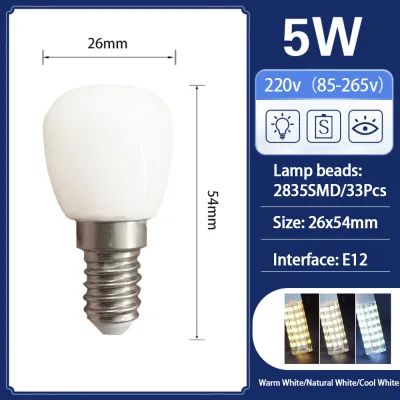
Prices are valid at publication and may change. Please refer to the product page for the latest price.
Verifying Voltage and Safety Before Comparing Brands
Before comparing the energy efficiency of different E17 LED bulb brands, you must verify their voltage compatibility. Singapore operates on a nominal mains voltage of 230V AC at 50Hz. In contrast, the E17 base is predominantly utilized in regions operating on 100V to 120V electrical grids. Many manufacturers produce E17 bulbs exclusively for these lower-voltage markets, meaning a significant portion of E17 bulbs sold on international ecommerce platforms are rated only for 110V or 120V.
Installing a 120V-rated E17 LED bulb directly into a Singaporean 230V socket will cause immediate, catastrophic failure of the internal driver circuit. The excessive voltage overloads the capacitor and semiconductor components, often resulting in a loud pop, smoke, and a potential fire hazard. Even if the bulb does not fail instantly, operating an under-rated bulb on a higher voltage causes extreme overheating, which rapidly degrades the LED chips and negates any theoretical energy savings.
To avoid this, carefully inspect the product packaging, online listing specifications, or the laser-etched markings on the bulb’s collar. Look for explicit confirmation of compatibility with “220-240V”, “230V”, or a wide-voltage range designated as “100-240V” (dual-voltage). If a product listing or packaging fails to state the operating voltage clearly, treat it as a high-risk item and avoid purchasing it.
For fixed wiring installations, damp environments like bathrooms, or work performed at heights, always isolate the mains power at the distribution board before attempting to replace or install a fixture. If you are retrofitting an imported appliance and the electrical specifications are unclear, stop the installation immediately. Consult the appliance manufacturer’s manual or hire a qualified professional electrician to verify the socket’s supply voltage before proceeding.
Key Metrics to Compare Energy Efficiency Across Brands
Once you have filtered out incompatible voltage options, you can compare the actual energy efficiency of the remaining E17 LED brands. The most reliable indicator of efficiency is Luminous Efficacy, which measures how effectively a bulb converts electrical power into visible light. This is expressed in lumens per watt (lm/W). Rather than simply comparing the wattage of different bulbs, you should divide the total lumen output by the rated wattage to find the efficacy.

For example, if Brand A offers a 4-watt E17 bulb that produces 360 lumens, its efficacy is 90 lumens per watt. If Brand B offers a 5-watt bulb that produces 400 lumens, its efficacy is 80 lumens per watt. In this scenario, Brand A is the more energy-efficient choice because it delivers more light per watt of electricity consumed. High-quality LED brands typically achieve higher efficacy through superior LED chip selection and more efficient driver designs.
Another critical factor is the Power Factor (PF), which is a decimal value between 0 and 1 printed on some technical datasheets. The power factor represents the ratio of real power used by the bulb to the apparent power flowing through the circuit. A low power factor (such as 0.4) means the bulb draws more current than it actually utilizes, which can cause minor efficiency losses in the surrounding electrical wiring. Look for brands that offer a higher power factor, ideally 0.5 or above for small residential bulbs, as this indicates a more sophisticated electrical design.
Thermal management also plays a vital role in sustaining long-term efficiency. LEDs are highly sensitive to heat; as the temperature of the LED junction rises, its light output drops, and its power consumption may shift. Efficient E17 brands utilize ceramic or aluminum-lined thermoplastic housings to draw heat away from the LED chips. Cheap, all-plastic bulbs often trap heat, leading to rapid lumen depreciation, color shifting, and premature failure, which ultimately ruins the economic benefit of switching to LED.
Matching Efficiency Profiles to Your Specific Use Case
The ideal E17 LED bulb depends heavily on where it will be installed, as different environments require different performance trade-offs. For appliance lighting, such as inside a refrigerator, microwave, or cooker hood, physical dimensions and environmental resistance are far more important than achieving the absolute highest lumens-per-watt rating.
In a refrigerator, the bulb must operate reliably in cold temperatures and fit within a highly restricted, recessed compartment. Because refrigerator lights are only active for brief periods, the absolute energy efficiency of the bulb has a negligible impact on your monthly utility bill. Instead, prioritize a compact physical profile and moisture resistance to ensure the bulb fits and survives the damp environment.
For cooker hoods or microwave interiors, the bulb is subjected to high ambient heat, steam, and physical vibrations. Standard decorative E17 LED bulbs are not designed to withstand these conditions; their internal solder joints and driver components will quickly fail. For these applications, you must select E17 bulbs explicitly rated as “appliance bulbs” or “heat-resistant.” Using a non-appliance-rated LED in a high-heat environment will accelerate thermal degradation, causing the bulb to dim permanently within a few weeks.
For decorative fixtures like chandeliers, wall sconces, or desk lamps, you may need to balance energy efficiency against light quality. Color Rendering Index (CRI) measures how accurately a light source reveals the true colors of objects, rated on a scale up to 100. High-CRI bulbs (CRI 90 or above) require specialized phosphors that absorb more blue light, which slightly reduces their overall luminous efficacy compared to standard CRI 80 bulbs. If you prioritize vibrant, natural colors in your living space, accepting a slightly lower efficacy is a reasonable trade-off. Similarly, if your fixture uses a dimmer switch, ensure the bulb is explicitly labeled as “dimmable” to avoid flickering and driver damage.
Decision Framework: Selecting the Best E17 LED for Your Needs
To make a confident purchase, use this structured decision framework to evaluate E17 LED bulbs based on your specific setup:
First, identify the supply voltage of your fixture. If the fixture is wired directly to Singapore’s 230V mains, you must select a bulb rated for 220-240V or a wide-voltage range of 100-240V. If the bulb is for an imported appliance that runs on a step-down transformer supplying 110V, you must select a 110-120V rated bulb.
Second, assess the installation environment. For ovens, microwaves, and range hoods, choose a brand that explicitly specifies high-temperature appliance rating and matches the exact physical dimensions of your existing bulb. For decorative home lighting, prioritize dimming compatibility and a high CRI (90+) if color accuracy is important to your decor.
Third, compare the calculated luminous efficacy (lumens divided by watts) among the compatible options. Choose the brand that offers the highest lumens-per-watt ratio within your budget, provided it meets the physical size constraints of your fixture.
Finally, verify the safety markings and avoid any products that lack clear specifications. If a bulb’s packaging does not state the voltage, lumen output, or dimming compatibility, do not purchase it. If no compatible E17 LED bulb can be found that safely matches your fixture’s voltage and physical constraints, do not attempt to force an incompatible bulb into the socket.
Frequently Asked Questions (FAQ)
Can I use an E14 LED bulb with an adapter in an E17 socket?
Yes, you can use an E14-to-E17 adapter to fit a more common E14 bulb into an E17 socket, but this workaround introduces several practical and safety limitations. Physically, the adapter adds extra length to the assembly, which often prevents the bulb from fitting inside tight appliance compartments, range hoods, or decorative glass shades. If the bulb protrudes too far, it may interfere with appliance doors or create an unsightly appearance in decorative fixtures.
Electrically, every additional mechanical interface introduces a potential point of resistance and failure. You must ensure that the adapter itself is rated for Singapore’s 230V mains voltage and that the wattage of the installed bulb does not exceed the adapter’s specified safety limits. In high-heat or high-vibration environments, such as inside a microwave or cooker hood, using adapters is highly discouraged as they can loosen over time, degrade under thermal stress, or create a contact hazard.
Do E17 LED bulbs consume less power than halogen equivalents?
Yes, E17 LED bulbs consume significantly less power than their halogen or incandescent counterparts, typically offering energy savings of 80% to 90%. A standard E17 halogen appliance bulb usually draws between 25 and 40 watts of electricity, whereas an equivalent E17 LED bulb designed to produce the same level of brightness typically draws only 3 to 5 watts. This drastic reduction in power consumption also means the LED bulb generates far less heat, reducing the thermal load on surrounding appliance components.
However, the actual financial savings on your electricity bill will depend on how many hours the bulb is used daily and the prevailing electricity tariff, which is calculated in S$ per kilowatt-hour. For appliance bulbs that only operate for a few seconds or minutes at a time, such as refrigerator lights, the direct financial savings will be negligible. For range hoods, desk lamps, or decorative chandeliers that remain switched on for several hours each day, the cumulative energy savings will be noticeable and will easily offset the higher initial purchase price of the LED bulb over its extended lifespan.
Community discussion
Share your experience or ask a question. Comments are reviewed before publication.