
Quick Answer: Balancing Efficiency and Brightness in G9 LEDs
When upgrading your compact light fixtures, finding the right G9 LED light bulb requires looking past flashy brand names and focusing on how a bulb’s physical design matches your fixture’s limits. Because G9 bulbs are incredibly compact, they face a unique engineering challenge: packing light-emitting diodes and electronic drivers into a tiny capsule.
The primary trade-off in these miniature bulbs is heat. Higher brightness levels naturally generate more heat, which must be dissipated quickly. If a high-output G9 LED is placed in a tight, enclosed fixture without adequate ventilation, the trapped heat will degrade the internal components, lowering both its operating efficiency and its overall lifespan.
Since there is no single, universally dominant brand that fits every home perfectly, your best approach is to compare verified packaging specifications rather than relying on vague marketing claims. By matching the actual lumen output and wattage draw to your specific fixture, you can secure a reliable, energy-efficient setup that lasts for years.
Products mentioned in this guide
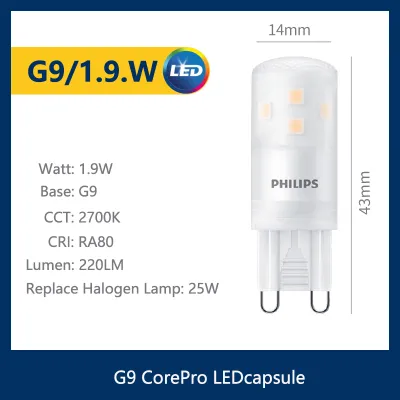
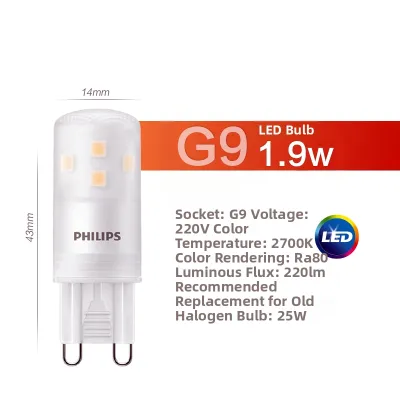
Prices are valid at publication and may change. Please refer to the product page for the latest price.
Essential Specifications to Verify Before Comparing Brands
Before you begin comparing different G9 LED light bulb brands, you must establish the baseline physical and electrical constraints of your lighting fixtures. G9 bulbs feature a two-pin base where the pins loop back into the glass or plastic body, spaced exactly 9 millimeters apart. While the base connection is standardized, the overall size of the bulb is not.

First, verify the operating voltage of your home’s electrical system. In Singapore, the standard mains voltage is 230V at 50Hz. You must ensure that any G9 LED bulb you purchase is rated for 220V to 240V operation. Installing a bulb designed for a lower voltage system will cause immediate failure or create a serious electrical hazard. Always isolate the power at the main switch before removing or installing any light bulb to prevent accidental electric shocks.
Second, check the maximum wattage rating printed on your light fixture. Even though LED bulbs draw significantly less power than their older halogen counterparts, the fixture’s socket and wiring are still rated for a specific maximum thermal and electrical load. Staying well below this limit ensures safe operation.
Finally, measure the physical clearance inside your fixture’s shade or cover. Halogen G9 bulbs are notoriously tiny, whereas G9 LED bulbs are often noticeably wider and longer because they must house a complex electronic driver circuit and a heat sink. Always measure the internal diameter and depth of your fixture’s housing to confirm that a bulkier LED replacement will actually fit inside without touching the glass shade.
Evaluating Energy Efficiency Across G9 LED Options
To accurately compare the energy efficiency of different G9 LED light bulb brands, you must learn to look past the prominent “halogen equivalent” wattage printed on the front of the box. This equivalent rating is merely a marketing estimate of how much light the bulb produces compared to an old halogen bulb. Instead, focus on the actual power consumption, which is listed as the bulb’s rated wattage (usually between 2W and 5W for G9 LEDs).
The most reliable way to measure true efficiency is by calculating the luminous efficacy of each bulb. This is done by dividing the total light output (measured in lumens) by the actual power consumed (measured in watts). For example, a G9 LED bulb that produces 400 lumens while drawing 4 watts has an efficacy of 100 lumens per watt (lm/W). When comparing brands, a higher lumens-per-watt ratio indicates a more efficient bulb that converts more electricity into visible light rather than wasted heat.
Thermal management plays a massive role in maintaining this efficiency over time. Because G9 bulbs are so small, they lack the space for large, heavy metal heat sinks. Look closely at the construction materials used by different brands. Bulbs with ceramic bodies or advanced polycarbonate housings generally offer superior heat dissipation compared to cheap, fully enclosed plastic models. Efficient heat dissipation prevents the LED chips from overheating, which preserves their light output and prevents the efficiency from dropping as the bulb ages.
Assessing Brightness and Light Quality for Your Space
Brightness is no longer measured by wattage; instead, you must compare the raw lumen output of each G9 LED light bulb. A higher lumen rating means a brighter light. For general ambient lighting in a chandelier or wall sconce, a bulb producing 200 to 300 lumens is usually sufficient. For task-oriented areas, such as under-cabinet lighting or vanity mirrors, you may want to look for high-output options that deliver 400 lumens or more.
Light quality also depends heavily on color temperature, which is measured in Kelvin (K). This choice is entirely a matter of personal preference and spatial function. Warm white bulbs (typically 2700K to 3000K) emit a cozy, yellowish glow that mimics traditional halogen bulbs, making them ideal for living rooms and bedrooms. Cool white or daylight bulbs (4000K to 6000K) provide a crisp, bluish-white light that enhances focus and visibility in kitchens, bathrooms, and workspaces.
Another critical metric to compare across brands is the Color Rendering Index (CRI). Rated on a scale from 0 to 100, CRI measures how accurately a light source reveals the true colors of objects compared to natural sunlight. For spaces where color accuracy is vital—such as above a vanity mirror, in a walk-in wardrobe, or highlighting artwork—choose G9 LED bulbs with a CRI of 90 or higher. Lower-quality brands often have a CRI below 80, which can make your home’s interior decor look dull, washed out, or unnaturally gray.
Structuring Your Brand Comparison Matrix
When you are ready to make a purchase, organizing your options into a structured comparison matrix will help you identify the best value. Create a simple checklist for each G9 LED light bulb brand you are considering, noting down the following key specifications: actual wattage, lumen output, calculated efficacy (lumens per watt), color temperature, CRI, and whether the bulb is explicitly rated as dimmable.
In addition to these performance metrics, evaluate the long-term value by checking the manufacturer’s warranty terms and stated lifespan. A reputable brand will typically offer a multi-year warranty (often two to three years) and state an expected lifespan of 15,000 to 25,000 operating hours. Be cautious of brands that promise exceptionally long lifespans but offer no warranty coverage to back up those claims.
Most importantly, verify that any bulb you select carries the appropriate electrical safety certifications. In Singapore, look for the Enterprise Singapore Safety Mark on the packaging or product listing. This certification ensures that the bulb has undergone rigorous testing to meet local safety standards, protecting your home from potential electrical faults, short circuits, or fire hazards.
Decision Framework: Choosing the Right G9 LED Bulb
To finalize your decision, apply a practical framework based on your specific installation environment and usage needs. If you are installing G9 LED bulbs in tight, enclosed light fixtures, prioritize models with ceramic bodies and slightly lower wattages. This combination prevents excessive heat buildup inside the fixture, protecting both the bulb’s internal driver and the delicate materials of your light fixture from heat damage.
For task lighting, vanity mirrors, or accent displays where visual clarity is paramount, prioritize light quality over raw brightness. Select a bulb with a high CRI of 90 or above, and choose a color temperature that matches the room’s function—such as a clean 4000K cool white for bathrooms or a warm 2700K for relaxed dining areas.
Finally, always check your light switches before buying. If your fixture is connected to a dimmer switch, you must purchase G9 LED bulbs that are explicitly labeled as “dimmable.” Standard, non-dimmable LED bulbs will flicker, buzz, or fail prematurely if subjected to a dimming circuit. Furthermore, ensure your dimmer switch is compatible with LED technology; older leading-edge dimmers designed for halogens often require a minimum electrical load that low-wattage G9 LEDs cannot meet, necessitating an upgrade to a modern trailing-edge LED dimmer.
Frequently Asked Questions (FAQ)
Can I use a dimmable G9 LED bulb in a non-dimmable fixture?
Yes, you can safely install a dimmable G9 LED bulb in a standard, non-dimmable light fixture. In this setup, the bulb will simply operate at its maximum brightness whenever the switch is turned on. However, dimmable LED bulbs are generally more expensive than their non-dimmable counterparts due to the more complex internal circuitry required for dimming. If you do not plan to dim the lights, choosing a standard non-dimmable model is a more cost-effective option.
Why do some G9 LED bulbs flicker or buzz after installation?
Flickering or buzzing is almost always caused by an electrical incompatibility between the low-wattage G9 LED bulb and the existing circuit. This issue is incredibly common when retrofitting LEDs into fixtures controlled by older dimmer switches designed for high-wattage halogen bulbs. The low power draw of the LED fails to meet the dimmer’s minimum load requirement, causing unstable power delivery. To resolve this, you may need to replace your old dimmer with a modern LED-compatible trailing-edge dimmer, or verify that the bulb brand you chose is explicitly listed on the manufacturer’s dimmer compatibility chart.
Do G9 LED bulbs get hot enough to damage enclosed light fixtures?
While G9 LED bulbs run significantly cooler than traditional halogen bulbs—which can reach scorching temperatures—they still generate heat at their base where the electronic driver is located. In a tightly enclosed fixture with poor airflow, this heat can accumulate over time. While it is highly unlikely to damage a glass or metal fixture, the trapped heat will rapidly degrade the LED’s internal components, leading to flickering, dimming, or premature bulb failure. To prevent this, ensure your enclosed fixtures have some ventilation, or choose G9 LEDs with robust ceramic heat sinks designed to handle restricted airflow.
Community discussion
Share your experience or ask a question. Comments are reviewed before publication.