
Finding the most energy-efficient GU10 LED bulb for your home in Singapore requires looking beyond brand names. While major manufacturers and local lighting brands offer a wide range of options, efficiency is determined by specific product generations, thermal engineering, and component quality rather than brand reputation alone.
To identify the most cost-effective GU10 LED, you must compare the luminous efficacy—measured in lumens per watt—and verify the certified lifespan of each individual model. By focusing on objective technical specifications and local safety standards, you can select bulbs that minimize electricity bills while ensuring long-term reliability in our tropical climate.
How to Measure GU10 LED Energy Efficiency
Luminous efficacy is the primary metric used to evaluate the electrical efficiency of any light source. Expressed in lumens per watt (lm/W), this ratio indicates how much visible light a bulb produces for every watt of electricity it consumes. A higher lm/W rating means the bulb is more efficient, converting more electrical energy into light and wasting less as heat.
Products mentioned in this guide
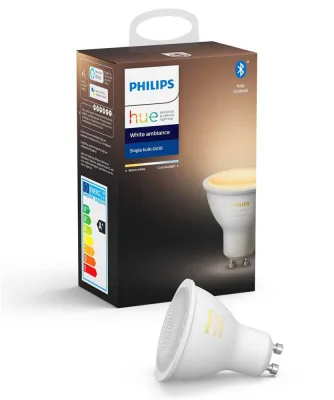
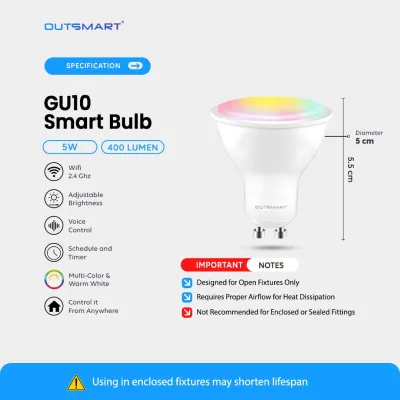
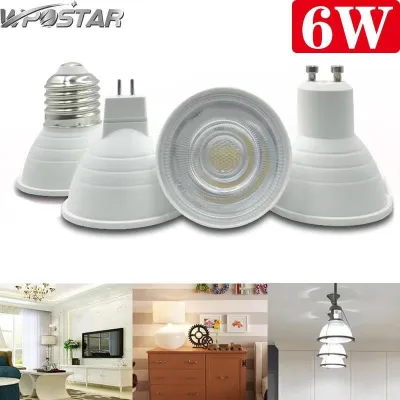
![[SG Seller] GU10 3tone Tri tone Bulb for Spotlight Track Light GSE](https://img.lazcdn.com/g/p/0aff796a467357ff4cd7aeb057448a60.png_400x400q80.png_.webp)
![LED LIGHT GU10 Bulb 5w [Spotlight Track Light Feature Wall Light]](https://img.lazcdn.com/g/p/437080a57739e0569ee953c3223dce4f.png_400x400q80.png_.webp)
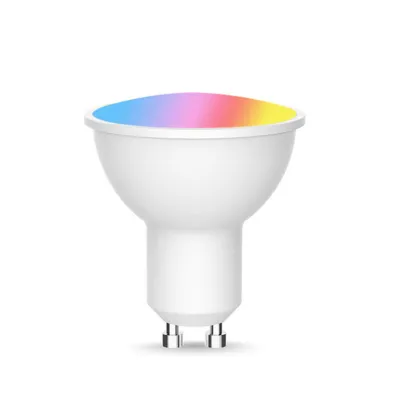
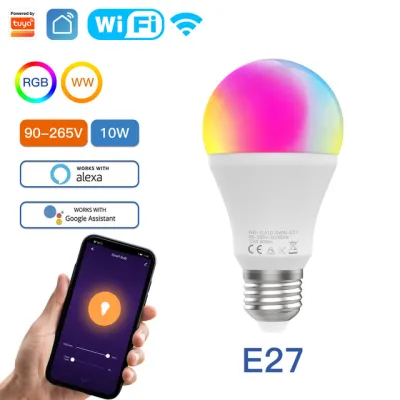
Prices are valid at publication and may change. Please refer to the product page for the latest price.
When shopping for GU10 LEDs, it is important to distinguish between actual power consumption and equivalent halogen wattage claims. Packaging often features prominent labels such as “50W equivalent” alongside a much smaller number representing the actual wattage, such as 4.5W or 5W. The equivalent wattage is simply a marketing comparison to help consumers transition from legacy halogen bulbs; the actual wattage is the figure used to calculate your energy consumption.
Beam angle also plays a significant role in how you perceive brightness and light distribution. GU10 bulbs are directional spotlights, typically offering beam angles ranging from a narrow 24 degrees to a wider 60 degrees. A narrow beam concentrates light into a intense, focused spot, which may appear brighter directly underneath but covers a smaller area. A wide flood beam distributes light more evenly across a room, reducing the need for additional fixtures and optimizing overall spatial efficiency.
Where to Find Reliable Efficiency Data
To obtain accurate performance data, look for the technical specification sheet or the product packaging. Reputable manufacturers print detailed specifications directly on the box or provide downloadable data sheets online. Key metrics to verify include the nominal luminous flux (measured in lumens), the exact power consumption (measured in watts), and the rated operating hours.

In Singapore, GU10 bulbs operate on the standard mains voltage of 230V at 50Hz. Because these bulbs connect directly to the mains power supply, they must carry the Safety Mark issued by the Enterprise Singapore Consumer Product Safety Office. This certification ensures the bulb has undergone rigorous testing for electrical safety, insulation, and fire resistance, protecting your home from electrical faults.
Be cautious of unbranded or generic bulbs sold on online marketplaces that lack clear safety markings or detailed technical specifications. Products that use vague marketing terms like “ultra-bright” or “maximum savings” without providing verifiable lumen or efficacy data often underperform. These uncertified bulbs may also feature low-quality internal drivers that fail prematurely under local operating conditions.
How to Calculate True Cost Effectiveness
To determine the true cost of ownership for a GU10 LED bulb, you can calculate its estimated annual operating cost using a straightforward formula. You will need the bulb’s actual wattage, your average daily usage hours, and the current local electricity tariff.
$$\text{Annual Electricity Cost} = \left( \frac{\text{Wattage} \times \text{Daily Usage Hours} \times 365}{1,000} \right) \times \text{Electricity Tariff (S\$ per kWh)}$$
For a complete financial comparison, combine this operating cost with the initial purchase price distributed over the bulb’s rated lifespan. A cheaper bulb with a shorter lifespan of 15,000 hours may end up costing more over time than a slightly more expensive bulb rated for 25,000 hours, as you will need to replace the cheaper model more frequently. Calculating the total cost per 1,000 hours of use provides a balanced metric for comparison.
Thermal management is another critical factor influencing long-term cost-effectiveness. Singapore’s warm, humid climate can accelerate heat buildup, particularly when GU10 bulbs are installed in tight, enclosed recessed ceiling fixtures. High temperatures degrade the sensitive electronic components inside the LED driver, leading to premature failure long before the LED chips themselves wear out. Choosing bulbs with robust heat sinks—such as those made from aluminum or advanced thermal plastics—helps maintain efficiency and prolongs the bulb’s actual lifespan.
Which GU10 LED Should You Choose?
Your choice of GU10 LED should align with the specific function of the space and the physical installation environment. For general ambient lighting in living rooms, corridors, or kitchens, prioritize high lm/W models with wide beam angles. This setup ensures broad, even illumination across the room while keeping overall energy consumption low.
For accent lighting, such as highlighting artwork, feature walls, or decorative niches, opt for lower-wattage models with narrow beam angles. Because these bulbs focus light onto a specific target, you do not need high lumen output to achieve the desired visual impact, allowing you to save energy by using lower-wattage options.
If your home features dimming systems, you must verify dimmer switch compatibility before purchasing. Standard LEDs are generally non-dimmable; installing them on a dimmer circuit can cause persistent flickering, buzzing, or immediate driver damage. Look for explicit “dimmable” labeling on the packaging, and check the manufacturer’s compatibility list to ensure the bulb works seamlessly with your specific dimmer type, whether it is a leading-edge or trailing-edge system.
Finally, always prioritize safety during installation. Before replacing any light bulbs or working near ceiling fixtures, isolate the mains power at the distribution board. If your existing recessed housings lack adequate ventilation, or if you need to modify fixed electrical wiring, stop and consult a licensed electrical worker to ensure the installation complies with local safety regulations.
Frequently Asked Questions (FAQ)
Does a higher wattage GU10 LED always produce more light?
No, a higher wattage does not guarantee more light output. Wattage measures the amount of electrical power a bulb consumes, whereas lumens measure the actual amount of visible light produced.
Due to rapid advancements in LED technology, a newer, highly efficient 4W GU10 LED can produce the same or greater light output (lumens) than an older, less efficient 6W model. Always compare the lumen rating rather than the wattage to determine how bright a bulb will be.
Can I use standard GU10 LEDs in enclosed or insulated ceiling fixtures?
Standard GU10 LEDs should not be used in fully enclosed or tightly insulated fixtures unless they are explicitly rated for such environments. LEDs are highly sensitive to heat buildup.
When trapped in an enclosed space without adequate ventilation, the heat generated by the bulb cannot dissipate. This thermal stress rapidly degrades the internal driver capacitors, leading to flickering, dimming, or complete bulb failure. Always check the manufacturer’s specifications for enclosed-fixture compatibility before installing bulbs in restricted spaces.

Community discussion
Share your experience or ask a question. Comments are reviewed before publication.