
Direct Answer: Finding the Most Energy-Efficient T5 LED Tube
When evaluating T5 LED tubes for energy efficiency in Singapore, established global lighting manufacturers such as Philips (Signify), Osram (LEDVANCE), and Panasonic consistently deliver the highest performance. While individual product specifications undergo regular updates, these leading brands design their tubes with superior driver electronics and high-grade light-emitting diodes that optimize energy conversion.
The true measure of energy efficiency is not simply the lowest wattage on the packaging, but rather the tube’s luminous efficacy, which is measured in lumens per watt (lm/W). High-efficacy tubes produce more light while consuming less electricity. To secure genuine long-term energy savings, look for T5 LED tubes that carry reputable international certifications, feature high lm/W ratings (typically 120 lm/W to 150 lm/W or higher), and offer robust manufacturer warranties that guarantee lumen maintenance over time.
How to Measure and Compare T5 LED Energy Efficiency
Understanding the technical specifications of T5 LED tubes allows you to make an objective comparison that goes beyond brand marketing. Evaluating these metrics ensures you select a product that maximizes illumination while minimizing your monthly SP Group utility bill.
Products mentioned in this guide
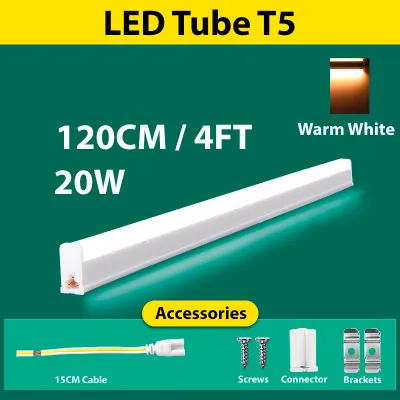
![LED PRO LED LIGHT Led T5 Led Tube/ Led Tube Tri-Tone Daylight/Cool White/Warm White [300mm/600mm/900mm/1200mm]](https://img.lazcdn.com/g/p/88326b36ba15a5b70e2b9bb596605a3d.jpg_400x400q80.jpg_.webp)
![[Buy 2 Free 1] BWL LED LIGHT LED Tube T5 LED Tube TRI-TONE/3000K/4000K/6000K](https://img.lazcdn.com/g/p/2718f00f73afda62d0ec0525659e883f.jpg_400x400q80.jpg_.webp)
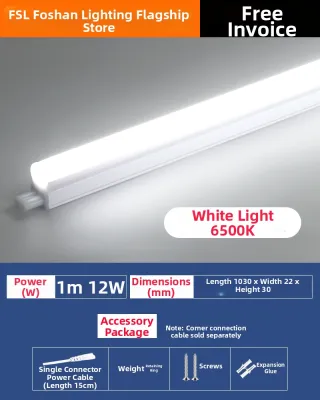
![[BUY 5 FREE 1] DFS LED LIGHT Led T5 T5 LED Tube Tri-tone [300mm/600mm/900mm/1200mm]](https://img.lazcdn.com/g/p/3f0c88d562a97ceb8011943e7ef20370.jpg_400x400q80.jpg_.webp)
![[BUY 5 FREE 1] DFS Led T5 Led Tube T5 Tube 1200mm/900mm/600mm/300mm Daylight/Cool White/Warm White](https://img.lazcdn.com/g/p/2a8dc6cec0535c44d7ed2292c9bb5f96.jpg_400x400q80.jpg_.webp)
Prices are valid at publication and may change. Please refer to the product page for the latest price.

Luminous Efficacy (lm/W)
Luminous efficacy represents the efficiency of a light source in converting electrical power into visible light. To calculate this metric, divide the total light output in lumens (lm) by the power consumed in watts (W). For example, a T5 LED tube that produces 1,600 lumens while consuming 10 watts has an efficacy of 160 lm/W. In contrast, older fluorescent T5 tubes often operate at only 80 to 90 lm/W. When comparing brands, prioritizing a higher lm/W ratio ensures you receive the maximum amount of light for every cent spent on electricity.
Wattage vs. Brightness
A common misconception is that a lower-wattage tube is automatically the most efficient choice. However, if a low-wattage tube fails to deliver the brightness required for your space, you may end up installing additional fixtures, which ultimately increases overall energy consumption. True efficiency means achieving your desired illumination level with the lowest possible power draw. Always match the lumen output of the LED replacement to the light output of your existing fixture to maintain consistent brightness.
Lifespan and Lumen Maintenance
All light sources gradually dim over time, a process known as lumen depreciation. LED efficiency must therefore be evaluated over the product’s entire operating life. Reliable manufacturers publish lumen maintenance ratings, typically expressed as L70 or L80. An L70 rating of 50,000 hours means the tube will still produce at least 70% of its original light output after 50,000 hours of use. Brands that use high-quality phosphors and superior thermal management systems prevent rapid dimming, ensuring the tube remains highly efficient throughout its lifespan rather than needing premature replacement.
Power Factor (PF)
Power Factor measures how effectively an electrical appliance converts incoming current into useful work, represented on a scale from 0 to 1.0. A high Power Factor (typically 0.9 or above) indicates that the T5 LED tube draws power efficiently with minimal electrical waste. While residential users in Singapore are billed primarily for active power, commercial properties can face penalties from utility providers for low power factors. Opting for tubes with a high Power Factor reduces strain on the building’s electrical infrastructure and supports overall system efficiency.
Comparing Popular T5 LED Tube Brands in Singapore
Singapore’s retail market offers a mix of premium global brands and budget-friendly alternatives. These brands can be found across local lighting showrooms along Balestier Road, hardware stores, and online marketplaces. Each brand approaches energy efficiency, driver design, and build quality with distinct product strategies.
Philips (Signify)
Philips is a dominant force in the Singapore lighting market, particularly through its CorePro and MASTER LEDtube product lines. The brand focuses heavily on high-efficacy designs, with premium models frequently exceeding 140 lm/W. Philips utilizes advanced integrated drivers that provide stable current, which eliminates visible flickering and protects the LEDs from premature decay. Their master-tier products are engineered for excellent thermal dissipation and superb lumen maintenance, making them highly reliable for spaces where lights remain on for extended periods.
Osram (LEDVANCE)
Osram, managed under LEDVANCE, is highly regarded for its SubstiTUBE series. These T5 LED tubes are built with a strong emphasis on robust thermal management, using high-grade glass or shatterproof polycarbonate housings. The glass models offer excellent structural rigidity and heat dissipation, which helps keep the internal LED chips cool and maintains high efficacy over time. Osram’s designs are highly optimized for direct retrofit applications, delivering reliable energy savings without compromising on light distribution or color consistency.
Panasonic
Panasonic is a trusted household name in Singapore, known for manufacturing T5 LED tubes that balance energy efficiency with visual comfort. Their products typically offer a stable efficacy range of 110 lm/W to 130 lm/W. Panasonic places a strong emphasis on driver reliability, ensuring their tubes can withstand minor voltage fluctuations in the electrical grid. These tubes are particularly popular for residential cove lighting and false ceilings, where uniform light distribution and long-term operating stability are key priorities.
Value and Alternative Brands
For budget-conscious projects, local and regional brands such as Opple, Megaman, and various proprietary house brands are widely available. These options feature lower upfront purchase prices and competitive initial efficacy ratings on paper. However, buyers should exercise caution and closely inspect the build quality, driver specifications, and warranty terms. Lower-cost brands may use cheaper capacitors in their drivers, which are more susceptible to premature failure in Singapore’s warm, humid climate, potentially wiping out any initial savings through shorter product lifespans.
Compatibility and Safety: Ensuring Your T5 LED Tube Fits
Upgrading to an energy-efficient T5 LED tube requires careful attention to physical and electrical compatibility. Incorrect installation can lead to electrical hazards, reduced efficiency, or permanent damage to the new tube.
Ballast Compatibility
Traditional fluorescent fixtures utilize an electronic ballast to regulate current. When upgrading to T5 LED, you must choose between plug-and-play (ballast-compatible) tubes and ballast-bypass (direct-wire) tubes:
- Plug-and-Play: These tubes slide directly into your existing fixture without any rewiring. While convenient, the old electronic ballast remains active, continuously consuming 1 to 3 watts of standby power. Additionally, if the old ballast eventually fails, the light will stop working, requiring a ballast replacement.
- Ballast-Bypass: This method involves removing or bypassing the old ballast and wiring the mains electricity directly to the tube sockets. Eliminating the ballast removes its associated energy losses, making ballast-bypass the most energy-efficient configuration for long-term use.
Safety Boundary
Because ballast-bypass installations require direct exposure to 230V mains voltage, strict safety protocols must be followed. Always isolate the electrical circuit by switching off the main power at your distribution board (DB box) before commencing any work. If you are unfamiliar with electrical wiring or if your building features complex multi-tube fixtures, do not attempt to rewire the system yourself. In Singapore, you should engage a licensed electrical worker (LEW) or a qualified professional to perform the modification safely and in accordance with local electrical safety standards (such as SS 638).
Physical Dimensions and Pin Types
T5 LED tubes utilize a G5 bi-pin base, which features a pin spacing of exactly 5mm. This is significantly narrower than the G13 base used by larger T8 tubes. Before purchasing, measure the exact length of your existing fixture. Standard T5 lengths in Singapore typically correspond to nominal sizes of 2 feet (approximately 549mm), 3 feet (approximately 849mm), or 4 feet (approximately 1149mm). Double-check these measurements, as physical dimensions must match your fixture precisely to ensure a secure fit.
Voltage and Frequency
Verify that any T5 LED tube you purchase is rated for Singapore’s standard electrical grid, which operates at 230V AC at a frequency of 50Hz. Importing lighting equipment designed for different regional grids (such as 110V systems) without verifying voltage compatibility can result in immediate equipment failure, electrical shorts, or fire hazards.
Calculating the True Cost and Energy Savings
To determine whether a premium, high-efficacy T5 LED tube is worth the higher upfront investment compared to a cheaper alternative, you can perform a straightforward financial calculation.
Upfront Cost vs. Operational Cost
While budget-friendly T5 LED tubes cost less at the cash register, premium high-efficacy tubes from brands like Philips or Osram consume fewer watts to produce the same amount of light. Over several years of continuous operation, the reduction in electricity consumption often far outweighs the initial price difference. This makes the total cost of ownership for premium tubes significantly lower.
Estimating Savings
You can estimate your potential savings by comparing the wattage of your current lighting setup against a new T5 LED tube. Use the following formula to calculate annual electricity costs:
$$\text{Annual Cost} = \left( \frac{\text{Fixture Wattage} \times \text{Daily Operating Hours} \times 365}{1000} \right) \times \text{Electricity Tariff}$$
Consider a typical Singapore household replacing a traditional 28W fluorescent T5 tube (which actually draws about 31W when factoring in ballast energy loss) with a highly efficient 14W T5 LED tube. Assuming the light is switched on for 8 hours daily and utilizing a representative SP Group residential tariff of S$0.30 per kWh:
- Fluorescent Tube Cost: $(31\text{W} \times 8\text{ hours} \times 365 \text{ days} / 1000) \times \text{S}\}0.30 = \text{S}\}27.16$ per year.
- T5 LED Tube Cost: $(14\text{W} \times 8\text{ hours} \times 365 \text{ days} / 1000) \times \text{S}\}0.30 = \text{S}\}12.26$ per year.
- Annual Savings: S$14.90 per tube.
If your home uses ten cove light tubes in the living room, upgrading to efficient T5 LEDs translates to roughly S$149 in annual savings on your electricity bill.
When to Upgrade
If your existing lights are used for more than four hours a day, upgrading to high-efficacy T5 LEDs immediately is financially advantageous, as the payback period is typically under 18 months. For lights that are rarely turned on, such as those in a household shelter or a utility closet, you can wait until the existing fluorescent tubes fail before replacing them with LED alternatives.
Decision Framework: Which T5 LED Tube Should You Buy?
To finalize your purchase, align your brand selection with the specific requirements of your space and your long-term energy goals.
- Choose a premium high-efficacy brand (e.g., Philips, Osram) if: Your lights operate for long hours daily, such as in living room cove lighting, kitchen workspaces, retail shops, or office environments. In these scenarios, the superior energy savings, excellent color rendering, and long lifespans of premium tubes easily justify the higher initial investment.
- Choose a value brand if: The fixtures are located in low-traffic or occasional-use areas, such as storerooms, corridors, or residential bomb shelters. In these spaces, the lights are rarely turned on long enough for high-efficacy energy savings to offset a higher purchase price.
- Verify first if: You are uncertain about your existing ballast type or your ability to safely rewire the fixture. Take the time to examine your current light fittings, read the manufacturer's compatibility sheets, and consult a professional installer to ensure a safe, efficient, and long-lasting upgrade.
Frequently Asked Questions (FAQ)
Do T5 LED tubes save more energy than T8 LED tubes?
T5 LED tubes are physically narrower, measuring 5/8 of an inch in diameter compared to the 1-inch diameter of T8 tubes. While T5 LED tubes are highly efficient and often utilize advanced, high-density LED chips, the actual energy saved is determined by the specific luminous efficacy (lm/W) of the individual products being compared rather than the tube’s physical diameter. However, because T5 fixtures are frequently designed with highly integrated reflectors, they can achieve better directional light delivery, which often improves overall system efficiency in task and cove lighting applications.
Can I use a T5 LED tube in a T8 fixture?
No, T5 LED tubes cannot be directly installed in a T8 fixture. T5 tubes utilize a G5 bi-pin base with a 5mm pin spacing and are physically shorter than T8 tubes, which use a G13 bi-pin base with a 13mm pin spacing. Attempting to force a T5 tube into a T8 fixture will not work and can damage the contacts. To use T5 LED technology in a space designed for T8 tubes, you must either install specialized physical adapter brackets or replace the entire light fixture with a dedicated T5-compatible housing.
Community discussion
Share your experience or ask a question. Comments are reviewed before publication.