
Finding a reliable clock projector in Singapore requires looking past flashy online listings and focusing on established consumer electronics manufacturers that offer local warranty support and certified electrical safety. While generic white-label options flood online marketplaces, brands with a history in home electronics, digital timepieces, or projection technology provide the most consistent performance. To make a worthwhile investment, you must evaluate how a brand handles voltage compatibility, projection clarity, and long-term component durability. By focusing on reputable brands that design products specifically for international electrical standards, you can avoid the common pitfalls of dim displays, failing projection bulbs, and incompatible power plugs. In an era where smartphones often disrupt sleep with notifications, a dedicated clock projector serves as an excellent, low-distraction alternative for checking the time in the middle of the night.
Key Features to Evaluate in Clock Projectors
Projection clarity is the most critical technical specification to evaluate when comparing different brands. A high-quality projector uses a focused LED light source and an adjustable lens system to cast sharp, legible digits onto your ceiling or wall. Look for models that offer adjustable brightness levels for the projection itself, not just the main clock face. Auto-dimming capabilities are highly beneficial, as they use ambient light sensors to automatically lower the display intensity when the room goes dark, preventing the projection from keeping you awake. Some advanced models also feature image-flipping or 180-degree rotation controls, ensuring that the projected numbers are oriented correctly from your viewing position in bed, rather than appearing upside down or mirrored.
The main display screen should offer clear formatting options, such as switching between 12-hour and 24-hour formats. Many modern clock projectors also integrate secondary data fields, including the date, day of the week, and indoor environmental readings like temperature and humidity. If you rely on these sensors, verify whether the brand calibrates them at the factory or if they are prone to reading high due to internal heat generated by the clock’s backlight. A well-designed clock will isolate the temperature sensor from the internal circuitry to ensure accurate ambient readings.
Products mentioned in this guide
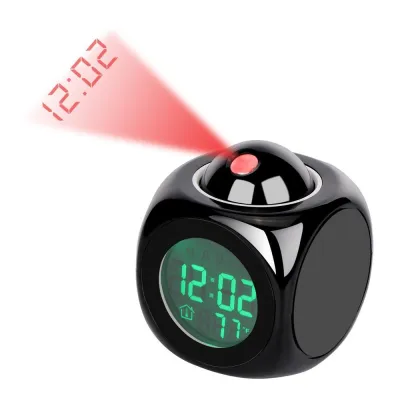
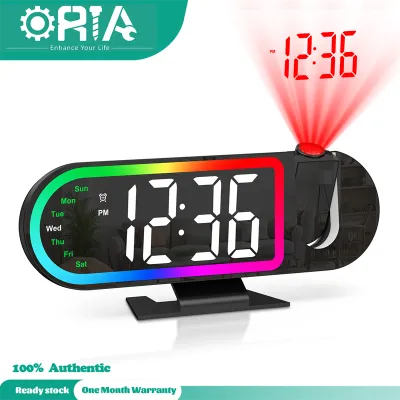
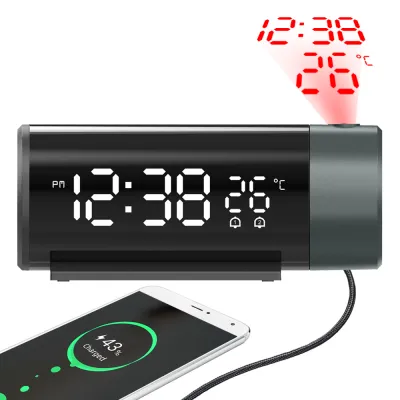
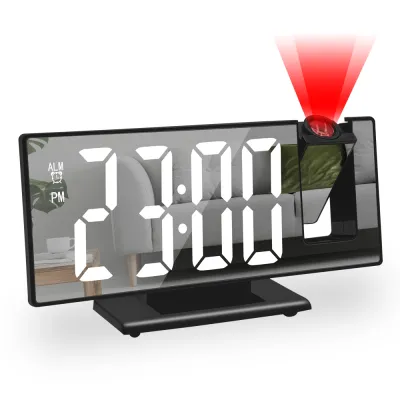
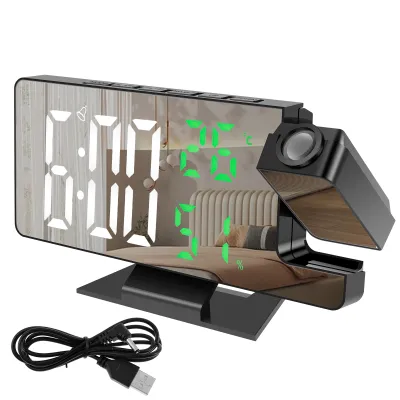
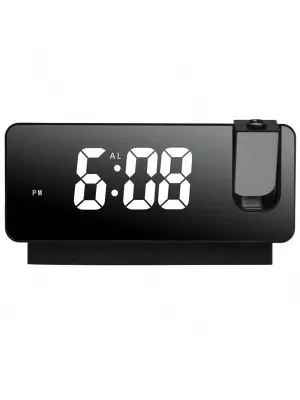
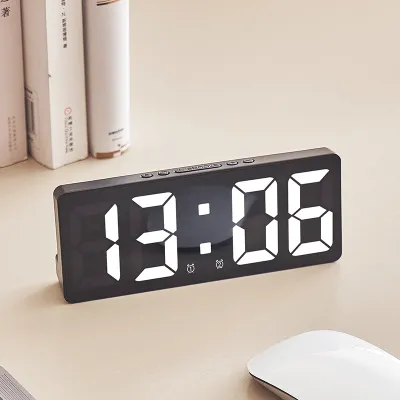
Prices are valid at publication and may change. Please refer to the product page for the latest price.
Power configuration is another critical decision point. Continuous plug-in models are the standard for projection clocks because casting a constant light beam requires a steady flow of electricity. Battery-operated models exist but are typically designed for travel or temporary use, often requiring you to press a button to activate the projection for only a few seconds to conserve power. For a permanent bedside setup, a plug-in model with a button-cell battery backup to save your time settings during a power outage is the most practical choice. This hybrid setup ensures that even if your home experiences a brief power interruption, your alarms and time settings remain intact.
How to Verify Brand Reliability and Product Quality
When shopping on Singaporean ecommerce platforms, distinguishing between established electronics brands and generic white-label products is essential for long-term satisfaction. Established brands invest in custom tooling, high-grade optical lenses, and robust internal circuitry. In contrast, white-label products are often mass-produced by third-party factories and sold under various rotating brand names. These generic models frequently suffer from lower-quality LEDs that dim rapidly over a few months of continuous use, eventually rendering the projection feature useless.

To assess a brand’s reliability, look closely at long-term user reviews rather than just the initial five-star ratings. Pay attention to feedback regarding common failure points. For instance, check if users report that the motorized projection arm becomes loose over time, causing the image to drift or sag. Screen burn-in on the main LCD or LED display and premature dimming of the projection bulb are also frequent complaints on poorly engineered models. A reliable brand will use high-grade components that maintain their brightness and structural integrity over years of daily adjustment.
Warranty terms and local distributor support are strong indicators of a brand’s commitment to quality. A reliable brand will offer a clear warranty period—ideally managed by an authorized distributor in Singapore. This ensures that if the device fails, you have a physical address or a local customer service channel to contact for a replacement or repair, rather than dealing with international shipping costs that exceed the value of the clock itself. Check if replacement parts, such as power adapters or backup battery covers, are easily accessible. Brands that stand behind their products typically offer at least a 12-month warranty and provide clear instructions on how to claim support locally.
Matching Clock Projectors to Your Room and Needs
Your choice of clock projector should align closely with the specific room environment and your personal sleep habits. For a primary bedroom setup, light control is the most critical factor. Many sleep experts recommend projection clocks that use red or amber light, as these wavelengths are less disruptive to circadian rhythms and preserve night vision compared to bright blue or white light. The clock must also operate silently; mechanical ticking or a buzzing transformer can easily disrupt a quiet sleeping environment. Ensure the buttons have a soft, quiet click so that adjusting the alarm in the middle of the night does not wake your partner.
In a child’s bedroom, safety and simplicity take precedence. Look for clock projectors constructed from durable, impact-resistant plastics that can withstand accidental drops from a nightstand. The user interface should be intuitive, with large, clearly labeled buttons that allow children to easily turn off alarms or toggle the projection. Ensure the power cord is securely connected and that any battery compartments are locked with screws to prevent young children from accessing small button-cell batteries. Some children’s models also include gentle nightlight features or playful projection designs, which can help soothe children who are afraid of the dark.
If you plan to place the clock on a desk, high shelf, or non-traditional angle, physical footprint and adjustment flexibility become your primary concerns. A compact footprint ensures the clock does not crowd your workspace. The projection arm should offer a wide range of motion—ideally 180 degrees of rotation—allowing you to project the time onto a distant wall or a sloped ceiling. Manual focus wheels are also essential for these setups, as they let you sharpen the image regardless of the projection distance. This flexibility is particularly useful in modern Singaporean apartments where layout constraints might require placing the clock on a shelf opposite the bed rather than on a traditional bedside table.
What to Check Before Buying Online or In-Store
Before finalizing your purchase, you must verify several technical and logistical details to ensure the clock projector operates safely and effectively in your Singapore home. First and foremost is electrical compatibility. Singapore operates on a 230V supply voltage at 50Hz. Ensure the power adapter supplied with the clock is rated for this voltage and features a standard Type G three-pin plug. Avoid using uncertified adapters or relying on flimsy travel adapters for a device that remains plugged in continuously. Look for local safety certifications, such as the Safety Mark, which indicates the power supply has been tested and approved for safe local use. Purchasing parallel imports from regions with different voltage standards can lead to overheating, short circuits, or premature device failure.
Next, measure the intended projection distance in your room. Most clock projectors have an optimal projection range, typically between 1 and 3 meters. If your ceiling is exceptionally high or if you plan to project across a large room, the image may become too dim or blurry to read. Additionally, consider the surface texture and color of your walls or ceiling. Matte, light-colored surfaces provide the best contrast, while dark, textured, or highly reflective surfaces can distort or absorb the projected light. If your bedroom features dark accent walls or textured wallpaper, you may need to adjust the projection angle to target a plain, light-colored ceiling instead.
Finally, scrutinize the seller’s credentials, especially when purchasing online. Verify whether the seller is an authorized dealer for the brand in question. Authorized sellers are much more likely to honor warranties and provide genuine products. Review the return policy carefully; a reputable seller should offer a clear window for returns or exchanges if the product arrives with dead pixels, a faulty projection bulb, or a damaged power adapter. Taking these precautions ensures that your investment is protected and that you receive a high-quality, safe device that meets your expectations.
Frequently Asked Questions (FAQ)
Do clock projectors work well in brightly lit rooms?
No, clock projectors are not designed for high-ambient-light environments. The LED light source used in these devices is optimized for dark or dimly lit rooms. In a brightly lit room or under direct sunlight, the ambient light will wash out the projection, making it difficult or impossible to read. For the best visibility, use the projection feature at night or in rooms with effective blackout curtains.
Can I adjust the projection angle and focus?
Yes, most reputable clock projectors feature adjustable projection heads and manual focus mechanisms. The projection arm typically rotates forward and backward, allowing you to position the image on the wall or ceiling. A manual focus wheel or dial is usually located near the lens, enabling you to sharpen the digits based on the specific distance between the clock and the projection surface.
Are battery-operated models as bright as plug-in ones?
Generally, no. Battery-operated clock projectors are designed to conserve power, so they usually feature lower-intensity projection bulbs or require you to press a button to temporarily project the time. Plug-in models draw continuous power from an electrical outlet, allowing them to maintain a much brighter, sharper, and constant projection without draining batteries.
Community discussion
Share your experience or ask a question. Comments are reviewed before publication.