
Finding a tea-scented reed diffuser that maintains its crisp, soothing aroma over several months in Singapore can be a challenging task. Many homeowners purchase a promising green tea or white tea diffuser, only to find the liquid depleted within weeks or the scent faded into a faint memory. Because scent longevity depends on complex interactions between formulation, reed material, and room environment, identifying the most enduring option requires evaluating specific product specifications rather than relying on generic marketing claims. This guide provides the framework to assess, select, and maintain tea diffusers effectively in local conditions, ensuring your living space remains beautifully perfumed without constant, costly replacements.
What Determines Reed Diffuser Longevity?
To understand why some diffusers last for months while others dry up in weeks, it is essential to look at the mechanical and chemical factors that dictate how long a diffuser’s liquid and scent will last. The primary driver of longevity is the base liquid volatility. The carrier liquid is the solvent that holds the fragrance oils and helps them travel up the reeds. Alcohol-based carriers, such as ethanol or isopropyl alcohol, evaporate rapidly. While they offer a strong, immediate burst of scent, they deplete the bottle quickly. On the other hand, heavier oil-based or glycol-based solutions, such as dipropylene glycol (DPG) or Dowanol, evaporate at a much slower, more controlled rate, allowing the diffuser to last significantly longer.
The reed material and its porosity also play a critical role in how liquid is absorbed and released. Natural rattan reeds contain dozens of tiny, open vascular channels that draw liquid upward via capillary action. However, because rattan is an organic material, these channels can vary in size and are prone to clogging over time by dust or heavy fragrance oils. Synthetic fiber reeds are engineered with highly uniform, porous structures. They tend to wick liquid faster and more consistently than rattan, which can provide a stronger scent throw but may also consume the liquid at a slightly faster rate. Wood or bamboo reeds are much denser and less porous, often resulting in a very slow, muted release that may not adequately disperse lighter tea scents.
Products mentioned in this guide
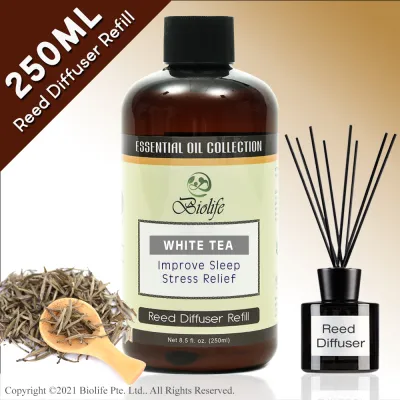
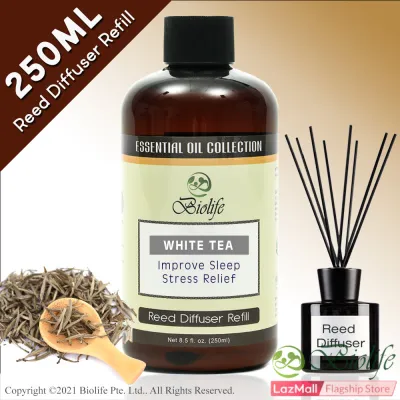
![Biolife White Tea scent Reed Diffuser Refill (250ml) with glass reed diffuser and reed stick Essential Oil Aromatherapy Long Lasting Scent [BD]](https://img.lazcdn.com/g/p/7efc91a6e6af08c47448a83faf5dd2ca.jpg_400x400q80.jpg_.webp)
Prices are valid at publication and may change. Please refer to the product page for the latest price.
Finally, the fragrance oil concentration determines the balance between scent intensity and liquid lifespan. Premium diffusers typically feature a fragrance oil concentration of 15% to 25%. While a higher concentration of pure fragrance oil can extend the liquid’s life because the oils themselves evaporate slower than the carrier solvent, it also increases the viscosity of the mixture. If the formulation is too thick, the reeds may struggle to wick the liquid efficiently, leading to a weak scent throw despite a full bottle. Conversely, a low oil concentration evaporates quickly, leaving you with an empty vessel in a matter of weeks.
Choosing Tea Scent Notes for Lasting Power
When searching for a tea scent diffuser that lasts, the specific fragrance profile you choose is just as important as the chemical carrier. Fragrance formulation relies on a fragrance pyramid consisting of top, middle, and base notes, each evaporating at different rates. Top notes, such as citrus (bergamot, lemon, mandarin) or light green tea accords, consist of small, highly volatile molecules. These notes provide the initial, refreshing burst when you first open the bottle, but they dissipate into the air almost immediately.

Middle notes, often referred to as the heart of the fragrance, include floral or herbal elements like jasmine, chamomile, oolong tea, or white tea. These notes linger for several hours, forming the core character of the scent. The true longevity of a diffuser, however, relies on its base notes. Base notes consist of heavy, complex molecules that evaporate very slowly over days and weeks. In tea-scented profiles, these are typically represented by black tea, smoked lapsang souchong, cedarwood, amber, patchouli, or woody musk. These heavy compounds act as fixatives, anchoring the lighter tea and citrus notes and slowing down their overall evaporation rate.
To identify a long-lasting option, you must learn to read product labels and online descriptions carefully. Look past the front marketing name and examine the detailed fragrance notes. A diffuser labeled simply as “Fresh Green Tea” with top notes of mint and lemon will likely lose its potency much faster than a “Black Tea & Cedarwood” or “Smoked Oolong” blend that explicitly lists heavy base notes.
This highlights a key trade-off between scent throw and sustained longevity. A highly volatile, citrus-heavy green tea diffuser will fill a large living room instantly but empty the bottle rapidly. A well-formulated, long-lasting tea diffuser is designed to provide a consistent, low-intensity background aroma that gently perfumes the space over several months, rather than an overwhelming burst that quickly fades.
Adapting to Singapore's Indoor Environments
Singapore’s tropical climate presents a unique set of environmental factors that directly impact how reed diffusers perform. High ambient temperatures and high relative humidity alter both the evaporation rate of the carrier liquid and how the scent molecules travel through the air. High heat increases the kinetic energy of the liquid molecules, causing them to evaporate much faster than they would in cooler, temperate climates.
The widespread use of air conditioning in Singaporean homes further complicates this dynamic. While air conditioning cools the indoor air, it also dehumidifies it. This dry, cooled air acts like a sponge, drawing moisture out of the exposed reeds and accelerating the consumption of the diffuser liquid. Paradoxically, cold air also suppresses the volatility of fragrance molecules, meaning you might find your diffuser depleting rapidly while the actual scent throw feels weaker than usual. Additionally, the transition between air-conditioned periods and natural ventilation creates thermal cycles that can cause the reeds to dry out and clog more quickly.
To combat these environmental challenges, strategic placement is essential. Keep your tea scent diffuser away from direct sunlight, such as on window sills, as UV rays and heat degrade the fragrance oils and accelerate evaporation. Avoid placing the diffuser directly in the path of active air currents, including ceiling fans, standing fans, and air-conditioning vents. While these currents help disperse the scent, they do so by drastically speeding up liquid depletion. Instead, place the diffuser in a high-traffic area with gentle, natural air movement, such as a hallway, entryway, or the center of a living room, where passing footsteps naturally circulate the aroma without drying out the reeds.
Verifying Brand Specifications and Labels
Before purchasing a tea scent diffuser from a local boutique or an online marketplace, it is crucial to evaluate product claims to ensure you are getting true value. Many brands make ambitious claims about how long their products last, but a quick cross-reference of the liquid volume (measured in milliliters) against the estimated lifespan can help you spot unrealistic promises. A standard 100ml diffuser typically lasts between 4 to 8 weeks under normal conditions. If a brand claims a 100ml bottle will last six months in Singapore’s climate, this is highly unlikely unless the formula is so viscous that it barely diffuses at all.
Ingredient transparency is another key indicator of quality. Reputable brands often disclose their carrier bases, highlighting the use of non-toxic, low-volatility solvents like dipropylene glycol (DPG) or bio-based alternatives. Be cautious of brands that use vague terms like “proprietary diffuser base” or fail to mention if their formula contains high percentages of alcohol, which will shorten the product’s lifespan.
To find the true value of a diffuser, calculate the cost per month in S$ rather than focusing solely on the upfront retail price. For example, a premium S$60 diffuser containing 200ml of high-quality, slow-evaporating oil that lasts four months costs S$15 per month. A cheaper S$20 diffuser containing 100ml of alcohol-based liquid that evaporates in three weeks costs over S$26 per month to maintain.
Use the following specification verification checklist to evaluate products before making a purchase:
| Specification | What to Look For | Red Flags |
|---|---|---|
| Volume (ml) | 100ml to 200ml for standard rooms; clear bottle markings. | Unusually small volumes (under 50ml) claiming multi-month lifespans. |
| Carrier Type | Low-volatility glycol, DPG, or bio-based solvents. | High alcohol content listed first; vague "perfume base" descriptions. |
| Reed Count & Type | 5 to 8 high-quality rattan or engineered synthetic fiber reeds. | Too few reeds (under 3) or cheap, highly irregular bamboo sticks. |
| Estimated Lifespan | Realistic estimates (e.g., 100ml for 1–2 months). | Exaggerated claims (e.g., 100ml lasting over 4 months in open air). |
Maintenance Routines to Extend Scent Life
Maximizing the lifespan and performance of your tea scent diffuser does not stop at the purchase stage; it requires a consistent, low-risk maintenance routine. The most important practice is a proper reed flipping protocol. To maintain a steady scent throw without accelerating evaporation, flip the reeds once every one to two weeks. Avoid flipping them daily, as this exposes the wet ends to the air too frequently, causing the liquid to evaporate much faster. When flipping, always use a paper towel to grip the reeds to prevent transferring oils to your skin or dripping liquid onto your furniture.
Over time, reeds become fully saturated with fragrance oils and can collect airborne dust, which blocks the microscopic capillaries. If you notice the scent has faded but the bottle is still half-full, do not throw away the liquid. Instead, replace the old reeds with a fresh set of the same material. This simple step can instantly revive the diffusion process.
Safe handling is also critical to protect your home environment. Always place your diffuser on a protective coaster or tray, preferably made of ceramic, glass, or metal. Diffuser liquids can easily damage varnished wood, plastic, or painted surfaces if spilled. Keep the bottle on a stable, level surface out of reach of children and pets. If you need to clean the bottle or change the reeds, do so over a sink to prevent accidental spills.
Frequently Asked Questions (FAQ)
Can I mix different tea scent diffuser brands in the same room?
Mixing different tea scent diffuser brands in the same room is generally not recommended if you want a clean, cohesive aroma. Different brands use distinct fragrance pyramids; for example, mixing a smoky lapsang tea diffuser with a sweet, citrusy green tea diffuser can create discordant olfactory notes that clash rather than complement each other. Additionally, placing multiple diffusers close together does not extend their individual lifespans; it simply increases the concentration of fragrance molecules in the air, which can quickly overwhelm a standard-sized room.
Why does my tea diffuser smell weak after a few weeks?
A sudden drop in perceived scent strength is often caused by olfactory fatigue, commonly known as nose blindness. Your brain naturally filters out constant, unchanging background smells to remain sensitive to new environmental cues. To test if this is the case, step out of the room or your home for a few hours; if the scent is noticeable when you return, your diffuser is working fine. If the scent is truly weak, check the reeds for dust accumulation or dried liquid blockages, and flip or replace them to restore capillary action.
Are fiber reeds better than rattan for tea scents?
Fiber reeds and natural rattan reeds each have distinct advantages depending on the viscosity of the tea fragrance liquid. Synthetic fiber reeds are highly porous and wick liquid rapidly and uniformly, making them excellent for lighter, water-based, or glycol-based tea scents where a strong, immediate throw is desired. Natural rattan reeds wick more slowly due to their organic vascular structure, making them better suited for heavier, oil-based tea formulations where a slow, steady release is preferred. Always check the manufacturer’s recommendation, as they typically supply the reed type best matched to their specific carrier liquid’s viscosity.

Community discussion
Share your experience or ask a question. Comments are reviewed before publication.