
Upgrading your lighting is one of the most straightforward ways to lower your household utility expenses. Among the various plug-in compact fluorescent lamps (CFLs) commonly found in recessed downlights, the G24D base is a frequent sight in residential corridors, kitchens, and commercial spaces. G24D LED bulbs generally consume less wattage for the same light output and last significantly longer than traditional CFLs, making them the superior choice for long-term electricity savings. However, the exact financial benefit depends on your specific usage hours, local electricity tariffs, and whether your existing G24D fixtures require ballast bypassing. This guide provides the framework to calculate your actual savings, navigate installation requirements, and determine if upgrading is the right move for your space.
Check Your Fixture: G24D Pin Configurations and Fit
Before purchasing any replacement bulbs, you must verify the physical and electrical compatibility of your existing fixtures. The G24D designation refers to a plug-in base with two pins, but these bases come in several distinct sub-types, such as G24d-1, G24d-2, and G24d-3. Each sub-type features a unique plastic keying guide block in the center. If you purchase a G24d-1 LED bulb for a G24d-2 socket, the physical plastic tabs will prevent the bulb from sliding into place. To avoid installation issues, remove your current CFL bulb and inspect the base or check the label inside the fixture housing to identify the exact pin configuration.
Physical dimensions are another critical factor when transitioning from CFL to LED. Traditional G24D CFLs consist of thin glass tubes, whereas LED replacements require integrated drivers and metal or plastic heat sinks to dissipate heat. These heat sinks often make the LED bulb wider or longer than the original fluorescent tube. Measure the internal depth and diameter of your downlight canister or fixture housing before buying. If the fixture is too narrow, a bulky LED bulb may not fit, or it may lack the ventilation required to prevent heat buildup, which can prematurely degrade the LED driver.
Products mentioned in this guide
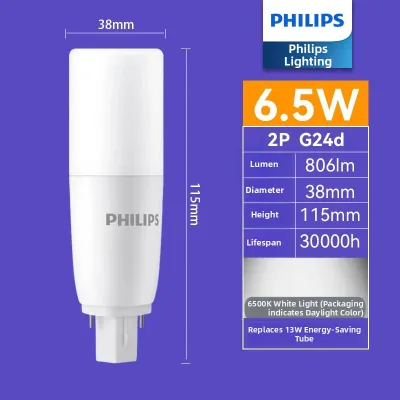
![[3 Year Warranty] Philips LED Vertical PLC PL-C G24D 6.5W Light Bulb (Warm White / Cool White / Cool Daylight)](https://img.lazcdn.com/g/p/7f847a8d326564d046487338afa327b3.jpg_400x400q80.jpg_.webp)
![[Authorized Dealer] Philips LED PL-C 2Pin G24D 7.5W | 9W](https://img.lazcdn.com/g/p/00bd40b976dfdaeffe0c196f9263de83.jpg_400x400q80.jpg_.webp)
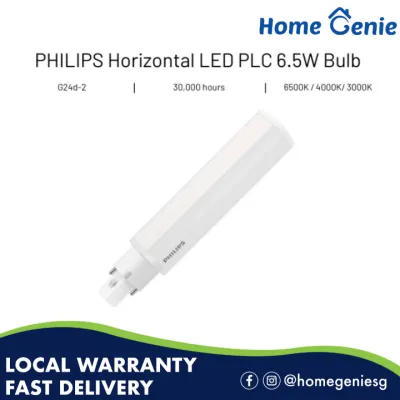
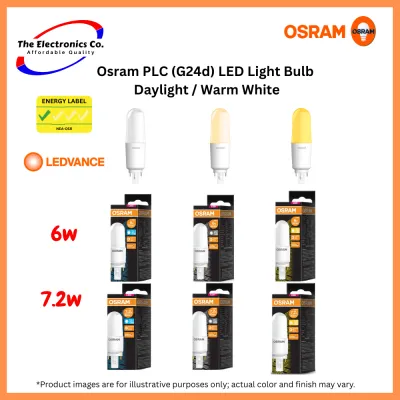
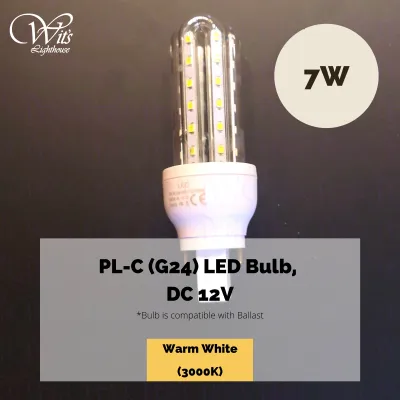
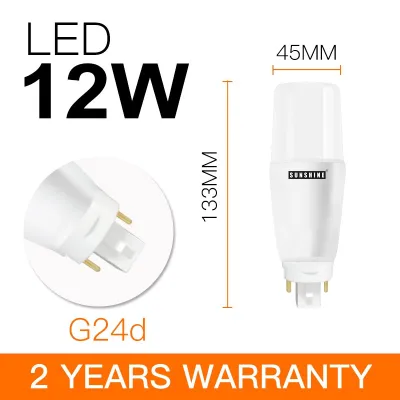
Prices are valid at publication and may change. Please refer to the product page for the latest price.
Additionally, you must verify the electrical specifications of the replacement bulb. Check that the voltage rating matches your local electrical supply, which is typically 230V in Singapore. Ensure the bulb carries recognized electrical safety certifications to guarantee it has undergone rigorous testing. Mismatching the pin layout, exceeding the fixture’s maximum wattage limit, or forcing an incompatible base into the socket can permanently damage the fixture and create electrical hazards.
Energy Use and Brightness: Matching Lumens, Not Just Watts
To evaluate how much electricity you can save, you must shift your focus from wattage to lumens. Wattage measures the amount of electrical power a bulb consumes, while lumens measure the actual amount of visible light emitted. Traditional CFLs require higher wattage to produce the same brightness that modern LEDs can achieve with a fraction of the power. When shopping for a G24D LED, look at the lumen output of your current CFL and find an LED that matches or slightly exceeds that number, rather than trying to match the old wattage rating.

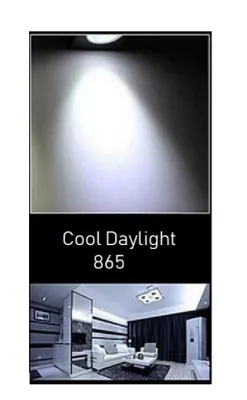
Light appearance, or color temperature, is another essential consideration that affects the ambiance of your space. Read the lighting facts label on the packaging to verify the color temperature, measured in Kelvins (K). For spaces where you prefer a warm, cozy atmosphere, such as living rooms or bedrooms, look for bulbs rated around 2700K to 3000K. For task-oriented areas like kitchens, study rooms, or commercial corridors, a cool white or daylight appearance of 4000K to 6500K may be more appropriate. Matching these values ensures your new energy-efficient lighting maintains the desired visual comfort.
The physical distribution of light also plays a major role in overall efficiency. CFL bulbs are omnidirectional, meaning they emit light in a 360-degree pattern. In a recessed downlight, much of this light is directed upward or sideways into the fixture housing, relying on internal reflectors to bounce the light downward. Over time, these reflectors accumulate dust and degrade, reducing the usable light. Many G24D LED bulbs are directional, focusing their light output downward in a 120-degree to 180-degree beam angle. This directional nature means less light is wasted inside the fixture, allowing a lower-lumen LED to deliver the same perceived brightness on your floors and work surfaces as a higher-lumen CFL.
Total Cost of Ownership: Upfront Price vs. Replacement Frequency
To determine whether upgrading to G24D LEDs is financially viable, you need to look beyond the initial purchase price and calculate the total cost of ownership. While LEDs generally carry a higher upfront cost in S$ compared to traditional CFLs, their long-term operational savings often offset this initial investment. To calculate your specific savings, you will need three primary variables: the purchase price of the bulbs, your estimated daily usage hours, and your current electricity tariff.
You can estimate your annual electricity cost for a single bulb using a straightforward formula: multiply the bulb’s wattage by your average daily operating hours, multiply by 365 days, divide by 1,000 to convert to kilowatt-hours (kWh), and then multiply by your local electricity tariff in S$ per kWh. By running this calculation for both your existing CFL and the prospective G24D LED, you can clearly see the annual difference in your utility bill. For fixtures that remain illuminated for long periods, such as security lights or commercial common areas, these savings accumulate rapidly.
Longevity is the second major component of the financial equation. Check the manufacturer-rated lifespan on the packaging of both bulb types. LEDs typically boast a rated lifespan that is several times longer than that of standard CFLs. This means that over the operational life of a single G24D LED bulb, you might need to purchase and install multiple replacement CFLs.
In addition to the direct cost of buying replacement bulbs, you must factor in the hidden labor and inconvenience of frequent bulb changes. This is particularly important for bulbs installed in hard-to-reach areas, such as high ceilings, stairwells, or busy commercial corridors. If you must hire a technician or spend valuable time setting up tall ladders to replace burnt-out CFLs, the maintenance savings of a long-lasting LED can quickly surpass the energy savings alone.
The Ballast Factor: Plug-and-Play vs. Direct-Wire Installation
One of the most critical technical hurdles when upgrading G24D fixtures is dealing with the legacy ballast. Traditional fluorescent fixtures contain an electrical ballast to regulate the current flowing through the CFL. G24D fixtures, which typically feature a 2-pin socket, almost always utilize older magnetic ballasts. Before purchasing an LED replacement, you must determine whether the bulb is designed to work with your existing ballast or if it requires direct-wire installation.
Plug-and-play (Type A) G24D LEDs are designed to slide directly into your existing fixture without any wiring modifications. While this offers a quick and simple installation, it comes with trade-offs. The legacy ballast will continue to draw a small amount of residual power, known as ballast loss, which slightly reduces your overall energy savings. Furthermore, if the old ballast eventually fails, the LED bulb will stop working, and you will be forced to either replace the ballast or bypass it anyway.
Direct-wire (Type B) G24D LEDs bypass the ballast entirely, connecting the bulb directly to the mains voltage. This method maximizes energy efficiency by eliminating ballast loss and removes a common point of electrical failure. However, bypassing a ballast requires modifying the fixture’s internal wiring.
Because direct-wire installation involves working with fixed electrical wiring, safety is paramount. Always isolate the power at the main distribution board or consumer unit before attempting any electrical work. Because modifying a light fixture carries inherent risks of short circuits, electrical shock, or fire if done incorrectly, this task should only be performed by a licensed electrician or qualified professional. Ensuring compliance with local electrical standards protects your property and guarantees a safe, reliable installation.
The Verdict: When to Switch to G24D LED and When to Wait
Deciding whether to upgrade your G24D bulbs immediately or maintain your current setup depends on several practical and financial conditions.
You should choose to switch to G24D LEDs immediately if you have fixtures in high-use areas where lights remain on for several hours a day, as this maximizes your electricity bill savings. Upgrading is also highly recommended if your current bulbs are located in hard-to-reach spots where maintenance is difficult, or if you are already planning to hire an electrician for other home improvements and can easily bundle the ballast-bypass work.
Conversely, you may want to stick with your current CFLs or wait to upgrade if the fixtures are located in rarely used spaces, such as guest rooms or storage closets, where the low usage hours mean it would take years to recoup the upfront cost of the LED. Additionally, if you are renting your property and do not have authorization to make permanent electrical modifications, or if the entire downlight fixture is outdated and due for a complete aesthetic replacement, waiting to install an entirely new integrated LED luminaire may be the more practical choice.
Before making any final decisions, always verify the technical details of your setup. Check your fixture’s ballast type, confirm the exact G24D pin configuration, and ensure the LED bulb you select is rated for your specific installation environment, such as enclosed downlight canisters. Taking these precautionary steps ensures your transition to energy-efficient lighting is safe, cost-effective, and successful.
Community discussion
Share your experience or ask a question. Comments are reviewed before publication.