
When searching for the perfect signature scent for your home, the ion orchard diffuser—inspired by the crisp, luxurious, tea-and-fruit aroma that wafts through Singapore’s premier shopping mall—is a highly sought-after luxury. But before investing your hard-earned money, a critical question arises: how long does an ion orchard diffuser actually last in a real-world home environment? While many premium home fragrances promise months of continuous aroma, the actual lifespan of your diffuser depends heavily on physical, chemical, and environmental factors. Understanding these variables allows you to set realistic expectations and ensure your living space remains beautifully scented without prematurely draining your wallet.
Expected Scent Duration and Real-World Variables
When evaluating the lifespan of a premium home fragrance product, it is helpful to establish a baseline. Under controlled laboratory conditions, a standard 100ml reed diffuser typically lasts between four to eight weeks, while a larger 200ml vessel can extend up to twelve to sixteen weeks. However, these estimates are general industry standards and can vary dramatically when placed inside a real-world home. The rate at which the fragrance oil is drawn up the reeds and dispersed into your room depends on several physical and chemical factors that go far beyond simple bottle volume.
One of the most critical determinants of diffuser longevity is the chemical formulation of the carrier liquid. High-quality diffusers utilize specialized, alcohol-free carrier solvents such as dipropylene glycol (DPG) or Dowanol. These solvents have a low vapor pressure, meaning they evaporate slowly and steadily, allowing the fragrance molecules to be released gradually over a longer period. Conversely, cheaper diffusers often rely on alcohol-based carriers. While alcohol provides an immediate, highly intense burst of fragrance, it flashes off rapidly, depleting the bottle in a fraction of the time and leaving behind a faint, flat scent profile.
Products mentioned in this guide
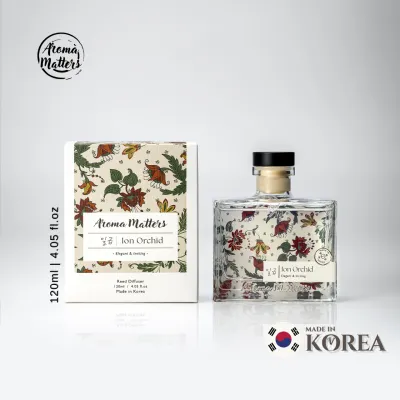
Prices are valid at publication and may change. Please refer to the product page for the latest price.
It is also vital to distinguish between “scent throw” and “liquid depletion.” Scent throw refers to how effectively the fragrance molecules travel through the air to fill a room, whereas liquid depletion is the physical reduction of the liquid level inside the bottle. A common issue users encounter is a diffuser that still contains liquid but has stopped throwing any scent. This occurs because the lighter, highly volatile top notes of the fragrance oil evaporate first, leaving behind the heavier, less volatile base oils and carrier solvents. These heavier molecules can saturate and clog the reeds, preventing the remaining fragrance from evaporating effectively. Therefore, judging a diffuser’s lifespan solely by the liquid level can be misleading.
Key Factors That Affect Your Ion Orchard Diffuser Longevity
To understand how your ion orchard diffuser will perform, you must look at the specific environment in which it is placed and how the physical apparatus is managed. Evaporation is a thermodynamic process, meaning it is directly influenced by the surrounding air, temperature, and physical barriers.

Environmental Conditions in Singapore
Living in Singapore presents a unique set of atmospheric challenges for home fragrance products. The island’s tropical climate is characterized by high ambient temperatures, often hovering between 26°C and 32°C, and relative humidity levels that frequently exceed 80%. While high humidity generally slows down the evaporation of water, it behaves differently with oil-based reed diffusers. The elevated ambient heat increases the kinetic energy of the fragrance oil molecules, causing them to evaporate much faster than they would in cooler, temperate climates.
Furthermore, the indoor climate control of your Singaporean home plays a massive role in how fast your diffuser depletes. In a room that is consistently air-conditioned, the relative humidity is artificially lowered, and the air is kept in constant motion by the unit’s fan. This dry, moving air draws moisture and volatile oils out of the reeds at an accelerated rate, significantly shortening the lifespan of the product. On the other hand, placing the diffuser in a naturally ventilated room with open windows exposes it to Singapore’s natural heat and outdoor breezes. While this can create a pleasant, occasional draft of scent, the high heat and strong wind currents will also cause the oil to evaporate rapidly and unevenly.
Reed Management and Placement
The physical mechanics of a reed diffuser rely entirely on capillary action, where the liquid climbs up the microscopic channels within the reeds and evaporates once it reaches the exposed surface. The number of reeds you choose to insert into the bottle acts as the primary throttle for both scent intensity and liquid depletion. If you place a full set of eight to ten reeds into a 100ml bottle, you will enjoy an incredibly rich and powerful scent throw that easily fills a large living room. However, this massive increase in surface area means the liquid will evaporate up to twice as fast as it would if you had only used four or five reeds.
Placement is another critical variable that can quietly sabotage your diffuser’s longevity. Positioning your diffuser in direct sunlight—such as on a sunny windowsill or near a balcony door—is highly detrimental. The ultraviolet (UV) rays from the sun can break down the complex chemical bonds of the fragrance oils, altering the scent profile and causing the glass bottle to heat up. This thermal energy accelerates evaporation dramatically. Similarly, placing the diffuser directly in the path of active air currents, such as next to an oscillating fan, directly under a ceiling fan, or right beside an air conditioning vent, will strip the oil from the reeds faster than the capillary action can naturally replenish it, leading to premature dry-out.
Practical Steps to Maximize Scent Longevity
To get the absolute most value out of your premium home fragrance, you do not have to settle for a weak scent throw. By implementing a few simple, low-risk maintenance habits, you can significantly extend the lifespan of your diffuser while maintaining a consistent aromatic presence in your home.
First, manage your reed-flipping routine with care. Many people believe that flipping the reeds every day is the best way to keep the scent strong. However, this practice is highly inefficient. Every time you flip the reeds, you expose a fully saturated end to the air, which causes an immediate flash-evaporation of the fragrance oil, rapidly depleting your bottle. Instead, aim to flip your reeds only once every one to two weeks, or only when you notice the scent throw beginning to fade naturally. When flipping, always use a paper towel to grip the reeds to prevent the concentrated oils from getting onto your skin or dripping onto delicate wooden furniture, which can cause permanent staining or damage.
Second, customize the number of reeds based on the specific dimensions of the room. A common mistake is using a full bundle of reeds in a small, enclosed space like a bathroom or a study. In these compact environments, the air quickly becomes saturated with fragrance, and the excess evaporation is simply wasted. For smaller rooms, start with just three to four reeds. You will find that this provides a subtle, pleasant aroma while doubling the lifespan of the liquid. For larger, open-concept living areas, you can gradually add more reeds until you achieve the desired balance of scent throw and longevity.
Finally, maintain the cleanliness of your diffuser vessel. Over time, dust and airborne particles settle on the neck of the bottle and the exposed parts of the reeds, creating a sticky barrier that hinders capillary action. Periodically wipe the neck of the bottle with a clean, dry cloth. If you plan to travel or leave your home unoccupied for an extended period—a common occurrence during school holidays or long weekends in Singapore—take a moment to pause your diffuser. Remove the reeds, place them on a protected tray, and seal the bottle tightly with its original plastic stopper or screw cap. This simple step halts evaporation entirely, ensuring your precious fragrance oil is preserved for your return.
Signs It Is Time to Replace or Refill Your Diffuser
Even with meticulous care, every reed diffuser will eventually reach the end of its functional life. Recognizing the clear visual and olfactory signs of depletion will help you decide when it is time to take action rather than leaving an ineffective bottle on your shelf.
The most obvious sign is, of course, the physical liquid level. When the fluid drops to the bottom ten percent of the bottle, the remaining liquid is often highly concentrated, viscous, and dark. This residue consists of the heaviest base notes and carrier solvents that are too heavy to climb up the reeds. At this stage, even flipping the reeds will yield very little scent throw. Another clear indicator is the physical state of the reeds themselves. Over months of continuous use, the microscopic pores of rattan or fiber reeds become clogged with dust, pet dander, and microscopic debris from the air, as well as crystallized fragrance compounds. If your reeds look dark, dusty, or feel greasy and saturated but no longer emit a fragrance, they have lost their capillary capacity.
When you reach this point, it is crucial to understand the difference between needing a simple liquid refill and needing a completely new setup. Many brands offer cost-effective refill bottles of their signature scents. However, pouring fresh oil into a vessel with old, clogged reeds is a recipe for disappointment. The old reeds will fail to draw up the fresh oil, and you will find that the scent throw remains weak. To ensure optimal performance, always pair a fresh liquid refill with a brand-new set of reeds. This restores the capillary action to its maximum efficiency and ensures your home is filled with the crisp, clean notes of the fragrance once again.
Evaluating the Value: Is the Price Point Justified?
Investing in a premium home fragrance is as much a financial decision as it is an aesthetic one. To determine whether the price point is justified for your household budget, it helps to establish a practical cost-per-month framework. Suppose a premium 100ml diffuser set costs S$40 initially. If, through proper placement and reed management, you successfully extend its lifespan to two full months, your cost of home scenting is S$20 per month. However, the economics become even more favorable when you look at subsequent purchases. By reusing the decorative glass vessel and purchasing only scent refills (which typically cost around S$20 to S$30) along with a fresh pack of reeds, your ongoing monthly cost can drop to as low as S$10 to S$15.
When compared to alternative home fragrance methods, reed diffusers offer a highly competitive value proposition. Scented candles, while atmospheric, require active supervision, pose a fire hazard in high-rise HDB flats or condominiums, and only emit fragrance when lit. A high-quality candle might burn for 40 hours, which translates to only a few weeks of intermittent use. Room sprays and electronic nebulizers provide immediate bursts of scent but require manual effort or electricity, and their effects dissipate within hours. A reed diffuser, by contrast, operates passively and continuously, providing a round-the-clock olfactory welcome without consuming electricity or requiring your active attention.
To objectively assess the quality and value of any diffuser before buying, always examine the product label or manufacturer specifications. Look for formulations that specify a high concentration of pure fragrance oils (ideally between 15% and 25%) and explicitly state the use of non-toxic, slow-evaporating carriers. Avoid products that list alcohol or water as primary ingredients, as these will deplete far too quickly to justify their cost. By choosing a high-concentration, alcohol-free formulation and managing it wisely, an ion orchard diffuser can easily prove to be a highly cost-effective luxury that transforms the ambiance of your Singaporean home.
Community discussion
Share your experience or ask a question. Comments are reviewed before publication.