
A MUJI reed diffuser is a popular choice for adding a subtle, continuous scent to your home, but planning your budget and repurchase schedule requires knowing exactly how long the fragrance oil will last. Under typical indoor conditions, a bottle of MUJI fragrance oil lasts anywhere from one to three months. The exact lifespan depends heavily on the volume of the bottle you purchase, the number of reeds you insert, and the specific climate of your living space.
In tropical environments like Singapore, where homes alternate between humid, naturally ventilated air and dry, air-conditioned drafts, evaporation rates can vary significantly. Understanding how these factors interact allows you to manage your diffuser more efficiently, ensuring you get the maximum scent throw without exhausting the oil prematurely.
Expected Lifespan of MUJI Fragrance Oil in a Reed Diffuser
When evaluating how long your MUJI fragrance oil will last, the most direct factor is the bottle volume. MUJI typically offers its home fragrances in two primary sizes: a smaller 60ml trial bottle and a standard 180ml bottle. As a baseline, the 60ml bottle generally provides scent for approximately three to six weeks, while the larger 180ml bottle is designed to last between two and three months.
Products mentioned in this guide
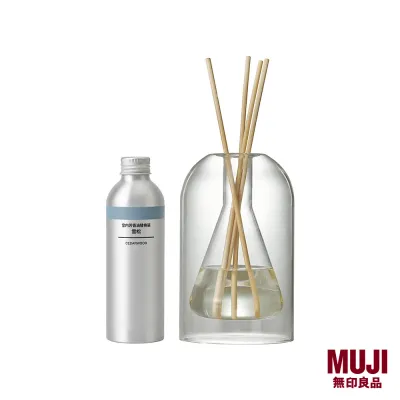
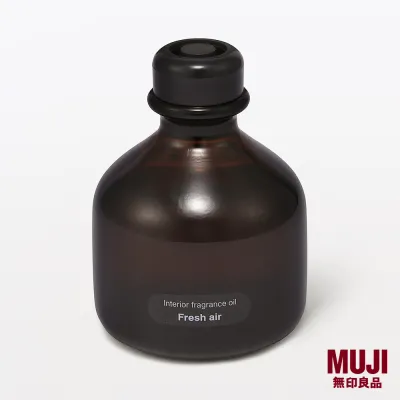
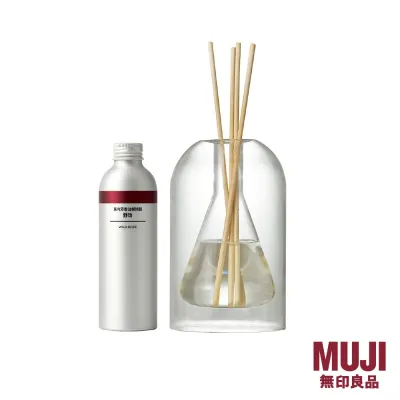
Prices are valid at publication and may change. Please refer to the product page for the latest price.
However, it is vital to distinguish between physical evaporation and active scent throw. Physical evaporation refers to the speed at which the liquid level in the glass vessel drops as the carrier solvents and essential oils travel up the reeds and disperse into the air. Scent throw, on the other hand, describes how effectively those dispersing molecules fill the room with a noticeable aroma. You might find that while there is still liquid visible in your bottle, the actual fragrance has weakened significantly because the highly volatile scent molecules have evaporated, leaving behind a less aromatic base.
Manufacturer estimates for diffuser lifespans are almost always calculated under highly controlled, ideal laboratory conditions. These standard tests assume a constant room temperature, moderate relative humidity, and minimal air movement. In a real-world home environment, these ideal parameters rarely exist. Daily household activities, varying ventilation setups, and seasonal climate shifts mean your actual usage duration will naturally fluctuate from these baseline estimates.
Key Factors That Influence Evaporation and Scent Throw
To understand why your diffuser might empty faster than expected, you must look at the physical and environmental forces acting upon the oil. The rate of diffusion is not a fixed constant; it is a dynamic process governed by your setup and your indoor climate.

Number and Material of Reeds
The reeds act as microscopic straw-like channels that draw the oil upward via capillary action. Inserting more reeds increases the total surface area available for the oil to meet the air, which naturally accelerates the evaporation rate. If you use the entire bundle of eight reeds provided in a standard MUJI set, the oil will disappear much faster than if you use only three or four. Additionally, the material of the reeds matters; highly porous natural rattan reeds wick oil steadily but can become saturated or clogged over time, whereas synthetic fiber reeds may draw oil even more rapidly, intensifying the scent but shortening the oil’s lifespan.
Airflow and Room Temperature
Temperature is a primary driver of evaporation. In a tropical climate like Singapore, ambient indoor temperatures are naturally warm, which excites the fragrance molecules and causes them to evaporate quickly. Conversely, running a constant air-conditioning unit introduces a different set of variables. While cooler air can slightly slow down evaporation, the air coming from an AC unit is also exceptionally dry. This low humidity combined with active air currents can strip moisture and volatile oils from the reeds at an accelerated rate, sometimes causing the liquid level to drop surprisingly fast.
Humidity Levels
High ambient humidity can heavily influence how you perceive the fragrance. When the air is saturated with moisture, it becomes heavier, which can suppress the dispersion of lighter fragrance molecules. Even though the oil is physically evaporating from the bottle, the scent may feel thick, stagnant, or barely noticeable in a highly humid, un-air-conditioned room. This often prompts users to add more reeds, inadvertently speeding up oil consumption when the real issue is air circulation.
Placement and Room Size
Where you place your diffuser determines how quickly the air carries the scent away. A diffuser positioned in a high-traffic hallway, near an open window, or directly in the path of a ceiling fan will experience rapid airflow. This constant movement of air pulls the fragrance off the reeds quickly, increasing evaporation. Furthermore, room size dictates scent concentration; a diffuser that easily fills a small, enclosed study with a rich aroma will struggle in a spacious, open-concept living room, tempting you to use more oil to achieve the same effect.
Practical Ways to Make Your MUJI Reed Diffuser Last Longer
Maximizing the lifespan of your MUJI fragrance oil does not mean you have to sacrifice a fragrant home. By implementing a few low-risk maintenance habits, you can extend the physical life of the oil while keeping the scent throw consistent.
Strategic Reed Management
Many people flip their reeds daily in an attempt to boost the scent, but this is highly inefficient. Every time you flip the reeds, you expose fully saturated wood to the open air, causing a sudden burst of fragrance followed by rapid evaporation. Instead, limit flipping to once every one to two weeks, or only when you notice the scent starting to fade. This simple adjustment keeps the evaporation rate steady and prevents the oil from being wasted.
Optimizing Placement
Keep your glass diffuser vessel away from direct sunlight, heat sources, and active drafts. Placing the bottle on a sunny windowsill or directly under an air-conditioning vent will cause the oil to heat up or dry out prematurely. Instead, choose a stable, shaded surface with gentle, natural air circulation—such as a side table or a shelf away from direct drafts—where the scent can disperse naturally without being forced out of the bottle by high-speed airflow.
Adjusting the Reed Count
You do not need to use the entire pack of reeds at once. When opening a new bottle of MUJI fragrance oil, start with just three or four reeds. Allow 24 hours for the oil to fully saturate the reeds and assess the scent strength. If the aroma is sufficient for your space, leave it as is; you will effectively double the lifespan of your oil compared to using a full set of eight reeds. Only add more reeds one by one if you find the scent throw is too weak for the room.
Dust and Debris Control
Over time, airborne dust, pet dander, and cooking grease will settle on the exposed portion of your reeds. This debris clogs the tiny pores of the rattan, blocking the oil from wicking upward properly. When this happens, the oil stops dispersing, but the liquid in the bottle continues to slowly evaporate from the neck. To prevent this waste, gently wipe the bottle neck clean during your weekly house cleaning, and replace the reeds entirely if they look visibly dusty or feel greasy to the touch.
Signs It Is Time to Refill or Replace Your Diffuser
Recognizing when your diffuser is truly depleted—as opposed to simply needing a quick adjustment—helps you avoid premature repurchases and ensures your home remains consistently fragrant.
Visual Inspection of Oil Levels
The most obvious sign is a low oil level, but you must look closely at the bottom of the bottle. Once the liquid level drops below the bottom half-inch, the reeds can no longer make sufficient contact to wick the oil upward. If you see a tiny amount of dark, thick residue resting at the very bottom of the glass vessel, this is typically composed of heavy base notes and carrier solvents that are too dense to climb the reeds. At this point, the active fragrance oil is fully depleted.
Testing for Olfactory Fatigue
Before assuming your diffuser is empty, rule out olfactory fatigue, commonly known as nose blindness. When you live with a specific scent day after day, your brain naturally filters it out as background noise. To test this, leave your home for a few hours or move the diffuser to a completely different room. If you return and can suddenly smell the fragrance clearly, your diffuser is still working perfectly, and you simply became temporarily desensitized to the scent.
Identifying Reed Saturation
If the bottle still contains plenty of oil but you cannot smell anything even after flipping the reeds, the issue is likely reed saturation. Over several months, reeds lose their natural wicking capability as they become completely waterlogged or clogged with dust. If the liquid level has stopped dropping entirely, it is a clear sign that the reeds have stopped wicking. Replacing the old reeds with a fresh set will instantly restore the scent throw without requiring you to buy new oil.
Noticing Shifts in the Scent Profile
Fragrance oils are blended using top, middle, and base notes. The lighter top notes (such as citrus, mint, or herbal scents) evaporate first, providing that initial bright burst of fragrance. As the weeks pass, these volatile notes disappear, leaving behind the heavier, woodier, or warmer base notes. If your diffuser suddenly smells flat, overly heavy, or slightly chemical, it means the premium fragrance components have fully evaporated, and it is time to clean the vessel and start fresh.
Assessing Value and Planning Your Repurchase
To determine if MUJI fragrance oils offer good value for your household budget, you can track your usage and compare your options systematically.
Calculating Your Monthly Cost
You can easily calculate your personal cost-per-use to see how it fits into your home decor budget. Take the retail price of the MUJI fragrance oil (for example, a standard 180ml bottle typically ranges between S$29 and S$39 in Singapore, depending on the specific scent blend) and divide it by the number of months the bottle lasted. If a S$33 bottle lasts you three months, your monthly cost is S$11. This simple calculation allows you to compare the ongoing cost of reed diffusers against other home fragrance options like scented candles or electric diffusers.
Refills versus New Sets
To maximize both your budget and environmental sustainability, look for MUJI’s refill options. Rather than buying a completely new glass set with every purchase, you can reuse your existing glass vessel. Purchasing refill bottles or pouches is generally more economical than buying a full starter kit. It also reduces packaging waste, making it a highly sustainable choice for long-term home scenting.
Managing Your Repurchase Cycle
Avoid gaps in your home fragrance by tracking your opening dates. When you open a fresh bottle of MUJI fragrance oil, use a permanent marker to write the date on a piece of tape affixed to the bottom of the bottle. Once you establish your personal average lifespan (e.g., exactly ten weeks for a 180ml bottle in your living room), you can set a reminder on your phone to purchase your next refill a week before the current bottle is projected to run out.
Frequently Asked Questions (FAQ)
Why did my MUJI reed diffuser stop smelling even though there is oil left?
This common issue is usually caused by clogged reeds or olfactory fatigue. Over time, dust and airborne particles settle on the reeds, blocking their microscopic pores and stopping the oil from wicking upward. Alternatively, your nose may have simply grown accustomed to the scent. To resolve this, wipe the bottle neck, replace the old reeds with a fresh set, and temporarily move the diffuser to a different room to reset your sense of smell.
Can I use MUJI fragrance oil in an ultrasonic humidifier or electric diffuser?
No, MUJI reed diffuser oils are specifically formulated for passive wicking and are not compatible with ultrasonic humidifiers or electric diffusers. Reed diffuser oils contain dense carrier solvents designed to evaporate slowly at room temperature; these solvents can clog the delicate ultrasonic plates, melt plastic components, or release concentrated chemical vapors that are unsafe to inhale. Always check the product label and your device’s manufacturer instructions, and only use water-soluble essential oils designed specifically for electric diffusion.

Community discussion
Share your experience or ask a question. Comments are reviewed before publication.