
When setting up a home fragrance system, managing expectations regarding longevity is key to getting the most out of your purchase. The Hooga Black Series reed diffuser is a popular choice for home styling and ambient scenting, known for its minimalist dark aesthetic and diverse fragrance profiles. Typically, a standard 100ml bottle from this series will last between 4 to 6 weeks under normal conditions, while the larger 200ml version can remain active for about 8 to 12 weeks. However, these figures are not absolute. The actual lifespan of your diffuser is a dynamic variable governed by your home’s unique environment, your choice of placement, and how actively you manage the reeds. Understanding the mechanics of how these diffusers work will help you maintain a consistent scent throw without prematurely depleting the precious liquid.
Realistic Lifespan Expectations for the Hooga Black Series Reed Diffuser
To set accurate baseline expectations for your Hooga Black Series reed diffuser, it is important to understand that its longevity is not a single, fixed number. The rate at which the fragrance oil is consumed depends heavily on the specific volume of the bottle you purchase—typically 100ml or 200ml—as well as the specific chemical formulation of the fragrance oil itself. Different scents within the Black Series utilize different combinations of essential oils, synthetic aroma compounds, and carrier solvents. Some heavier, resinous, or woody scents naturally evaporate at a slower rate than lighter, citrusy, or floral formulations. When setting up your diffuser, always check the specific product packaging or the brand’s official label for the manufacturer’s estimated duration, which is calculated based on standardized testing conditions.
A crucial distinction to make when evaluating your diffuser’s performance is the difference between “scent throw” and “liquid depletion.” Scent throw refers to how effectively and strongly the fragrance projects into your living space. Liquid depletion, on the other hand, is the physical evaporation of the liquid mixture inside the glass bottle. A reed diffuser works via capillary action: the porous reeds absorb the liquid, drawing it upward until it reaches the exposed portion of the reed, where it evaporates into the surrounding air. Over time, you may notice that while physical liquid remains in the bottle, the scent throw has diminished significantly. This happens because the highly volatile top notes of the fragrance oil evaporate first, leaving behind the heavier, less aromatic carrier base or base notes. Consequently, you should view the expected lifespan of your diffuser as a flexible range influenced by your daily habits and environment, rather than a guaranteed expiration date marked by an empty bottle.
Products mentioned in this guide
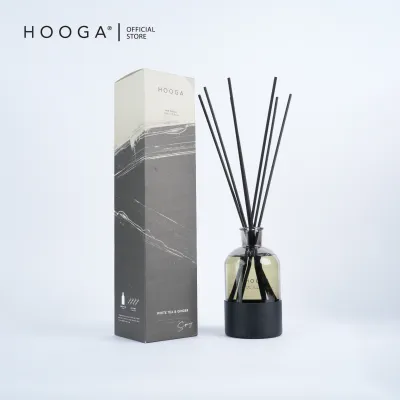
![[6 NEW SCENTS] Hooga Black Series Reed Diffuser 200ml](https://img.lazcdn.com/g/p/1ffd8c3f6be39df0f302c26adff3be23.jpg_400x400q80.jpg_.webp)
Prices are valid at publication and may change. Please refer to the product page for the latest price.
Key Factors Influencing Scent Longevity in Singapore Homes
The performance of any passive home fragrance product is highly sensitive to its immediate surroundings. In Singapore homes, several local environmental factors can dramatically accelerate or slow down the rate at which your Hooga Black Series diffuser operates.

Climate and Room Temperature
Singapore’s tropical climate presents unique challenges for home fragrance. High ambient temperatures, often around 30°C in non-air-conditioned spaces, impart more kinetic energy to liquid molecules, causing carrier solvents and fragrance oils to evaporate faster than in cooler climates. Conversely, high relative humidity—frequently exceeding 80%—can suppress wicking slightly as the air is already moisture-saturated.
In air-conditioned rooms, the dynamics shift. Air-conditioning units cool and dehumidify the air. This drier, cooler environment can slow physical evaporation, potentially extending the physical lifespan of the diffuser. However, lower temperatures can also suppress scent volatilization, making the fragrance throw feel more localized or subtle compared to a warmer room.
Airflow and Placement
Air circulation is a powerful driver of diffuser depletion. Placing your Hooga Black Series diffuser in areas with high airflow—such as under a ceiling fan, next to an oscillating fan, near an open window, or in the direct path of air-conditioning vents—rapidly strips evaporated scent molecules from the reeds. While this yields a strong, well-dispersed fragrance, it forces the reeds to draw up more liquid, emptying the bottle much faster.
Conversely, placing the diffuser in stagnant, enclosed spots like deep shelves or tight corners preserves the liquid but limits the scent throw. Avoid placing the glass bottle in direct sunlight or near heat-emitting appliances like televisions or kitchen stoves. UV light and heat break down delicate chemical bonds in fragrance oils, causing the scent profile to warp, fade, or turn unpleasant.
Reed Management and Material
The reeds are the physical conduit for the fragrance, and how you manage them dictates how long the liquid lasts. The Hooga Black Series typically comes with specialized reeds designed to complement the brand’s aesthetic. The number of reeds you insert acts as a control valve: using all of them maximizes the evaporation surface area for a powerful scent throw but a short lifespan, while using fewer reeds restricts wicking and slows consumption.
Reed material also affects wicking speed. Natural rattan reeds contain hollow channels that slowly draw oil upward through capillary action. Synthetic fiber reeds absorb and release liquid at a faster, more consistent rate. Knowing your reed type helps you anticipate whether your diffuser will lean toward a rapid, intense release or a slower, prolonged delivery.
Proven Maintenance Tips to Extend Your Diffuser's Life
To maximize the usable lifespan of your Hooga Black Series reed diffuser and maintain a steady, pleasant fragrance throw, you can implement several simple, low-risk maintenance practices.
Flipping the Reeds
Flipping the reeds is the most effective way to revive a fading scent throw, but it must be done carefully to avoid damaging interior surfaces. Diffuser oils can strip paint, dissolve varnishes, or leave oily stains on wooden furniture, marble, or natural stone. To flip safely:
- Lift the reeds gently, holding them over the bottle opening for a few seconds to let excess liquid drip back inside.
- Move the reeds over a sink or protected surface, then flip them upside down.
- Lower the reeds back into the bottle, ensuring the newly saturated ends are exposed.
- Immediately wipe away any drips on the bottleneck or surrounding surfaces.
If a spill occurs, immediately consult the treated item’s manufacturer instructions for proper cleanup. Limit flipping to once a week to prevent rapid liquid depletion.
Adjusting Reed Count
You do not need to use all the reeds that come in the package. Instead, tailor the number of reeds to the specific dimensions of the room. For small, enclosed spaces like bathrooms, entryways, or compact study rooms, start with only 3 to 4 reeds. This prevents the fragrance from becoming overwhelmingly dense and significantly extends the life of the oil. For larger, open-plan spaces like living rooms or dining areas, you can gradually add more reeds—up to 6 or 8—until you achieve the desired scent throw.
Optimal Placement
Place your diffuser on a stable, elevated surface, such as a sideboard, console table, or shelf, ideally at waist-to-chest height where natural air currents can gently disperse the scent at breathing level. To protect your furniture from potential condensation, slow leaks, or accidental tips, always place a decorative coaster, glass tray, or ceramic plate underneath the glass vessel. Avoid placing the diffuser in high-traffic pathways where it could easily be knocked over.
Reed Replacement
If you find that the liquid level in your Hooga Black Series bottle is still relatively high but the scent throw has completely vanished—even after flipping the reeds—the reeds themselves are likely the issue. Over time, airborne dust, pet hair, and microscopic debris settle on the exposed portion of the reeds, while heavier fragrance molecules clog the internal capillary pathways. When this happens, the reeds lose their ability to wick the oil. Instead of throwing away the remaining liquid, simply discard the old reeds and replace them with a fresh set of high-quality reeds to restore the diffuser’s performance.
Clear Signs It Is Time to Replace or Refresh the Diffuser
Recognizing when your reed diffuser has reached the end of its functional life helps you avoid keeping an ineffective, dusty bottle on display.
Scent Fade
The most obvious indicator that your diffuser is spent is a complete lack of fragrance projection. If you can no longer smell the scent when entering the room, and flipping the reeds or moving the bottle yields no improvement, the volatile aromatic compounds have fully evaporated. Even if clear liquid remains at the bottom of the bottle, it is likely just the heavy carrier solvent devoid of active fragrance.
Reed Saturation and Clogging
Examine the physical appearance of your reeds. If they have turned extremely dark, appear greasy, feel brittle, or are heavily coated in household dust, they have reached complete saturation. Once the pores are fully clogged, the wicking action stops entirely, rendering the diffuser inactive.
Liquid Degradation
Examine the remaining oil inside the glass vessel. If the liquid has changed color significantly—such as turning from clear to a dark, muddy amber—or has become cloudy, the fragrance oils have oxidized. If the liquid develops a sour, stale, or chemical off-odor that differs from the original profile, the oil has degraded and should be discarded.
End-of-Life Handling
When your diffuser has reached the end of its life, handle the disposal of the remaining components responsibly. Never pour the leftover diffuser oil down your household sink or toilet, as these concentrated chemical compounds can damage plumbing fixtures and harm municipal water systems. Instead, absorb any remaining liquid with a paper towel and dispose of it in your general household waste.
The heavy, high-quality black glass vessel of the Hooga Black Series is far too beautiful to throw away. Wash the empty bottle thoroughly with warm, soapy water to remove all residual oils, let it air dry completely, and repurpose it as a stylish home decor piece. It makes an excellent minimalist bud vase, a holder for makeup brushes, or a chic container for office stationery.
Frequently Asked Questions (FAQ)
Can I refill the Hooga Black Series glass bottle with other diffuser oils?
Yes, you can reuse the glass vessel for other diffuser oils once it is empty. However, you must thoroughly clean and dry the bottle before introducing a new liquid. Any residual oil from the previous scent can mix with the new formulation, potentially causing the liquids to separate, turn cloudy, or create an unpleasant, clashing fragrance profile. Check if the brand offers official refill pouches, or ensure your chosen replacement oil is compatible with standard reed diffusion.
Should I reuse the same reeds when refilling or replacing the liquid?
It is highly recommended to use brand-new reeds whenever you refill the bottle or change the fragrance liquid. Old reeds are already fully saturated with the previous oil, clogged with household dust, and embedded with older scent molecules. Reusing them will severely compromise the wicking efficiency of the fresh oil and can distort the pure scent profile of your new fragrance.
Why does my reed diffuser smell stronger on some days than others?
Fluctuations in scent intensity are completely normal and are influenced by both environmental changes and human biology. On warmer, more humid days, the rate of oil evaporation increases, releasing more fragrance into the air. Changes in indoor air currents—such as opening a window or turning on a fan—will also temporarily alter how the scent is distributed. Additionally, your olfactory system naturally adapts to constant ambient scents over time, a process known as olfactory fatigue or nose blindness. If you spend several consecutive hours in the same room, you may perceive the scent as weaker, whereas someone entering the room from the outside will immediately notice a strong, pleasant fragrance.

Community discussion
Share your experience or ask a question. Comments are reviewed before publication.