
When searching for the most reliable LED flood light brands for outdoor security in Singapore, the key is knowing how to evaluate brand support, local certifications, and build quality. Because Singapore’s tropical climate features intense humidity, heavy monsoon downpours, and high ambient temperatures, off-brand or uncertified fixtures often fail prematurely. A reliable brand is defined by its compliance with local safety standards, the robustness of its weatherproofing, and the accessibility of its local after-sales support. Rather than relying on unverified online reviews, homeowners and property managers should focus on specific technical benchmarks and verification steps to identify trustworthy outdoor lighting solutions.
By understanding how to assess IP ratings, thermal management, sensor technologies, and installation requirements, you can confidently select a high-performing security light. This guide outlines the essential specifications, control options, safety guidelines, and maintenance practices required to keep your property well-lit and secure.
Core Specifications for Weather Resistance and Durability
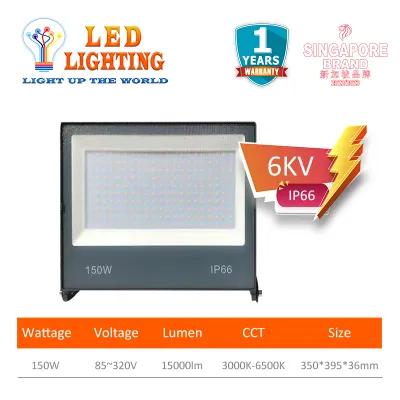
To withstand Singapore’s demanding outdoor environment, an LED flood light must possess a high level of physical protection. The Ingress Protection (IP) rating system classifies the degree of protection against solids and liquids. For outdoor security lighting exposed to the elements, IP65 is the absolute minimum standard, meaning the fixture is completely dust-tight and protected against water jets. For highly exposed areas like perimeter walls, open driveways, or unshielded rooftops, upgrading to an IP66-rated fixture provides superior protection against high-pressure water jets during intense monsoon downpours.
Products mentioned in this guide
![Very Bright IP67 LED Flood Light | LED Light | LED 30W 50W 100W 150W 200W [Rainproof] *2 YEAR WARRANTY*](https://img.lazcdn.com/g/p/a94f935be2c8201b20af86a112c95844.jpg_400x400q80.jpg_.webp)
![LEDVANCE Floodlight ECO LED 20W [830/840/865]](https://img.lazcdn.com/g/p/ce55bf604dd2a9e2d7a62b2a3a4d084b.jpg_400x400q80.jpg_.webp)
![LEDVANCE Floodlight ECO LED 30W [830/840/865]](https://img.lazcdn.com/g/p/a66ce7dc9889045ff871e841fedbb108.jpg_400x400q80.jpg_.webp)
Prices are valid at publication and may change. Please refer to the product page for the latest price.
Thermal management is another critical factor in determining the lifespan of an LED fixture. While LEDs are highly energy-efficient, they still generate significant internal heat that must be dissipated. In Singapore’s consistently warm climate, inadequate heat dissipation causes the LED chips and internal drivers to degrade rapidly, leading to premature dimming or complete failure. Reliable brands utilize heavy-duty die-cast aluminum housings with integrated cooling fins rather than cheap plastic enclosures. The aluminum acts as an efficient heat sink, drawing warmth away from the sensitive electronics and dispersing it into the surrounding air.
When planning your security layout, you must also match the light output, beam angle, and color temperature to the specific zone you wish to monitor. For standard residential driveways and back alleys, a light output of 1,500 to 3,000 lumens is generally sufficient to deter intruders without causing excessive glare. A wide beam angle of 100 to 120 degrees is ideal for illuminating broad areas, while a narrower beam of 60 degrees can focus light on specific entry points like gates or side doors. For security cameras to capture clear, high-contrast footage, a cool white color temperature of 4000K to 5000K is highly recommended, as it provides better visual clarity than warm yellow light.
Choosing the Right Motion Sensor and Lighting Control
Integrating the right motion sensor technology ensures your security lights activate precisely when needed, balancing property protection with energy efficiency. Passive Infrared (PIR) sensors are the most common choice for residential security. These sensors detect changes in infrared radiation, triggering the light when a warm body, such as a person or a vehicle, moves across their field of view. PIR sensors are highly effective for open outdoor layouts because they are relatively unaffected by wind-blown foliage or falling rain, minimizing unnecessary activations.

Microwave sensors offer an alternative technology by emitting high-frequency electromagnetic waves and measuring the reflection off moving objects. While microwave sensors are incredibly sensitive and can detect motion through light barriers like glass or thin wooden fences, they are highly prone to false triggers in outdoor environments. In Singapore, heavy tropical rain or swaying tree branches can easily trigger a microwave sensor, making them less suitable for fully exposed outdoor areas unless their sensitivity can be precisely calibrated.
For continuous low-level illumination, you can select fixtures equipped with dusk-to-dawn photocells. These sensors monitor ambient light levels, automatically turning the flood light on at sunset and off at sunrise. Many advanced security systems combine photocells with motion sensors, keeping the light at a dim, energy-saving level throughout the night and boosting it to 100% brightness only when motion is detected. This dual-mode operation provides constant visibility while conserving electricity.
To prevent your security lights from becoming a nuisance to your household or neighbors, look for fixtures that offer adjustable control dials. These typically include sensitivity controls to adjust the detection range, timer durations to set how long the light remains on after motion stops (usually adjustable from 10 seconds to 10 minutes), and lux controls. Properly calibrating the lux dial ensures the sensor only activates when the ambient light drops below your chosen threshold, preventing the light from turning on during gloomy, overcast afternoons.
Safe Installation and Mounting Guidelines
Before purchasing or installing any outdoor electrical fixture, you must verify its compatibility with Singapore’s standard electrical supply of 230V AC at 50Hz. Outdoor lighting circuits must be protected by a Residual Current Circuit Breaker (RCCB) or a Residual Current Device (RCD) at the main distribution board. This safety device immediately cuts off power if an electrical fault or moisture ingress is detected, preventing severe electrical shocks and protecting your property’s electrical infrastructure.
Mounting height and tilt angles play a crucial role in maximizing ground coverage while maintaining neighborly etiquette. For optimal security coverage, mount your LED flood lights at a height of 2.5 to 4 meters. This height keeps the fixture out of easy reach of vandals while allowing the light to spread effectively. Tilting the fixture downward at a 45-degree angle directs the light onto your driveway or garden path, preventing light trespass into neighboring windows and reducing glare that could blind your security cameras or passing drivers.
While replacing an existing plug-and-play outdoor fixture is relatively straightforward, any installation involving fixed electrical wiring, new circuit runs, or work at significant heights strictly requires a Licensed Electrical Worker (LEW). In Singapore, electrical work in damp outdoor locations carries a high risk of short circuits if not sealed correctly. A licensed professional will ensure that all cable connections are housed within IP-rated junction boxes, sealed with weatherproof silicone, and properly grounded to guarantee long-term safety and compliance with local building regulations.
Routine Maintenance and Troubleshooting Steps
Regular maintenance is essential to extend the operational lifespan of your outdoor security lights and ensure they remain fully functional. Over time, dust, pollen, spiderwebs, and organic growth like algae or mold—which thrive in Singapore’s humid climate—can accumulate on the optical lens and sensor window. This buildup reduces the light output and impairs the sensor’s sensitivity. To clean the fixture safely, isolate the power at the main switchboard, then wipe the lens and housing with a soft, damp microfiber cloth and mild soapy water. Avoid using abrasive pads or harsh chemical solvents, as these can scratch the lens or degrade the protective rubber seals.
If you encounter operational issues, systematic troubleshooting can help identify the cause before you seek professional repair. If the LED flood light begins to flicker, it is often a sign of a loose wiring connection, a failing LED driver, or incompatibility with an external dimmer switch. A delayed sensor response or a complete failure to trigger is usually caused by a dirty sensor lens, incorrect sensitivity settings, or the sensor being angled too low. If the light remains on continuously during the day, check if the photocell is blocked by dirt or shaded by overhanging foliage, and verify that the lux dial is not set to its maximum daylight position.
Periodic physical inspections are highly recommended, especially after severe thunderstorms or during the monsoon seasons. Check the mounting brackets for any signs of rust or loosening caused by strong winds. Inspect the cable glands and weather seals around the lens and sensor housing to ensure they remain intact and flexible. If you notice any condensation forming inside the lens, it indicates that moisture has bypassed the seals; in such cases, the fixture should be powered down and inspected by a professional to prevent a short circuit.
Purchasing Checklist and Warranty Verification
To ensure you are buying a safe, compliant, and durable product, always use a structured checklist before finalizing your purchase. In Singapore, electrical accessories and controlled goods must carry the Enterprise Singapore Safety Mark. This mark, accompanied by a unique certification number, proves that the product’s LED driver and electrical components have been tested and certified safe for local residential use. Avoid purchasing unbranded or uncertified fixtures from overseas online marketplaces, as they often lack this essential safety certification.
When evaluating warranties, look for brands that offer a comprehensive warranty of at least 2 to 5 years. It is crucial to read the fine print to verify whether the warranty covers both the LED driver and the motion sensor accessory, as some manufacturers offer shorter coverage periods for the sensor components. A reliable brand will have a clear, straightforward warranty claim process supported by a local distributor or service center, saving you the hassle of shipping defective items overseas.
Finally, purchase your security lights through established local channels. Visiting specialized lighting showrooms, authorized hardware retailers, or official brand online stores allows you to inspect the build quality firsthand and speak with knowledgeable staff. These reputable sellers can provide genuine products, valid local warranties, and reliable after-sales support, ensuring your outdoor security system remains dependable for years to come.
Frequently Asked Questions (FAQ)
Do LED flood lights attract insects at night?
Yes, certain LED flood lights can attract insects, but this depends heavily on the color temperature and light spectrum. Insects are naturally drawn to shorter wavelengths of light, particularly blue and ultraviolet light, which are highly prevalent in cool white (5000K to 6500K) LED fixtures. If your security light is installed in an area prone to heavy insect activity, selecting a warmer color temperature, such as warm white (3000K), can significantly reduce the number of insects attracted to your property while still providing adequate security illumination.
Can I install a flood light on a wooden fence or gate?
Yes, you can install an LED flood light on a wooden fence or gate, provided you take proper structural and thermal precautions. First, ensure the wood is structurally sound, rot-free, and capable of supporting the weight of the fixture and its mounting bracket. Second, because LED flood lights rely on their metal housings to dissipate heat, you must ensure there is adequate clearance between the back of the fixture and the wooden surface. Mounting the fixture onto a non-combustible spacer or mounting block is highly recommended to prevent heat buildup and eliminate any potential scorching or fire hazards.
How do I prevent my motion sensor light from turning on during the day?
To prevent your motion sensor light from activating during daylight hours, you need to adjust the lux control setting on the sensor housing. The lux dial, often marked with sun and moon icons, determines the level of ambient darkness required for the sensor to trigger the light. If the light turns on during the day, the dial is likely set too close to the sun icon. Slowly turn the dial toward the moon icon until the light only activates when the ambient light drops to your desired nighttime level. Additionally, ensure the photocell sensor is clean and not shaded by trees or roof eaves, which can trick the sensor into thinking it is dark.
Community discussion
Share your experience or ask a question. Comments are reviewed before publication.