
To compare UFO LED lights effectively in Singapore, you must look beyond brand names and focus on luminous efficacy, which measures how much light a fixture produces for every watt of electricity it consumes. Evaluating these specifications on product labels allows you to identify which models deliver the highest brightness for the lowest operating cost. Because actual performance varies by manufacturer, buyers must analyze verified specification sheets rather than relying on marketing claims.
By understanding how to read and compare these technical specifications, you can design a lighting layout that maximizes visibility while minimizing your monthly energy bills. This guide provides the framework needed to evaluate energy efficiency, assess physical and electrical compatibility, and plan a safe, high-performing installation for any large space.
Understanding Energy Efficiency and Lumen Output in UFO LEDs
When evaluating high-bay lighting, it is essential to separate the concept of brightness from power consumption. Lumens represent the total amount of visible light emitted by a source, whereas wattage indicates only the amount of electrical power the fixture draws from the grid. In older lighting technologies, wattage was a reliable proxy for brightness, but modern LED engineering has decoupled these two metrics entirely.
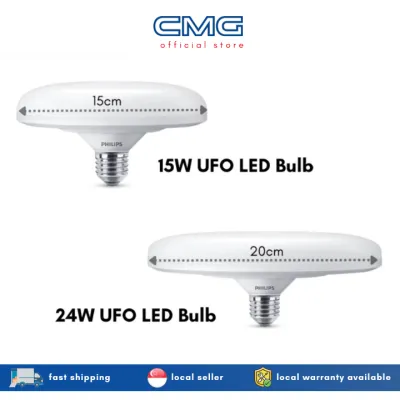
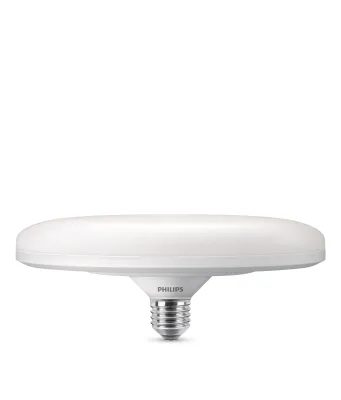
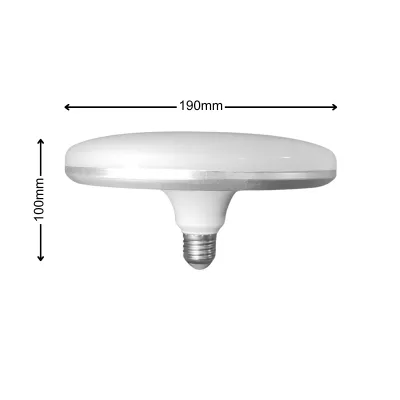
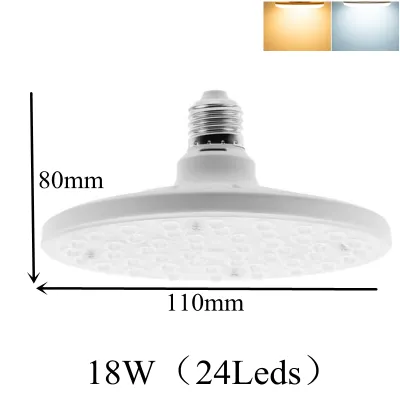
Products mentioned in this guide
![[SG seller] Philips E27 MyCare LED 24W UFO Bulb | Goldberg Home](https://img.lazcdn.com/g/p/f89fe8f5afef82d869e23507ff80753d.png_400x400q80.png_.webp)
![[Climate Voucher] PHILIPS UFO 15W 24W LED Bulb E27 Base Easy Replacement](https://img.lazcdn.com/g/p/b23fd78644326a4d703d40b4ac7f95fd.jpg_400x400q80.jpg_.webp)
![[SG SELLER] LED Bulb E27 screw LED Flying Saucer Light High Brightness Energy-Saving Bulb for Household and Outdoor Use](https://img.lazcdn.com/g/p/29c242051805f539a812f8d2409e9ab4.png_400x400q80.png_.webp)
Prices are valid at publication and may change. Please refer to the product page for the latest price.
To gauge the true efficiency of a UFO LED light, you must calculate its luminous efficacy, expressed in lumens per watt (lm/W). You can find this by dividing the total rated lumen output by the fixture’s wattage. For example, a fixture delivering 20,000 lumens while drawing 150 watts has an efficacy of approximately 133 lm/W. Comparing this ratio across different brands reveals which fixture converts electricity into light most effectively.
Estimating your total light output requirements depends on the physical dimensions of your space and the specific tasks performed within it. Lighting requirements are measured in lux, which represents lumens per square meter. A storage facility might only require a basic level of 100 to 150 lux, whereas a detailed assembly line or workshop may require 300 to 500 lux to ensure safety and accuracy. Multiplying your target lux by the floor area in square meters gives you a baseline for the total lumens your fixtures must collectively produce.
Key Specifications to Check Before Comparing Brands
Before comparing different brands, you must verify that their electrical specifications match local infrastructure. In Singapore, the standard electrical supply operates at 230V AC at a frequency of 50Hz. Ensure the LED driver integrated into the UFO light is rated for this voltage range. Additionally, check the power factor (PF) rating on the specification sheet; a power factor of 0.90 or higher indicates that the fixture uses power efficiently without putting unnecessary strain on your building’s electrical system.

Beam angle selection is another critical parameter that directly impacts floor-level illuminance and light spread. UFO LED lights typically offer beam angles ranging from 60 to 120 degrees. A wide beam angle of 120 degrees distributes light over a broad area, making it suitable for lower ceiling heights, while a narrower beam angle of 60 or 90 degrees concentrates the light downward, which is necessary to achieve adequate brightness from high ceilings.
Color metrics should be selected based on your specific operational preferences rather than assumed performance rules. Correlated Color Temperature (CCT) determines the color appearance of the light, with cool white (5000K to 6500K) often preferred in industrial settings to promote alertness, while neutral white (4000K) offers a softer visual environment. The Color Rendering Index (CRI) indicates how accurately the light reveals colors; a CRI of 80 or higher is standard for general work, though specialized tasks like color matching may require a higher rating.
Thermal management is the single most important factor determining the lifespan of an LED fixture. High-power LEDs generate significant heat at the semiconductor junction, which must be dissipated to prevent premature failure. Look for fixtures featuring robust aluminum heat sinks with open-air flow designs that allow heat to rise and escape. Check the manufacturer’s lumen maintenance rating, typically denoted as L70 or L80, which indicates the number of operating hours the fixture can run before its light output drops to 70% or 80% of its original brightness.
Evaluating Value and Layout for Large Spaces
Planning a high-bay lighting layout requires matching your mounting height with the appropriate lumen output and beam spread. If you mount fixtures at a height of 5 to 6 meters, a moderate lumen output with a wider beam angle will provide even coverage. For mounting heights exceeding 8 meters, you will need higher-lumen fixtures equipped with narrower beam angles to project the light effectively down to the work plane.
To prevent dark spots and ensure uniform floor illumination, you must calculate the spacing between your fixtures. A common starting point is a spacing-to-mounting-height ratio of 1:1 to 1.5:1, meaning fixtures mounted at a height of 6 meters should be spaced 6 to 9 meters apart. You can verify the uniformity of your layout by requesting a photometric report or an IES file from the manufacturer, which simulates how light will distribute across your specific floor plan.
When comparing brands, weigh the initial S$ investment against the projected energy savings over the fixture’s operational lifespan. A cheaper, less efficient fixture may save money upfront but will accumulate higher electricity costs over years of daily operation. Calculating the total cost of ownership involves multiplying the fixture’s wattage by your daily operating hours and local utility rates, then adding the purchase price to compare the true long-term value of each option.
Always check for local electrical safety certifications and comprehensive warranty terms before finalizing a purchase. In Singapore, electrical equipment should carry recognized safety certifications, such as the Safety Mark or equivalent international compliance certificates like the CB Scheme, CE, or TÜV SÜD, which verify compliance with IEC safety standards. A robust manufacturer’s warranty of three to five years provides essential protection against premature driver or LED chip failure.
Decision Framework: Choosing the Right UFO LED
To select the ideal UFO LED light for your facility, apply a conditional decision framework based on your primary operational priorities:
- Choose high-efficacy (lm/W) models if your primary goal is long-term operational cost reduction and your facility runs for extended hours daily.
- Choose narrow beam angles (60 to 90 degrees) if your mounting heights exceed standard limits or if you need to illuminate narrow warehouse aisles without wasting light on the tops of racking systems.
- Choose robust IP (Ingress Protection) and IK (Impact Protection) ratings if your space is subject to high humidity, dust, or physical impact risks, such as in semi-outdoor loading bays or active manufacturing plants.
- Avoid standard fixtures if your existing electrical infrastructure cannot support the required electrical load without extensive rewiring; always verify your distribution board's capacity first.
- Verify structural ceiling mounts to ensure they can safely bear the physical weight of the fixture and withstand any dynamic movement caused by industrial ceiling fans or ventilation systems.
Installation and Safety Boundaries
Installing heavy high-bay fixtures involves significant electrical and physical risks that require strict adherence to safety protocols. Before beginning any installation or maintenance work, you must isolate the power supply at the main distribution board and implement lockout/tagout procedures to prevent accidental re-energization. Never work on live electrical circuits.
Verify the structural load capacity of your ceiling, hanging hooks, mounting brackets, and secondary safety cables. High-bay fixtures are heavy and subject to vibration, making secure anchoring essential to prevent catastrophic falls. Always use a secondary steel safety cable secured to a separate structural member of the building as a redundant safety measure.
Recognize when to stop DIY efforts and consult a professional. For fixed wiring, work at height, damp environments, or complex high-bay configurations, always engage a Licensed Electrical Worker (LEW) in Singapore. Professional installation ensures compliance with local electrical standards, such as CP 5, and guarantees the safety and longevity of your lighting system.
Frequently Asked Questions (FAQ)
How many lumens do I need for a warehouse or large workshop?
The total lumens required depends on your target lux level, the floor area, and the mounting height of the fixtures. For a standard warehouse requiring a baseline of 150 lux, you multiply 150 lux by the area in square meters to find the useful lumens needed at the floor level. Because light disperses and is absorbed by walls and ceilings, the total installed lumens of your fixtures will typically need to be higher than this raw calculation to account for these environmental losses.
Does a higher wattage always mean a brighter UFO LED light?
No, wattage only measures the electrical power consumed by the fixture, not the light output. A highly efficient UFO LED light with an efficacy of 160 lm/W will produce 16,000 lumens while drawing only 100 watts of power. Conversely, an older or less efficient fixture with an efficacy of 100 lm/W would require 160 watts of power to produce the exact same amount of light. Always compare the rated lumen output and luminous efficacy rather than relying on wattage to judge brightness.
Community discussion
Share your experience or ask a question. Comments are reviewed before publication.