
Quick Answer: Assessing the Sofirn SK31 for Compact Apartments
When a power outage occurs in a high-density residential building, having a reliable light source is essential for safety and navigation. Evaluating whether the Sofirn SK31 is a practical emergency light for your HDB flat requires a systematic look at its physical footprint, indoor-appropriate illumination, and power management features. Because manufacturers frequently update product specifications, you should always verify the exact dimensions, battery requirements, and lumen outputs on the official product label or manual before purchasing.
It is also important to remember that while a handheld torch is an excellent tool for targeted navigation, it should serve as one component of a broader, multi-layered household emergency lighting strategy rather than a standalone solution. Having a clear framework for assessing your portable lighting tools ensures your household remains prepared for any sudden utility disruptions.
Size and Storage: Fitting into HDB Utility Spaces
HDB flats are designed with space efficiency in mind, meaning every square meter of storage must be utilized wisely. When selecting an emergency light like the Sofirn SK31, its physical dimensions and weight are critical factors in determining where and how it can be stored. A practical emergency light should be compact enough to fit into easily accessible locations, such as a kitchen utility drawer, a distribution board cabinet, or a dedicated household shelter emergency kit. If a flashlight is too bulky or heavy, it is more likely to be relegated to deep storage, making it difficult to retrieve quickly when the lights suddenly go out.
Products mentioned in this guide
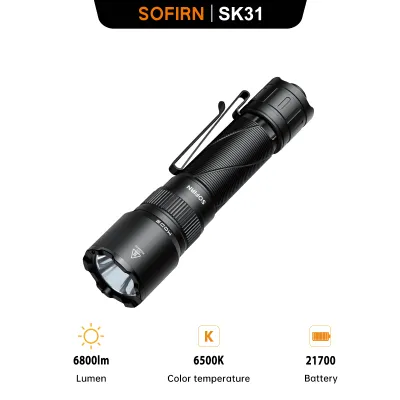
Prices are valid at publication and may change. Please refer to the product page for the latest price.

Portability is another essential consideration for multi-generational households. During a sudden blackout, the light must be easy to handle for all family members, including young children and elderly residents who may have limited grip strength. A heavy or overly complex tactical light can be difficult to operate under stress. Therefore, you should inspect the build materials of the torch—such as lightweight anodized aluminum or durable polycarbonate—to ensure it offers a balanced weight.
Additionally, check the grip texture of the device before finalizing your emergency setup. A flashlight with pronounced knurling or a rubberized sleeve will prevent accidental slips, ensuring secure handling even in high-stress situations or when hands are damp. Ensuring the physical form factor matches the physical capabilities of everyone in your home is a fundamental step in emergency planning.
Brightness and Beam Profile: Navigating Indoor Rooms
The interior layout of a typical HDB flat—characterized by concrete walls, light-colored paint, and relatively compact rooms—significantly influences how light behaves indoors. Using a high-output flashlight designed for long-range outdoor search-and-rescue can actually hinder indoor navigation. When a powerful beam strikes a white wall or a glossy surface at close range, it creates intense glare and temporary flash blindness. To prevent this visual discomfort, look for a flashlight that features multiple adjustable brightness modes, including a dedicated low-lumen or moonlight setting that allows you to read documents or navigate without straining your eyes.
Understanding the difference between a flood beam and a spot beam is also vital for indoor safety. A wide flood beam distributes light evenly across a broad area, making it ideal for illuminating an entire living room or kitchen during a blackout. Conversely, a focused spot beam projects a narrow, intense light over a longer distance, which is useful for identifying specific objects or navigating long, dark corridors, but can create harsh, disorienting shadows in confined spaces.
When evaluating the Sofirn SK31, check the manufacturer’s stated beam profile and lumen range to ensure it offers a versatile balance that supports close-up indoor tasks rather than just long-distance outdoor projection. A versatile beam profile allows you to adapt the light to different rooms, ensuring you can move safely from a narrow hallway into a wider living area without losing visibility.
Battery Life and Power Management: Preparing for Outages
A reliable power source is the backbone of any emergency lighting tool. When assessing the Sofirn SK31, you must carefully verify its battery configuration and charging interface. Some portable lights rely on standard alkaline batteries, while others utilize rechargeable lithium-ion cells. If the device uses rechargeable batteries, check whether it features a built-in charging port, such as a USB-C interface, or requires an external charging dock. You should also confirm the local availability of replacement batteries and compatible charging accessories in neighborhood stores or online marketplaces to ensure you are never left without power.
Battery runtime is another critical metric to analyze before making a decision. During an extended power outage, running a flashlight on its maximum brightness setting will rapidly deplete the battery, often within a couple of hours. Review the manufacturer’s specification sheet to determine the estimated runtime on lower, energy-saving modes. A practical emergency light should be capable of operating on a low or medium setting for several consecutive hours, providing continuous illumination throughout the night if necessary.
Furthermore, the local tropical climate requires careful consideration when storing batteries long-term. High humidity and elevated indoor temperatures can accelerate battery self-discharge, degrade internal components, and lead to catastrophic alkaline battery leakage. To preserve battery health, store your emergency flashlight and spare cells in a cool, dry place, ideally inside an airtight container with silica gel packs. If you plan to store the flashlight unused for several months, consider removing alkaline batteries entirely to prevent terminal corrosion, or ensure your rechargeable lithium-ion cells are kept at a safe storage charge level.
Integrating the Sofirn SK31 into Your Household Emergency Kit
While a high-quality handheld torch like the Sofirn SK31 is an invaluable asset for targeted navigation, relying solely on a single flashlight can leave significant gaps in your emergency preparedness. Handheld lights require you to dedicate one hand to holding the device, which complicates essential tasks such as preparing food, administering first aid, or inspecting your home’s electrical distribution board. To build a resilient household kit, supplement your handheld torch with hands-free lighting options, such as headlamps, magnetic-base work lights, or portable area lanterns that can be placed safely on flat surfaces.
Maintaining your emergency lighting equipment is just as important as acquiring it. Establish a routine maintenance schedule every three to six months to inspect your gear. During these checks, test the physical power switch to ensure it operates smoothly, inspect the rubber O-rings and seals for signs of cracking or dry rot, and clean any dust or debris from the lens. For rechargeable models, cycle the batteries by discharging them slightly and recharging them to ensure they retain their capacity over time.
Finally, you must establish clear stop conditions for your equipment to avoid safety hazards. If you observe visible corrosion on the battery contacts, physical swelling of a rechargeable cell, a sticky or unresponsive switch, or severe dimming that persists even after a full charge, do not attempt to use the device. Under these conditions, stop using the flashlight immediately and consult the manufacturer’s guidelines for professional repair options, or replace the unit entirely to guarantee your household’s safety during the next unexpected power failure.
Frequently Asked Questions (FAQ)
How often should I test my emergency flashlight batteries?
You should test your emergency flashlight batteries at least once every three to six months to ensure they remain reliable. For rechargeable lithium-ion batteries, avoid leaving them completely drained or fully charged at maximum capacity for years; instead, cycle them periodically according to the manufacturer’s instructions to maintain their lifespan. If you use standard alkaline batteries, inspect them regularly for signs of white powdery residue, swelling, or leakage, and replace them immediately if any degradation is visible.
Can a high-output tactical flashlight be too bright for indoor use?
Yes, an excessively bright flashlight can cause significant visual discomfort when used inside a compact HDB flat. High-lumen beams reflecting off light-colored walls or mirrors can cause temporary glare and eye strain. To ensure safe indoor navigation, choose a flashlight with multiple brightness settings, and practice bouncing the light off the ceiling to create soft, indirect ambient illumination throughout the room.
Community discussion
Share your experience or ask a question. Comments are reviewed before publication.