
When shopping for home fragrances, scent longevity is often the deciding factor between a satisfying purchase and a disappointing waste of money. Kundal, a brand widely recognized for its personal care and aromatherapy products, has gained significant traction in Singaporean households. However, determining whether a Kundal reed diffuser lasts longer than its competitors requires looking beyond brand marketing to examine the physical and chemical factors that govern evaporation.
In short, there is no universal lifespan for any single brand of reed diffuser. How long a Kundal diffuser lasts compared to other brands depends heavily on the specific product line, the base carrier oil used, your indoor environment, and your personal usage habits. Generally, a stronger initial scent throw—which many users prefer for masking household odors—correlates with a faster evaporation rate, meaning highly potent diffusers may deplete more quickly than subtler alternatives.
To make a fair comparison, you must look closely at the product specifications, such as liquid volume and carrier ingredients, rather than relying solely on brand names. By understanding the mechanics of scent dispersion, you can accurately evaluate which diffuser offers the best longevity and value for your specific living space.
Products mentioned in this guide
![[KUNDAL] Perfume Diffuser Rose Gold Limited Edition 200ml SET(2ea)](https://img.lazcdn.com/g/p/62791d086de4a90e0c8b0155442e0f16.jpg_400x400q80.jpg_.webp)
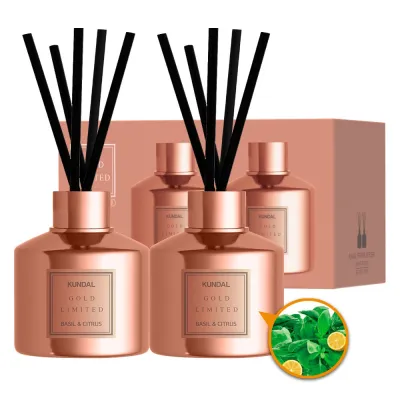
Prices are valid at publication and may change. Please refer to the product page for the latest price.
What Actually Controls Reed Diffuser Longevity?
To understand how Kundal compares to other brands, it helps to look at the physical variables that dictate how quickly any fragrance liquid disappears from its bottle. The first factor is the physical design of the vessel. A bottle with a narrow neck restricts the surface area of the liquid exposed to the air, which naturally slows down the rate of evaporation. Conversely, wide-mouthed decorative jars allow volatile compounds to escape much faster, shortening the product’s lifespan.
The material and quantity of the reeds also play a critical role in liquid consumption. Natural rattan reeds contain tiny, microscopic channels that draw the fragrance oil upward slowly and steadily. Synthetic fiber reeds, on the other hand, are highly porous and engineered to pull liquid up rapidly to maximize scent distribution. While fiber reeds provide a more intense aroma, they also cause the diffuser liquid to deplete at a much faster rate.
Environmental conditions inside your home are equally influential, especially in Singapore’s tropical climate. High ambient temperatures accelerate molecular movement, causing the carrier liquid to evaporate rapidly. If you place a diffuser in a room with constant air-conditioning, the dry air creates a moisture gradient that pulls liquid out of the reeds even faster. Similarly, placing a diffuser near ceiling fans, open windows, or high-traffic hallways increases air circulation, stripping the scent from the reeds and forcing the bottle to empty quickly.
How to Compare Kundal Specifications Against Competitors
When comparing Kundal to other brands on store shelves or online marketplaces, the ingredient list is your most reliable guide. Many budget-friendly diffusers rely on alcohol-based carriers, such as ethanol or isopropyl alcohol, to dilute the fragrance oils. Alcohol evaporates very quickly, providing a powerful initial burst of scent but causing the bottle to empty in a matter of weeks. Higher-quality formulations use non-alcohol carriers like glycol ethers or dipropylene glycol (DPG), which have much higher boiling points and evaporate at a slow, controlled pace.

Another common pitfall is falling for visual illusions regarding bottle size. A thick, heavy glass bottle can make a small amount of liquid look substantial. Always check the actual volume printed on the packaging in milliliters (ml) rather than judging by the physical height of the container. A 100ml bottle of a slow-evaporating, glycol-based diffuser will easily outlast a 200ml bottle of a cheap, alcohol-heavy alternative.
Finally, evaluate the reed package included with the product. Some brands supply thick, highly absorbent fiber reeds, while others provide thin rattan sticks. If a competitor package includes eight thick fiber reeds and Kundal includes five medium rattan reeds, the competitor’s setup will naturally draw down the liquid much faster under identical conditions. Comparing the reed specifications allows you to predict which product is configured for a sprint versus a marathon.
Calculating the True Value for Money
To determine if Kundal or any other brand offers genuine financial value, you can use a simple calculation to standardize your options. Because prices and bottle sizes vary widely across local retailers, calculating the cost per milliliter provides a clear baseline for comparison.
Use the following formula to evaluate your options:
- Unit Cost Formula: Unit Cost = Retail Price (S$) / Total Volume (ml)
Once you have the unit cost, you must adjust your expectations based on your scent preferences. If you prefer a subtle, background aroma, you can achieve this by using fewer reeds, which extends the lifespan of the bottle and lowers your long-term cost. However, if you require a heavy, intense scent to cover kitchen odors or bathroom dampness, you will need to use more reeds, which increases the consumption rate and raises your monthly cost.
Long-term value also depends heavily on the availability of official refill options. Purchasing a brand-new decorative glass bottle every time your diffuser runs dry is both expensive and environmentally wasteful. Brands that offer bulk refill bottles or flexible refill pouches allow you to reuse your existing glass vessels at a fraction of the cost, significantly improving the overall value proposition over time.
Daily Habits to Maximize Your Diffuser's Lifespan
Regardless of the brand you choose, simple adjustments to your daily habits can dramatically extend the lifespan of your reed diffuser without sacrificing scent quality. The most important step is strategic placement. Keep your diffuser away from direct sunlight, such as window sills, as solar heat warms the liquid and speeds up evaporation. Avoid placing the bottle directly in the path of air-conditioning vents, ceiling fans, or drafty entryways, which strip the moisture from the reeds too quickly.
Managing how often you flip your reeds is another easy way to conserve liquid. While flipping the reeds refreshes the scent throw, doing it too frequently drains the bottle rapidly. Limit flipping to once every one to two weeks, or only when you notice the fragrance has faded significantly.
When flipping the reeds, always perform the task over a sink or on top of a protective paper towel. Diffuser oils can permanently stain, strip, or damage wooden furniture, plastics, and painted surfaces if spilled. If any oil drips onto the side of the glass bottle, wipe it clean immediately to prevent damage to your tabletop.
Lastly, learn to recognize when your reeds are no longer functioning. Over time, household dust and airborne oils will settle on the exposed portions of the reeds, clogging the microscopic pores. If the liquid level in your bottle stops dropping but you can no longer smell the fragrance, the reeds are likely blocked. Instead of throwing away the remaining liquid, simply replace the old reeds with a fresh set to restore the scent throw.
Frequently Asked Questions (FAQ)
Can I mix Kundal diffuser oil with other brands?
It is highly recommended to avoid mixing different brands of diffuser oils in the same vessel. Different manufacturers use distinct carrier bases, ranging from alcohol and water-based solutions to various synthetic glycol ethers. Mixing these chemically incompatible bases can cause the liquids to separate, turn cloudy, or create a thick, gummy residue that completely clogs your reeds. Additionally, blending different fragrance formulations can alter the scent profile unpredictably, often resulting in an unpleasant aroma.
Why does my reed diffuser smell weak even when the bottle is full?
If a full bottle of diffuser oil is not producing a strong scent, the most common culprit is clogged reeds. In humid environments, airborne dust easily sticks to the moist reeds, sealing the pores and preventing the oil from traveling upward. Another common cause is olfactory fatigue, also known as nose blindness, where your brain naturally tunes out a continuous background scent. To test this, step out of your home for an hour; if the fragrance is noticeable when you re-enter, your diffuser is working correctly, and you may simply need to move it to a different room to reset your senses.

Community discussion
Share your experience or ask a question. Comments are reviewed before publication.