
Choosing the right chair seat pad is a critical decision for anyone spending long hours at a desk. The ideal material depends entirely on whether your body requires deep, contouring pressure relief or active temperature regulation paired with firm, stable support.
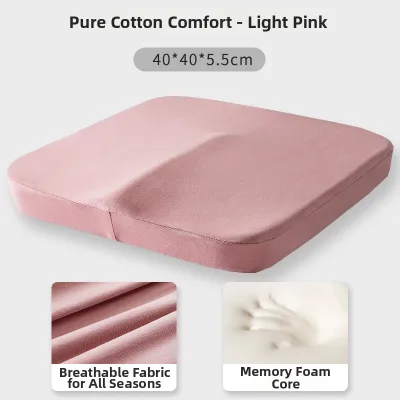
Memory foam is the premier choice if you experience targeted joint discomfort, tailbone sensitivity, or lower back pain. This material reacts to body heat and weight, molding precisely to your physical shape to eliminate localized pressure points. It creates a cradling sensation that makes hard wooden or poorly padded office chairs significantly more comfortable.
Gel seat pads, particularly those designed with an open honeycomb or grid structure, excel at managing heat and providing a highly stable, responsive seating surface. If you sit for uninterrupted blocks of time, run hot, or work in a warm environment, gel offers superior air circulation and reliable weight distribution. It prevents the sinking feeling associated with foam, keeping your pelvis properly aligned throughout the day.
Products mentioned in this guide
![[SG INSTOCK] Seat Cushion Memory Foam Orthopedic Pressure Relief Car Home Soft Office Chair Pad Wheelchair for Tailbone Sciatica Back Pain Relief](https://img.lazcdn.com/g/p/005adf43d933a7c5edf0e3585d56492d.jpg_400x400q80.jpg_.webp)
Prices are valid at publication and may change. Please refer to the product page for the latest price.
Hybrid options, such as gel-infused memory foam, attempt to bridge this gap by combining the contouring properties of foam with the thermal conductivity of gel. While these hybrids offer a balanced middle ground, understanding the distinct physical characteristics of each pure material is essential for making an informed purchase.
Pressure Relief and Support: How Each Material Feels
To understand how a chair seat pad will perform over an eight-hour workday, you must look at how the material behaves under constant load. Memory foam and gel interact with body weight through entirely different physical mechanisms, resulting in distinct tactile experiences and support profiles.
How Memory Foam Contours to Your Body
Memory foam is made from viscoelastic polyurethane, a material engineered to exhibit both viscous and elastic properties. When you sit on a memory foam chair seat pad, the material does not instantly compress like a standard sponge. Instead, it slowly yields to your body weight and softens further in response to your body heat, allowing you to sink gently into the cushion.
This slow-rebound behavior allows the foam to map the exact curvature of your underside. By conforming to your unique anatomy, it distributes your body weight across a much larger surface area, which drastically reduces peak pressure on your sit bones (ischial tuberosities) and tailbone (coccyx). This makes memory foam highly beneficial for individuals managing sciatica, piriformis syndrome, or general lower back stiffness.
However, this contouring effect is highly dependent on foam density. Low-density memory foams—often found in budget-friendly pads—frequently “bottom out” under continuous pressure, meaning the foam compresses completely until you are effectively sitting on the hard chair underneath. To ensure lasting support, look for high-density foam specifications, typically rated at 50 kg/m³ (approximately 3.1 lbs/ft³) or higher, rather than selecting a pad based solely on its thickness.
How Gel Distributes Weight and Pressure
Gel seat pads utilize a highly elastic polymer or silicone material, often molded into a structural grid or honeycomb pattern. Unlike memory foam, which relies on heat-activated sinking, gel supports weight through a mechanical process known as column buckling. Under localized pressure, the vertical walls of the gel grid support your weight up to a specific threshold, then buckle smoothly to transfer the load to surrounding columns.
This buckling action allows the gel pad to distribute weight evenly across the entire seating surface without letting you sink deeply into the cushion. The result is a firmer, more buoyant feel that keeps your pelvis in a neutral, active position. It is an excellent option for individuals who prefer a stable base that makes it easy to stand up, shift position, or maintain active core engagement while working.
An inherent trade-off of pure gel is its distinct rubbery texture and firmer initial feel. Users accustomed to plush, pillow-like cushioning may find a solid gel pad too rigid at first. Additionally, because gel does not contour to micro-variations in your posture as closely as memory foam, it may not provide the same level of acute pain relief for highly sensitive pressure points or specific tailbone injuries.
Heat Retention and Cooling: Managing Temperature Over Long Hours
Maintaining a comfortable temperature is a major factor in sitting comfort, especially in warm, humid climates like Singapore. When a seat pad traps body heat, it can lead to sweating, skin irritation, and general restlessness, forcing you to shift constantly or stand up to cool down.

Memory Foam and Heat Trapping
Traditional memory foam is notorious for trapping heat due to its dense, closed-cell molecular structure. Because the material requires body heat to soften and contour to your shape, it naturally absorbs and retains that thermal energy. The lack of open pathways within the foam restricts air circulation, turning the cushion into an insulator directly beneath you.
Over several hours of continuous sitting, this heat buildup can become highly uncomfortable. To mitigate this issue, manufacturers employ several design modifications. Some use open-cell foam formulations that allow air to pass through more freely, while others incorporate physical ventilation channels or infuse the foam with microscopic cooling gel beads.
It is important to manage expectations regarding gel-infused memory foam. While the infused gel absorbs heat initially, it eventually reaches thermal equilibrium with your body. These cooling infusions delay the rate of heat buildup rather than actively lowering your temperature. Consequently, the material of the outer cover—such as a highly breathable 3D spacer mesh—plays an equally critical role in promoting airflow and keeping the seating surface comfortable.
Gel and Natural Cooling Properties
Solid and elastomeric gels possess high thermal conductivity, meaning they can absorb a significant amount of heat from your body before they begin to feel warm. When you first sit on a gel chair seat pad, it feels noticeably cool to the touch. This initial temperature differential provides immediate comfort and helps lower skin temperature at the contact points.
Furthermore, the structural design of grid-style gel pads provides an unparalleled advantage in heat dissipation. The open columns of a honeycomb grid create a vast network of empty air space directly beneath your body. As you move, air is naturally pumped through these open channels, carrying away moisture and warm air while allowing cooler ambient air to circulate.
While a gel pad will eventually warm up to match the ambient room temperature over several hours, it does not trap heat or cause the stifling, sweaty sensation common with solid foam. It is highly effective at preventing humidity buildup, making it the superior material choice for non-air-conditioned spaces or offices where temperature control is inconsistent.
Longevity and Care: How They Hold Up to Daily Use
Investing in a chair seat pad requires evaluating how well the material will withstand daily wear and tear. A cushion that loses its supportive properties within a few months represents poor value and can lead to a return of physical discomfort.
Longevity and Shape Retention
Memory foam cushions degrade over time due to a phenomenon known as compression set. Under the constant heat and pressure of daily use, the microscopic cell walls of the polyurethane foam gradually weaken and lose their elastic memory. This leads to permanent sagging in the areas subjected to the highest load, typically directly under the sit bones.
To maximize the lifespan of a memory foam pad, it is essential to check the product specifications for density and recovery time. Premium, high-density memory foam recovers its original shape quickly once you stand up and can maintain its supportive structure for several years of daily use. Lower-density foams, by contrast, may begin to sag or flatten within six to twelve months, necessitating premature replacement.
Gel pads made from high-quality thermoplastic elastomers (TPE) or silicone exhibit exceptional durability and shape retention. These materials are highly resilient and do not rely on air-filled cells to provide cushioning. Even after years of heavy, continuous use, a quality gel grid will instantly snap back to its original dimensions without any permanent deformation or loss of support. For long-term durability under heavy daily use, gel consistently outperforms memory foam.
Cleaning and Cover Requirements
Proper maintenance is vital for keeping your seat pad hygienic, but the cleaning process differs significantly between the two materials. Neither memory foam nor gel should ever be placed in a washing machine or fully submerged in water. Machine washing can tear the delicate cellular structure of memory foam, while excessive water exposure can degrade the chemical bonds of certain gel polymers.
Because the core materials cannot be washed easily, a removable, machine-washable outer cover is an absolute necessity. When evaluating covers, consider the trade-offs of different fabrics:
- 3D Mesh: Highly recommended for both materials as it maximizes airflow, enhances the cooling properties of gel, and prevents sweat buildup.
- Velour or Plush Microfiber: Offers a soft, luxurious feel against the skin and prevents slipping, but tends to trap heat and collect lint or pet hair easily.
If a spill occurs and penetrates the outer cover, a gel pad is much easier to clean than memory foam. Because gel is non-porous, you can simply wipe the grid down with a damp cloth and mild soap, then let it air dry. Memory foam, on the other hand, acts like a giant sponge; if liquids penetrate the inner core, they are incredibly difficult to extract, which can lead to mold, mildew, or lingering odors.
Decision Framework: Which Seat Pad Should You Choose?
To narrow down your choice, evaluate your specific physical needs, work environment, and seating preferences against this practical decision framework.
Choose Memory Foam if:
- You suffer from acute pain: If you experience tailbone sensitivity, sciatica, or deep hip joint pain, the precise, contouring pressure relief of memory foam is highly effective.
- You prefer a plush, cradling feel: If you want your chair to feel soft and enclosing, memory foam provides that classic "sinking in" comfort.
- You work in a temperature-controlled environment: If your workspace is consistently air-conditioned, the heat-retaining properties of foam will be less of a concern.
Choose Gel if:
- You sit for extremely long, uninterrupted hours: The firm, stable support of a gel grid promotes better spinal alignment and prevents postural fatigue over extended sessions.
- You run hot or live in a humid climate: The natural heat dissipation and open-air channels of a grid-style gel pad will keep you dry and cool.
- You prioritize maximum durability: If you want a cushion that will not sag, flatten, or lose its shape over years of heavy use, gel is the superior investment.
- You need an easy-to-sanitize option: Gel is non-porous and simple to wipe down, making it highly practical for shared spaces or environments prone to spills.
Consider a Hybrid if:
- You want the best of both worlds: A layered cushion featuring a memory foam base topped with a thick gel layer offers contouring comfort alongside improved surface cooling.
- You verify the specifications: Ensure the gel layer is a physical, substantial sheet rather than just a thin spray-on coating or minor gel speckles, which offer little to no thermal benefit.
Verify first if:
- You use a highly specialized office chair: If your chair features a deeply contoured seat pan, a saddle seat, or a pronounced forward tilt, adding a thick, flat pad can disrupt the chair's engineered ergonomics. In these cases, a thin, high-density pad is usually preferred to avoid altering your seating posture.
Essential Specs to Verify Before You Buy
Before purchasing a chair seat pad, you must verify several physical and safety specifications to ensure the product is compatible with your body, your chair, and your desk setup.
Dimensions and Shape
Always measure the width and depth of your chair’s seat pan before buying. A pad that is too large will overhang the edges, causing it to tilt or slide, while a pad that is too small will leave your thighs unsupported and can pinch your hips.
Additionally, consider the shape of the pad. U-shaped cushions feature a cutout at the rear designed specifically to suspend the coccyx, preventing direct contact with the seat and relieving pressure on the tailbone. This is ideal for targeted pain relief. Rectangular or gently contoured square pads are better suited for general comfort and uniform weight distribution.
Non-Slip Base
A high-quality seat pad must remain securely in place. Look for cushions that feature a textured, rubberized, or silicone-dotted non-slip bottom. Without a secure grip, the pad will slide forward every time you sit down or shift your weight, forcing you to constantly readjust it and potentially straining your lower back in the process.
Thickness and Density
More cushioning is not always better. A seat pad that is too thick (e.g., exceeding 8 cm) will raise your seating height significantly. This can disrupt your ergonomic relationship with your desk, forcing you to raise your shoulders to type or causing your feet to dangle if your chair cannot be lowered sufficiently. For most standard office chairs, a thickness of 5 cm to 7 cm provides the ideal balance of cushioning and ergonomic stability.
For memory foam, pay close attention to density ratings rather than thickness alone. A thin, high-density foam pad (50 kg/m³ or higher) will provide far better support and longevity than a thick, low-density foam pad that collapses completely under your weight.
Weight Capacity
Always check the manufacturer’s specified weight limit for the cushion. Memory foam, in particular, is highly sensitive to weight; if you exceed the recommended limit, the foam will compress fully, rendering the cushion ineffective. Gel pads are generally more forgiving with weight distribution, but verifying the manufacturer’s guidelines is still highly recommended to ensure the product performs as intended.
Frequently Asked Questions (FAQ)
Can I use a gel or memory foam seat pad on a mesh office chair?
Yes, you can use a seat pad on a mesh chair, but you must proceed with caution. Mesh chairs are engineered to provide suspended, body-conforming support and maximum airflow. Adding a thick seat pad can block this ventilation and alter the carefully designed angle of the seat pan, which may put extra pressure on your thighs.
If you must use a pad on a mesh surface, choose a relatively thin, high-density option to minimize the change in your seating height. Additionally, ensure the pad has an exceptionally strong non-slip rubber grip, as smooth fabrics will slide easily on taut mesh material, creating a safety hazard.
Do memory foam seat pads flatten over time, and can I fix them?
Yes, all memory foam seat pads will experience some degree of permanent compression over time due to the breakdown of the foam’s cellular structure under constant heat and weight. Once the foam has fully bottomed out and lost its elasticity, it cannot be permanently restored or fluffed back up.
To extend the lifespan of your memory foam pad, rotate it 180 degrees every few weeks to distribute the wear evenly, and always follow the manufacturer’s care instructions. Avoid exposing the raw foam to direct sunlight or high heat, as this accelerates the degradation of the polyurethane material. When the foam no longer rebounds and fails to provide adequate support, it is time to replace the cushion.
Community discussion
Share your experience or ask a question. Comments are reviewed before publication.