
Selecting a suitable Philips led light for a Housing & Development Board (HDB) flat requires balancing visual comfort, spatial harmony, and physical clearance. With standard HDB ceilings sitting at a modest height of 2.6 metres, installing bulky or low-hanging light fixtures can quickly make a room feel cramped. The ideal lighting solution must provide sufficient illumination to cover the floor plan while maintaining a slim, unobtrusive profile that preserves precious headroom. By understanding how fixture dimensions, lumen outputs, and mounting styles interact with this specific ceiling height, you can select the perfect modern LED models to create an open, airy, and well-lit home.
Why Standard 2.6m HDB Ceilings Need Low-Profile Lighting
Standard residential construction in Singapore dictates a structural floor-to-ceiling height of 2.6 metres for the vast majority of HDB flats. While this height is highly functional, it imposes physical boundaries on the type of lighting fixtures you can safely install. A practical rule of thumb for residential interior design is to maintain a minimum clearance of 2.1 to 2.3 metres from the floor to the lowest point of any ceiling fixture. This clearance ensures that taller family members and guests can walk, stretch, or carry household items without any risk of making physical contact with the light.
When you choose thick fixtures, heavy decorative bezels, or semi-flush mounts that drop significantly below the ceiling line, you compress the visual volume of the room. This compression is particularly noticeable in compact HDB living rooms and bedrooms, where a low-hanging light draws the eye downward and makes the ceiling feel much lower than it actually is. Instead of looking up at a clean, expansive surface, your field of vision is interrupted by a heavy physical object that dominates the vertical space.
Products mentioned in this guide
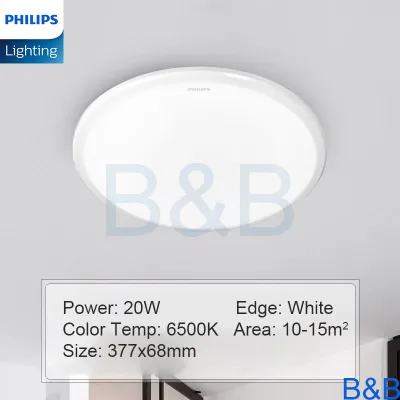
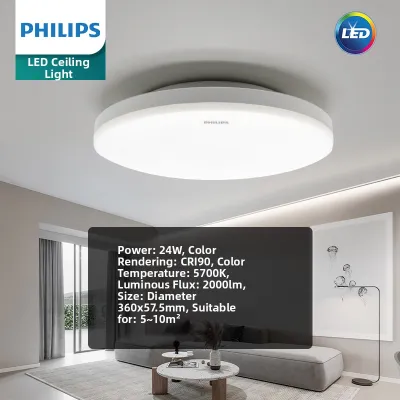
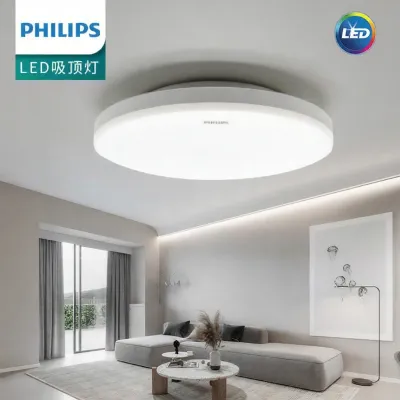
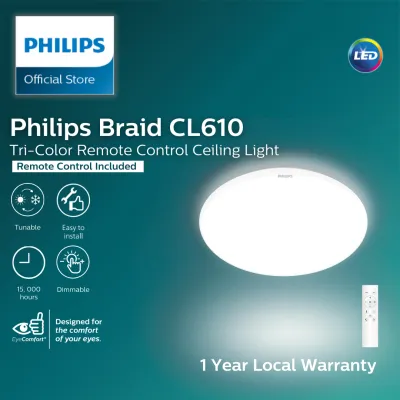
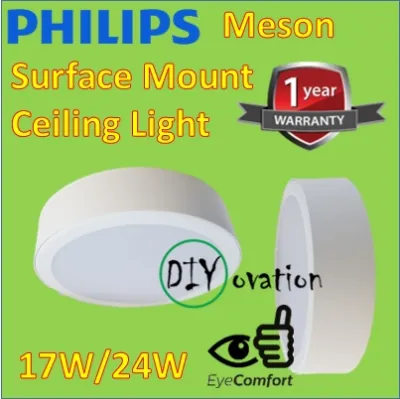
Prices are valid at publication and may change. Please refer to the product page for the latest price.
The psychological effect of low-hanging lights becomes even more pronounced in narrow areas, such as HDB corridors, entryways, and utility foyers. In these confined zones, flush-mount designs are essential for preserving an open, airy feel. A light fixture that sits nearly flush against the concrete slab allows light to spread horizontally across the ceiling surface, which visually expands the boundaries of the corridor and eliminates harsh, claustrophobic shadows.
Sizing and Brightness Guide for HDB Room Layouts
To achieve optimal lighting without overwhelming your home, you must match the physical size and light output of your chosen Philips led light to the specific dimensions of each room. For standard HDB bedrooms, which typically range from 10 to 15 square metres, a fixture diameter of 30 to 40 centimetres is highly recommended. In terms of brightness, look for a light output of approximately 1,500 to 2,500 lumens. This range provides excellent ambient illumination for daily activities without generating excessive glare that can strain your eyes in a smaller, enclosed space.

For larger communal spaces, such as combined living and dining areas that span roughly 20 to 30 square metres, you will need larger fixtures to distribute light evenly to every corner. Selecting a fixture with a diameter of 50 to 60 centimetres ensures that the scale of the light matches the furniture layout. These larger models should deliver between 3,000 and 4,500 lumens of brightness. Because these spaces host multiple activities, choosing a model with dimming capabilities or adjustable color temperatures is highly beneficial.
When browsing product specifications, it is vital to prioritize the “profile height” or physical thickness of the fixture over its diameter. A wide light with a very thin profile will look elegant and integrated, whereas a narrow light that protrudes deeply will look awkward. For a standard 2.6m ceiling, aim for fixtures that are under 5 to 8 centimetres in thickness. This low-profile design ensures the fixture blends seamlessly into the ceiling plane, maximizing both physical safety and visual space.
Additionally, pay close attention to the electrical specifications and certifications of any model you consider. Ensure the fixture is rated for Singapore’s standard electrical supply of 220V to 240V AC at 50Hz, and verify that it carries the Singapore Safety Mark. This certification guarantees that the internal LED driver and wiring have been tested to meet strict local electrical safety standards, protecting your home from potential short circuits or fire hazards.
Recommended Philips LED Light Categories for Low Ceilings
Philips offers several specialized categories of ceiling lights designed to address the challenges of low-clearance residential spaces. Understanding the design differences between these product lines will help you choose the right technology for your specific rooms.
Ultra-Slim and Flush-Mount Designs
Standard flush-mount LED ceiling ranges are the workhorses of HDB lighting, utilizing either edge-lit or direct-lit technology to achieve extremely thin profiles. Edge-lit models house the LED chips along the perimeter of the frame, directing the light sideways into a specialized light guide plate that disperses it downward. This engineering allows some models to achieve an incredibly slim profile of less than 3 centimetres. Direct-lit models place the LEDs directly behind the diffuser, but modern advancements have minimized the depth required to prevent individual light points from showing through.
A critical feature to look for in these standard ranges is the quality of the diffuser material. Philips utilizes high-quality PMMA (acrylic) or polycarbonate diffusers designed to eliminate harsh glare and distribute light uniformly. When a ceiling is only 2.6 metres high, you are physically closer to the light source than you would be in a high-ceiling home. A superior diffuser ensures that when you look upward, you see a soft, even glow rather than blinding hotspots, making these lights perfect for HDB corridors, kitchens, and study rooms.
Smart Lighting with Low Clearances
If you want to integrate your home into a smart ecosystem, the Philips Hue and Philips WiZ flush-mount ceiling light collections offer advanced features without sacrificing headroom. These smart fixtures allow you to adjust brightness levels and transition between warm white, cool white, and daylight settings. This color temperature tuning is incredibly valuable in multi-use HDB spaces; you can set a bright, cool daylight tone of 6500K for working or cleaning, and transition to a warm, cozy 2700K tone for evening relaxation.
Because smart ceiling lights contain integrated wireless receivers, Zigbee or Wi-Fi chips, and advanced dimming drivers directly inside the housing, they can sometimes be slightly thicker than basic non-smart models. It is crucial to verify the exact drop length in the product specification sheet before purchasing. Fortunately, many smart models are specifically designed with a shallow, tapered edge that visually tricks the eye, making the fixture appear even thinner than its physical measurements when mounted against a flat concrete ceiling.
Installation Constraints on HDB Concrete Ceilings
Mounting a new Philips led light on an HDB ceiling requires an understanding of the structural materials involved. Unlike drywall or plaster ceilings found in some landed properties, HDB ceilings are solid, reinforced concrete slabs. This means you cannot use standard drywall toggles or simple wood screws to secure your light. Safe installation requires a rotary hammer drill equipped with high-quality masonry drill bits to bore clean holes into the concrete, followed by the insertion of matching plastic wall plugs or concrete anchors to support the weight of the fixture.
Another common challenge is the alignment of the ceiling rose and the mounting bracket. HDB flats are typically handed over with a standard circular ceiling rose that houses the electrical connections. Modern, larger Philips flush-mount fixtures often feature mounting points that do not align perfectly with the pre-existing screw holes on the ceiling rose. To resolve this, installers must use universal mounting plates, crossbars, or adapter brackets that allow the fixture to be securely anchored to the concrete slab while covering the underlying junction box completely.
For wet or damp environments within your HDB flat, such as kitchens, bathrooms, or utility yards, you must verify the IP (Ingress Protection) rating of the fixture. Standard indoor ceiling lights are usually rated IP20, which offers no protection against moisture. In areas prone to steam and condensation, you should select fixtures with an IP44 rating or higher to prevent moisture from entering the electrical housing and causing premature driver failure or electrical trips.
Electrical safety must always be your top priority. Before attempting to inspect, remove, or install any ceiling fixture, you must isolate the power by turning off the corresponding circuit breaker at your home’s main consumer unit (DB box). In Singapore, any fixed electrical wiring work—including installing new light points, modifying existing circuits, or replacing ceiling fixtures that involve fixed wiring connections—must be carried out by an Energy Market Authority (EMA) licensed electrician. This ensures that the installation complies fully with local safety standards, protecting your warranty and your home’s safety.
Common Sizing and Selection Mistakes
One of the most frequent errors homeowners make is focusing entirely on the diameter of a ceiling light while completely ignoring its profile height or drop length. A fixture might have a compact 30-centimetre diameter, but if it projects 15 centimetres downward from the ceiling, it will severely disrupt the visual flow of a 2.6m room. Always check the full three-dimensional measurements of the product before making a decision.
Another common pitfall is falling in love with semi-flush mounts or pendant lights that feature decorative chains, rods, or hanging crystals. While these designs look beautiful in spacious showrooms with 3-metre ceilings, they are highly impractical for a standard HDB flat. Installing these fixtures in a 2.6m space often results in the bottom of the light hanging below the 2.0-metre mark, creating a physical hazard where residents can easily bump their heads or catch hand-held objects on the light.
Finally, avoid the temptation to over-light a small HDB bedroom by choosing an excessively high-lumen, large-diameter fixture. Installing a light designed for a large living room into a small study or bedroom creates a harsh, over-saturated environment that can cause eye strain and headaches. Furthermore, high-wattage fixtures can generate unnecessary heat buildup in compact spaces, forcing your air conditioning system to work harder to maintain a comfortable temperature.
Frequently Asked Questions (FAQ)
Can I install a Philips Hue ceiling light on an HDB concrete ceiling?
Yes, you can install a Philips Hue ceiling light on an HDB concrete ceiling, provided you use the correct mounting hardware. Because HDB ceilings are solid concrete, you must drill precise holes using a rotary hammer drill and secure the mounting bracket with high-quality masonry wall plugs. Additionally, smart ceiling lights require a constant electrical connection and contain integrated smart drivers. An EMA-licensed electrician should handle the fixed wiring installation to ensure the connections are safe, secure, and compliant with local electrical codes.
What is the maximum thickness a ceiling light should be for a 2.6m ceiling?
While there is no legal maximum thickness, keeping your ceiling light under 8 to 10 centimetres in thickness is highly recommended for a standard 2.6m HDB ceiling. Opting for a low-profile fixture between 3 and 8 centimetres ensures that you maintain comfortable headroom (at least 2.1 to 2.3 metres of clear vertical space) for taller residents and guests. This low profile also prevents the room from feeling visually cramped, maintaining a clean, modern, and spacious aesthetic throughout your home.
Community discussion
Share your experience or ask a question. Comments are reviewed before publication.