
Yes, the Philips Meson downlight is highly suitable for Singapore HDB flats with 2.6-meter ceilings. Its ultra-thin profile and integrated driver design make it one of the most practical recessed lighting choices for homes with limited vertical clearance. However, achieving a comfortable, glare-free environment requires careful planning. You must match the specific model’s recessed depth to your false ceiling cavity and calculate the correct spacing to avoid a cramped or overly bright atmosphere.
Understanding HDB Ceiling Constraints at 2.6m
Standard HDB flats, including both modern Build-To-Order (BTO) units and older resale apartments, typically feature a floor-to-ceiling height of approximately 2.6 meters. This height is functional but leaves very little vertical headroom for elaborate decorative lighting fixtures. Installing suspended chandeliers or thick flush-mount ceiling lights can make the living spaces feel visually congested and physically lower than they actually are.
To achieve a clean, modern aesthetic, many homeowners opt to install a false ceiling. This plasterboard structure is suspended below the original concrete slab to conceal electrical wiring, LED drivers, and structural unevenness. However, a standard false ceiling drop in an HDB flat usually ranges from 100mm to 150mm. Dropping the ceiling any further would breach local comfort preferences and make the rooms feel claustrophobic.
Products mentioned in this guide
![[Local Set] [3 Year Warranty] Philips Meson LED Downlight Ceiling Light 9W/13W Round/Square [Bundle Deal Available]](https://img.lazcdn.com/g/p/d8d02051d9b113c0010c4b1a40161081.png_400x400q80.png_.webp)
![[Climate Voucher] PHILIPS 3 Color Meson LED Downlight 5.5W 9W 13W 17W Tri Tone Scene Switch for False Ceiling Local Warranty](https://img.lazcdn.com/g/p/4f25f6fa6bf4fcf754b08b97b4102da3.jpg_400x400q80.jpg_.webp)
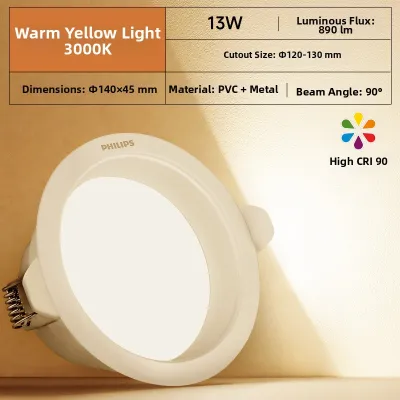
Prices are valid at publication and may change. Please refer to the product page for the latest price.
This limited plenum space—the empty cavity between the concrete slab and the plasterboard—creates a strict physical constraint. Any recessed luminaire you choose must fit comfortably within this shallow gap. If a downlight is too tall, it will physically strike the concrete slab above, preventing a flush installation and potentially damaging the fixture or the ceiling board. Therefore, verifying the physical dimensions of both your ceiling cavity and your chosen lighting fixture is the critical first step in your renovation planning.
Matching Philips Meson Dimensions to Your False Ceiling
The Philips Meson downlight series is highly regarded for its low-profile engineering, but you must still verify the exact dimensions of the specific model variant you intend to purchase. The Meson range includes multiple wattages—typically ranging from 5W to 21W—and each wattage corresponds to a different physical size, cut-out diameter, and recessed height. You can find these precise measurements on the official product packaging or the manufacturer’s technical specification sheet.

As a practical rule of thumb, the recessed depth of the downlight must be at least 20mm to 30mm shallower than the total depth of your false ceiling cavity. For example, if your false ceiling drop is 100mm, your downlight housing should ideally not exceed 70mm in height. This clearance is not merely for ease of installation; it is essential for safe heat dissipation, accommodating wiring bends, and bypassing minor structural obstructions like plasterboard metal runners.
Before purchasing, you must also verify the electrical specifications of the specific Meson model to ensure compatibility with your home’s electrical infrastructure. In Singapore, residential mains voltage is 230V at 50Hz, which matches standard local Philips retail models. Additionally, check the dimming method; the vast majority of standard Philips Meson downlights are non-dimmable. If you plan to use a dimmer switch, you must explicitly verify that the specific model variant supports dimming, as installing a non-dimmable LED on a dimmer circuit can cause persistent flickering, buzzing, or premature driver failure. Finally, look for local electrical safety certifications, such as the Singapore Safety Mark, to ensure the product has been tested and approved for safe domestic use.
If you are retrofitting an existing false ceiling, you must safely measure the available cavity depth before purchasing new fixtures. First, ensure the main power is isolated at the distribution board. Remove an existing light fixture or open a designated ceiling access panel. Insert a flexible wire probe or a non-conductive measuring tool upward through the opening until it gently contacts the concrete slab, then mark and measure the distance to the outer face of the drywall.
You must also verify the cut-out diameter, which is the exact size of the circular hole needed in the plasterboard. The Philips Meson series requires specific cut-out dimensions (such as 80mm, 105mm, 125mm, or 150mm depending on the wattage). Never assume a standard size fits all; always measure the physical product or refer to the manufacturer’s installation template before cutting any drywall.
Evaluating Light Distribution and Glare at 2.6m
In an HDB flat with a 2.6-meter ceiling, the distance between the light source and your eyes is relatively short. When standing, an average adult’s eyes are only 90cm to 100cm below the ceiling plane. This proximity makes glare control a critical factor in maintaining visual comfort and preventing eye strain. If a downlight distributes its light too intensely or lacks proper diffusion, it can create a harsh, dazzling effect when you look across the room.
The Philips Meson downlight features a wide beam angle, typically around 100 degrees or more. This wide distribution provides a soft, even wash of ambient light across the floor and walls, which is highly beneficial for low-ceiling environments. Unlike narrow-beam spotlights that create sharp, high-contrast pools of light and dark shadows, the Meson’s wide beam helps open up the space visually, making the room feel larger and more cohesive.
To ensure visual comfort, look closely at the design of the diffuser on the specific Meson model. These fixtures are engineered with integrated frosted diffusers that scatter the LED light evenly across the surface. This design helps minimize direct glare and hot spots. Additionally, verify if the model features Philips EyeComfort technology, which is designed to meet strict laboratory standards for flicker, strobe, and glare, ensuring the light remains gentle on the eyes during extended use.
While color temperature does not change the physical distribution of light, it heavily influences your spatial perception. For a 2.6-meter HDB ceiling, a warm white (3000K) or cool white (4000K) light is generally preferred for living spaces to create a cozy yet open feel. Avoid excessively bright daylight (6500K) in small, low-ceiling rooms unless the space is dedicated to high-precision tasks, as it can easily create a sterile, clinical atmosphere.
Installation Clearances and Electrical Safety
When installing recessed lighting like the Philips Meson downlight, safety and adherence to local regulations must be your highest priorities. Even though LED downlights generate significantly less heat than traditional halogen bulbs, they still produce thermal energy that must be dissipated. You must maintain adequate thermal clearance around and above the downlight housing to prevent heat buildup, which can degrade the LED chip and driver lifespan or pose a fire hazard if combustible materials are nearby.
Never cover the downlight or its external driver with thermal insulation or acoustic blankets unless the fixture is explicitly rated for insulation contact (IC-rated). Ensure that the air in the false ceiling plenum can circulate freely around the fixture. If you have installed acoustic rockwool or fiberglass insulation to reduce noise from neighbors upstairs, you must cut back the insulation to maintain a safe clearance of at least 50mm to 100mm around the perimeter of each downlight housing.
In Singapore, all fixed electrical wiring, new circuit routing, and modifications to the electrical system must comply with the local wiring standards (SS 638). Any such installation must be carried out by a Licensed Electrical Worker (LEW). Attempting to wire new ceiling points or modify your home’s electrical distribution board without proper licensing is illegal and voids your home insurance coverage. Always hire a qualified professional to handle the electrical connections.
Before performing any inspection, physical measurement, or fixture replacement, you must isolate the main power supply. Do not rely solely on the wall switch, as it may only cut the live wire while leaving the neutral wire active, or the switch itself could be miswired. Go to your home’s main distribution board (DB box) and switch off the corresponding miniature circuit breaker (MCB) or the main residual current circuit breaker (RCCB) to ensure the circuit is completely dead.
Common Sizing and Layout Mistakes in HDB Flats
Planning a lighting layout for a 2.6-meter HDB ceiling requires precision. One of the most common mistakes homeowners make is cutting drywall holes in the false ceiling before they have the physical downlights in hand. Minor design updates or model revisions can result in slight differences in the required cut-out diameter. Cutting holes prematurely often leads to loose-fitting fixtures, light leaks around the edges, or the need for messy and expensive plasterboard patching.
Another frequent error is failing to map out the false ceiling cavity for hidden obstructions. The plenum space behind your plasterboard is rarely completely empty; it often contains structural concrete beams, metal support frames, air-conditioning copper pipes, condensation drain lines, or water pipes. If you cut a hole directly beneath a concrete beam, you will not have the vertical depth required to mount the downlight. Always use a stud finder or refer to your renovation contractor’s framing plan before finalizing light positions.
Over-lighting is a pervasive problem in modern HDB renovations. Placing too many high-wattage downlights close together turns a relaxing living room into a harsh, clinical space. For a standard 2.6-meter ceiling, downlights should generally be spaced approximately 1.2 to 1.5 meters apart. This spacing ensures that the wide beam angles of the Philips Meson overlap sufficiently to eliminate dark spots while maintaining a warm, comfortable, and inviting residential atmosphere.
Finally, avoid placing downlights directly above seating areas, such as right over the sofa where you lie down, or directly in front of your television screen. Downlights positioned directly above seating can cause uncomfortable glare when you look up, while fixtures placed too close to a TV will create distracting reflections on the screen. Position the lights slightly offset from these key functional zones to maximize both comfort and usability.
Frequently Asked Questions (FAQ)
Can I install the Philips Meson downlight without a false ceiling?
No, you cannot install a standard recessed Philips Meson downlight directly into a concrete ceiling without a false ceiling. Recessed downlights require a physical cavity (plenum) behind the ceiling surface to house the recessed portion of the fixture, the electrical driver, and the connecting wires. If your HDB flat has an exposed concrete ceiling and you do not wish to install a false ceiling, you should look into surface-mounted alternatives. Philips offers surface-mounted downlights and surface track lighting systems that can be installed directly onto concrete slabs while maintaining a clean, modern aesthetic.
What is the ideal spacing for downlights in a 2.6m HDB living room?
For a standard 2.6-meter HDB living room, the ideal spacing for Philips Meson downlights is typically between 1.2 and 1.5 meters apart. This spacing allows the wide light beams to overlap smoothly near floor level, providing uniform ambient illumination without creating harsh shadows or dark corners. You should also position the downlights approximately 0.5 to 0.6 meters away from the walls to create a pleasing light wash effect on your walls and avoid casting harsh downward shadows on your wall art or furniture.
Community discussion
Share your experience or ask a question. Comments are reviewed before publication.