
Finding the right tri-colour LED ceiling light for a Singapore HDB flat requires evaluating fixtures based on physical dimensions, local safety certifications, and robust warranty frameworks rather than relying on brand names alone. Because HDB flats typically feature a standard ceiling height of 2.6 metres, the ideal brand is one that offers ultra-slim profiles, verified Enterprise Singapore (Safety Mark) certification, and accessible local after-sales support. By focusing on these core criteria, homeowners can avoid common pitfalls such as visual crowding, premature driver failure, and complicated warranty claims.
Sizing and Clearance Rules for HDB Ceilings
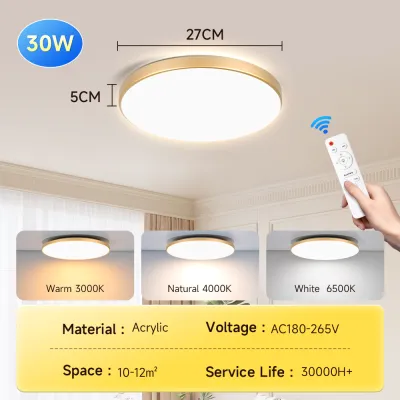
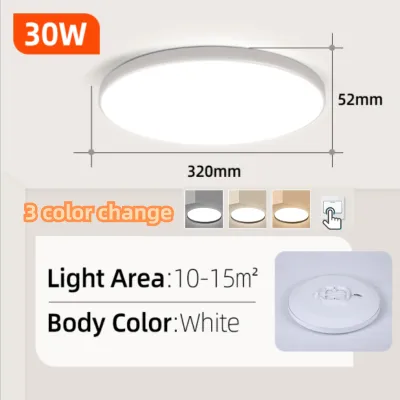
Standard HDB flats present unique spatial constraints that directly influence lighting selection. With a typical floor-to-ceiling height of approximately 2.6 metres, any fixture that protrudes too far downward can create a claustrophobic atmosphere and disrupt the visual flow of the room. To maintain an open and airy feel, homeowners should prioritize ultra-slim flush-mount ceiling lights. Fixtures with a profile thickness of 50 millimetres or less are highly recommended, as they sit close to the ceiling plane and minimize spatial intrusion.
Beyond thickness, the diameter of the ceiling light must be carefully matched to the room’s floor area to ensure balanced illumination. In standard HDB bedrooms, which generally range from 9 to 12 square metres, a fixture diameter between 350 millimetres and 450 millimetres is typically sufficient. This size provides ample light spread without dominating the ceiling. For larger living rooms, which often span 20 to 30 square metres, a single fixture with a diameter of 500 millimetres to 600 millimetres is more appropriate. Alternatively, homeowners can opt for a combination of a central flush-mount light and auxiliary recessed downlights to eliminate dark corners.
Products mentioned in this guide
![[Climate Voucher] PHILIPS 3 Color Meson LED Downlight 5.5W 9W 13W 17W Tri Tone Scene Switch for False Ceiling Local Warranty](https://img.lazcdn.com/g/p/4f25f6fa6bf4fcf754b08b97b4102da3.jpg_400x400q80.jpg_.webp)
![[3 Year Warranty] Philips Meson Scene Switch Downlight 3 Color Downlight Tri Color](https://img.lazcdn.com/g/p/c9bdcc527c086bb4edb1910bbd62abcf.jpg_400x400q80.jpg_.webp)
Prices are valid at publication and may change. Please refer to the product page for the latest price.
The visual design of the fixture also plays a critical role in how spacious a room feels. Edge-lit LED panels are particularly effective for low-ceiling environments. Unlike back-lit models that project light straight down in a concentrated beam, edge-lit fixtures distribute light laterally across the diffuser panel. This creates a softer, more even glow that bounces off the ceiling and walls, reducing harsh shadows and visually expanding the boundaries of the room. When evaluating brands, look for those that offer dedicated low-profile or edge-lit product lines designed specifically for compact residential spaces.
Evaluating Brand Reliability and Local Warranty Support
When shopping for tri-colour LED ceiling lights in Singapore, brand reliability is closely tied to local after-sales support and regulatory compliance. Because the Singapore market is flooded with parallel imports and unbranded fixtures via online marketplaces, verifying the authenticity of a brand’s local presence is essential. Homeowners should look for brands that operate physical showrooms or partner with established, authorised local distributors. A physical presence indicates a commitment to the local market and ensures you have a clear point of contact should technical issues arise.

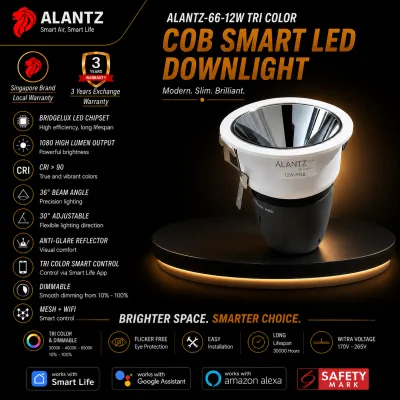
A critical step in evaluating any lighting brand is checking for the mandatory Enterprise Singapore Safety Mark. In Singapore, fixed electrical appliances, including LED drivers and ceiling light fixtures, must undergo rigorous testing to receive this certification. The Safety Mark ensures that the electrical components can withstand local voltage levels (230V, 50Hz) and are protected against short circuits, overheating, and electrical shocks. Never purchase or install a ceiling light that lacks a verified Safety Mark on its driver, as uncertified components pose a significant fire hazard in high-density HDB blocks.
Warranty terms can vary widely between brands, and reading the fine print is crucial before making a purchase. Homeowners should distinguish between “carry-in” warranties and “on-site” warranties. A carry-in warranty requires you to personally dismantle the faulty fixture, transport it to a service centre, and reinstall the replacement yourself. Conversely, an on-site warranty covers the cost of a technician visiting your HDB flat to diagnose, remove, and replace the faulty component. Given the height and electrical work involved, brands offering at least a one-to-two-year on-site warranty provide significantly better value and peace of mind.
It is also helpful to compare the support structures of international lighting giants versus local specialised brands. International brands often boast superior manufacturing standards, extensive research and development, and highly reliable, globally certified drivers. However, their warranty processes can sometimes be slowed down by corporate protocols. Local specialised brands, on the other hand, are highly attuned to the specific needs of HDB homeowners. They often provide faster response times, readily available spare parts, and flexible installation packages, making them a highly practical choice for local renovations.
Essential Technical Specs for Tri-Colour LED Models
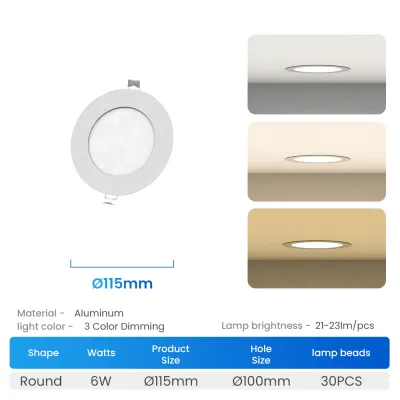
Tri-colour LED ceiling lights offer the convenience of switching between warm white (typically 3000K), cool white (typically 4000K), and daylight (typically 6500K) to suit different activities and times of day. The mechanism used to switch between these colours is a key technical specification to verify. The most common method is wall switch toggling, where flipping the existing wall switch off and on within a few seconds cycles the light to the next colour temperature. While this requires no special wiring, it can lead to synchronization issues if multiple lights are connected to a single switch.
For a more seamless user experience, some brands offer remote-controlled or smart-app-enabled tri-colour models. These systems allow you to adjust colour temperatures and dimming levels without cycling through switches. However, they require compatible internal receivers and drivers. When selecting a brand, verify the dimming method and ensure it matches your home’s wiring. Standard phase-cut wall dimmers are often incompatible with basic tri-colour LED drivers, leading to buzzing or flickering. If dimming is desired, ensure the fixture is explicitly rated as dimmable and paired with a compatible dimmer switch.
Visual comfort is heavily influenced by the Colour Rendering Index (CRI) of the LEDs. CRI measures how accurately a light source reveals the true colours of objects compared to natural sunlight. For residential spaces like living rooms and bedrooms, homeowners should look for fixtures with a minimum CRI of Ra 80. A higher CRI, such as Ra 90 or above, is ideal for dining areas and vanity mirrors, as it prevents colours from appearing dull or washed out.
Furthermore, visual health considerations should never be overlooked. Low-quality LED drivers often produce high-frequency flicker that, while invisible to the naked eye, can cause eye strain, fatigue, and headaches over prolonged exposure. Reliable brands utilize high-quality, flicker-free drivers that deliver a stable current to the LED chips. Additionally, check the Unified Glare Rating (UGR) of the fixture. A lower UGR (ideally below 19) indicates that the light diffuser is designed to minimize direct glare, protecting your eyes when looking toward the ceiling.
Installation Boundaries and Electrical Safety Checks
Installing a new tri-colour LED ceiling light involves working with fixed electrical wiring and working at height, both of which require strict adherence to safety protocols. Before purchasing a fixture, it is important to verify the load-bearing capacity of the existing ceiling junction box or concrete ceiling. Standard HDB concrete ceilings are exceptionally strong, but the mounting bracket must be secured using appropriate masonry wall plugs and screws. Ensure the screw hole spacing on the fixture’s mounting bracket aligns with the existing ceiling box to avoid drilling unnecessary holes.
In Singapore, electrical safety is governed by strict regulations. While homeowners are generally permitted to replace existing light fixtures on a like-for-like basis, any modification to the fixed electrical wiring must be carried out by a Licensed Electrical Worker (LEW). Scenarios that strictly require a licensed professional include installing new wiring routes, relocating light points, replacing missing earth wires, or integrating complex smart dimming systems. Attempting to alter fixed wiring without proper licensing is not only illegal but also poses severe safety risks.
Before undertaking any installation or maintenance work, mandatory power isolation is non-negotiable. Do not rely solely on the wall switch to cut the power, as some older HDB flats may have switched neutral wires, leaving the live wire active even when the switch is off. Always turn off the corresponding miniature circuit breaker (MCB) at the main distribution board (DB box). Once the power is isolated, use a reliable, non-contact voltage tester to verify that the ceiling wires are completely dead before touching them. Ensure you work on a stable ladder and have a second person present to assist with holding the fixture during mounting.
Frequently Asked Questions (FAQ)
Can I install a tri-colour LED light on a false ceiling in my HDB?
Yes, you can install a tri-colour LED light on an HDB false ceiling, but you must account for the limited load-bearing capacity of gypsum board. Standard plasterboard cannot support the weight of a heavy ceiling fixture directly. For lightweight fixtures (typically under 2 kilograms), you can use specialized spring toggle anchors or butterfly anchors that distribute the weight across a larger surface area of the board. For heavier fixtures, the mounting bracket must be screwed directly into the underlying metal support runners (studs) or secured to a timber support block installed behind the plasterboard. Always verify the weight of the fixture and the load limits of your false ceiling before installation.
Do tri-colour LED lights consume more electricity than single-colour models?
No, tri-colour LED lights do not consume more electricity than single-colour models of equivalent wattage. The power consumption of an LED light is determined by its rated wattage and the efficiency of its driver, not its ability to change colours. A tri-colour fixture contains both warm white and cool white LED chips. When you switch to warm white or daylight, only one set of chips operates at full capacity. When you switch to cool white (which is a mix of both), the driver balances the power distribution so that both sets of chips run at reduced capacity. Consequently, the overall energy consumption remains virtually identical across all three colour settings.
What should I do if the light only stays on one colour temperature?
If your tri-colour LED light stops cycling through colour temperatures, the issue is usually related to the switching speed or the LED driver. First, ensure you are toggling the wall switch at a moderate pace; flipping it too quickly or too slowly can prevent the driver’s internal controller from registering the command. If you have multiple lights on a single switch and they have fallen out of sync, turn off the wall switch for 10 to 15 seconds. This allows the capacitors in the drivers to discharge fully, resetting them to their default startup colour. If the light remains stuck on one colour despite resetting, the internal controller within the LED driver has likely failed, and the driver or the entire fixture will need to be replaced.

Community discussion
Share your experience or ask a question. Comments are reviewed before publication.