
When arranging a home altar in a Singapore HDB flat, placing Jade Emperor Money (玉皇钱) correctly is essential to maintaining spiritual respect and household harmony. The proper position for Jade Emperor Money is on the highest level of your altar setup, positioned centrally and directly in front of the supreme deity’s image or censer. Because the Jade Emperor represents the highest authority in the Taoist and traditional Chinese pantheon, these sacred offerings must occupy the most elevated and honorable position on the shrine, physically separated from and higher than offerings meant for lower-ranking deities or ancestors.
Navigating these traditional requirements within the compact spatial footprint of a modern HDB flat requires careful planning. By understanding the principles of vertical altar hierarchy, utilizing space-saving display solutions, and strictly adhering to local fire safety regulations, you can create a worship space that is both spiritually respectful and fully compliant with urban living standards.
Understanding Altar Hierarchy in a Singapore HDB Home
Traditional Chinese home altars in Singapore are deeply rooted in cosmological hierarchies, where the vertical plane represents the relationship between Heaven, Earth, and humanity. In a typical HDB flat, where floor space is at a premium, families rarely have the luxury of wide, multi-table altar spreads. Consequently, local worship practices have adapted by utilizing vertical, multi-tiered altars that maximize wall space while strictly preserving the spiritual order of precedence.
Products mentioned in this guide
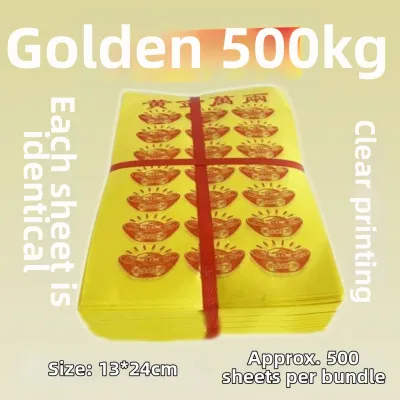
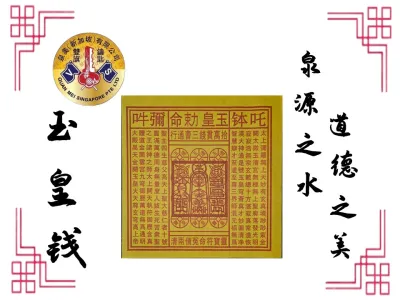
Prices are valid at publication and may change. Please refer to the product page for the latest price.
Within this vertical structure, the Jade Emperor—often referred to as Tiang Gong or the Heavenly Father—occupies the absolute pinnacle of the hierarchy. Even if you do not have a full-sized statue of the Jade Emperor, his presence is symbolically represented by a dedicated heavenly censer or specific sacred plaques. This supreme status dictates that any items associated with him, particularly Jade Emperor Money (玉皇钱), must be kept at the highest possible tier of the altar setup.
Understanding this hierarchy is a prerequisite for correctly placing any ritual items. If offerings are placed haphazardly, or if high-ranking heavenly offerings are mixed with those intended for earthly deities or ancestors, it is traditionally viewed as a disruption of spiritual order. Organizing your altar vertically ensures that you show the utmost cultural and religious respect while making efficient use of your HDB flat’s layout.
Correct Positioning for Jade Emperor Money (玉皇钱) Offerings
To ensure your rituals are conducted respectfully, you must pay close attention to how and where you stack, store, and present your offerings during active worship sessions.

Arranging Offerings During Active Worship
During a prayer session or festival, such as the Jade Emperor’s Birthday (Tian Gong Dan), the Jade Emperor Money should be placed front and center on the highest tier of your altar. If your altar is a single-flat surface, you can establish hierarchy by elevating the Jade Emperor Money on a dedicated ritual stand, a clean red tray, or a raised wooden platform. This physical elevation ensures that these sacred papers sit higher than any food offerings, tea cups, or joss paper intended for other deities.
When stacking the joss paper, ensure it is kept neat and undamaged. Unfold or fan out the sheets slightly if your local tradition requires it, but always keep them contained within a designated tray to prevent them from slipping or coming into contact with stray ash. The central placement signifies that these offerings are dedicated directly to the supreme ruler of Heaven before any other prayers are offered to lower-ranking house deities.
Positioning the Heavenly Censer and Holding Trays
In many Singaporean households, the censer dedicated to the Heavenly Father is either placed at the very front edge of the main altar table or suspended from the ceiling near the balcony or main window, facing outward toward the open sky. When placing your Jade Emperor Money relative to this setup, the holding tray containing the paper should sit directly behind or alongside the indoor censer.
Care must be taken to ensure that the stack of Jade Emperor Money does not block the deity’s image, plaque, or the main line of sight from the censer. It should also be kept at a safe distance from the active incense burner to prevent stray sparks from prematurely igniting the dry paper. If space is incredibly tight, you can place the holding tray on a small, temporary side table positioned adjacent to the high altar, provided it is kept clean, elevated, and dedicated solely to heavenly offerings for the duration of the prayers.
Navigating HDB Space Limits and Fire Safety Rules
Living in an HDB estate means balancing traditional religious obligations with community responsibility, space limitations, and strict safety guidelines.
Space-Saving Altar Arrangements
To maximize the limited footprint of a modern HDB living room, consider incorporating tiered acrylic or solid wood steps onto your existing altar surface. These steps allow you to create distinct vertical levels on a standard flat cabinet, making it easy to place the Jade Emperor Money on the topmost level without crowding the lower tiers where other deities or ancestral tablets reside. Modular acrylic risers are particularly popular in Singapore as they are easy to clean, lightweight, and do not visually clutter the worship area.
Crucial Safety Boundary
When handling and preparing Jade Emperor Money, fire safety must be your absolute priority. Singapore’s fire safety regulations strictly prohibit the burning of joss paper inside HDB flats, on balconies, or along common corridors. Burning materials in these confined residential spaces poses a severe fire hazard to your family and neighbors, creates excessive smoke that can trigger asthma or respiratory issues, and violates Town Council bylaws.
To practice your faith safely and legally, keep the Jade Emperor Money resting peacefully on your home altar throughout the entire prayer and offering ritual. Once the prayers are complete and the incense has finished burning, carefully gather the blessed joss paper and place it into a clean bag or container. Transport the offerings downstairs to the designated red or green metal burning bins, or the specialized eco-friendly burners, provided by the Town Council at the void deck or designated outdoor areas of your HDB estate. Always ensure the burning bin lid is closed properly after use to prevent ash from blowing into residential units.
Respectful Handling and Post-Ritual Maintenance
Maintaining a clean, orderly, and safe altar environment is a continuous practice that reflects your devotion and respect for the deities.
Once the incense sticks have completely burned down to ash, you can begin clearing the altar. Carefully collect the Jade Emperor Money from its elevated tray, ensuring that no loose ash or dust is scattered across the shrine. If any ash has fallen onto the altar surface, wipe it away immediately using a dedicated, clean cloth. Traditional etiquette suggests keeping a specific cloth solely for cleaning the altar, rather than using general household rags, to maintain spiritual purity.
Your choice of altar lighting also plays a significant role in both the aesthetic appeal and safety of your shrine. To illuminate your offerings and create a serene, traditional atmosphere, many homeowners prefer a warm red or yellow glow. Using safe, low-heat LED altar lamps is highly recommended over traditional wax candles or high-wattage incandescent bulbs, which can generate excessive heat and pose a constant fire risk.
When choosing LED altar lamps, verify their voltage compatibility (typically 220V–240V in Singapore), base or interface type (such as E12 or E14 screw bases), wattage limits, and physical dimensions to ensure they fit your shrine comfortably. Always look for local electrical safety certifications, such as the Safety Mark, to protect your home from electrical short circuits. If you are installing wall-mounted light fixtures or fixed wiring for a custom HDB altar, always isolate the power at the main distribution board before starting, follow the manufacturer’s installation instructions, and consult a qualified professional electrician for complex electrical work.
Frequently Asked Questions (FAQ)
Can I place Jade Emperor Money on the same tier as ancestor offerings?
No, Jade Emperor Money must never share the same physical tier or level as ancestor offerings. In traditional Chinese cosmology, heavenly deities occupy a vastly superior spiritual rank compared to ancestors. Mixing their offerings on the same level is considered highly disrespectful. As a quick rule of thumb for vertical separation on a standard HDB altar, always keep the Jade Emperor’s offerings on the absolute highest tier, other deities (such as Guan Yin or Guan Di) on the middle tier, and ancestral tablets and their associated offerings on the lowest tier or on a completely separate side table.
What if my HDB altar is too small for a separate Heavenly censer?
If physical space constraints prevent you from installing a separate, dedicated Heavenly censer, you can adopt widely accepted symbolic compromises. One common approach is to use a single, high-quality censer on your main altar, but dedicate your first and most respectful incense sticks to the Jade Emperor by facing outward toward the sky (the heavens) while praying, before placing the incense into the censer. Alternatively, you can install a small, secure, wall-mounted bracket just outside your main door or window to hold a compact Heavenly censer, ensuring it is structurally safe, approved by your household, and does not obstruct the common corridor or create a tripping hazard for neighbors.
Community discussion
Share your experience or ask a question. Comments are reviewed before publication.