
Quick Answer: Matching Yeelight Features to Room Needs
Selecting the right smart ceiling light depends on the room’s physical dimensions, primary functions, and your smart home ecosystem. There is no single model that fits every space perfectly; instead, a successful setup relies on matching specific product capabilities to the unique demands of each area in your home.
Living rooms require high lumen output, adjustable color temperatures, and optional ambient backlighting to accommodate both bright family gatherings and dim movie nights. Bedrooms demand low-glare diffusers, warm tones, and ultra-low moonlight modes to support healthy sleep cycles. Kitchens and dining spaces require high Color Rendering Index (CRI) values for visual clarity and food preparation, alongside dust and moisture resistance. By understanding these core requirements, you can systematically choose a model that enhances both the utility and comfort of every room.
Key Comparison Dimensions for Yeelight Ceiling Lights
Brightness (Lumens) and Wattage
When evaluating smart lighting, total lumen output is the primary metric of brightness, whereas wattage indicates power consumption. Modern LED efficiency varies, meaning a lower-wattage fixture from a premium series may produce more light than an older, higher-wattage model. For standard ceiling heights in Singapore homes (typically 2.6 to 2.8 meters in HDB flats and condominiums), a general guideline is to aim for 150 to 300 lumens per square meter for ambient areas, and 300 to 500 lumens per square meter for task-heavy zones. Calculate the total required lumens by multiplying your room’s square footage or square meterage by these targets, then verify the maximum lumen rating on the product label before purchasing.
Products mentioned in this guide
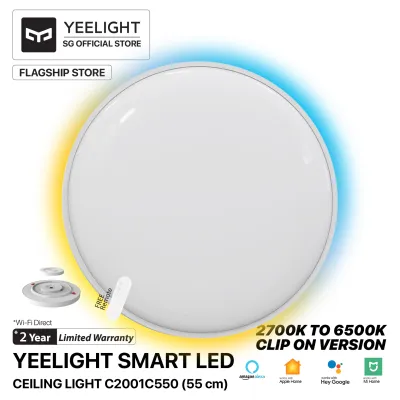
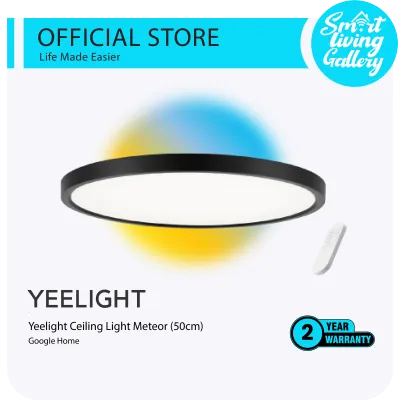
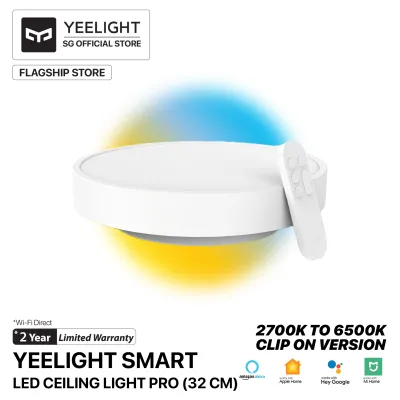
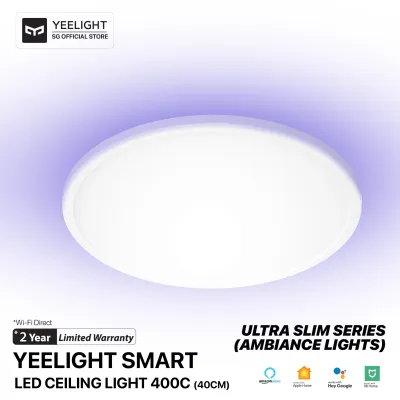
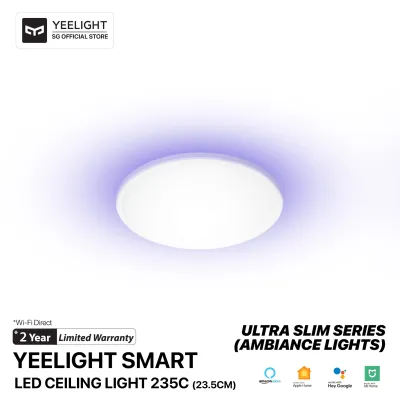
Prices are valid at publication and may change. Please refer to the product page for the latest price.

Color Temperature and Tunability
Color temperature is measured on the Kelvin (K) scale, ranging from warm yellow tones to crisp blue-white daylight. A range of 2700K to 6500K provides the versatility needed to transition a room’s atmosphere throughout the day. Warm white light (2700K to 3000K) mimics traditional halogen bulbs, promoting relaxation by signaling the body to wind down. Cool white to daylight (4000K to 6500K) suppresses melatonin production, making it ideal for focus, reading, and daytime productivity. Look for models featuring a dedicated “Moonlight Mode,” which utilizes specialized drivers to drop brightness down to 0.1 to 1 lumen, offering a soft nightlight that will not disrupt your sleep cycle.
Color Rendering Index (CRI)
Color Rendering Index, expressed as Ra, measures how accurately a light source reveals the true colors of objects compared to natural sunlight (which has a CRI of Ra100). Standard household LED fixtures often feature a CRI of Ra80 or lower, which can make skin tones look pale and home decor appear dull. Premium smart ceiling lights offer high color rendering of Ra90 or Ra95. This level of color fidelity is highly beneficial in spaces where visual precision is key, such as dining rooms where food is presented, closets where clothes are matched, and vanities where makeup is applied.
Smart Ecosystem and Controls
Smart ceiling lights operate on various communication protocols, primarily Wi-Fi (2.4GHz) and Bluetooth Low Energy (BLE) Mesh. Models using BLE Mesh require a compatible smart home hub or gateway to enable remote internet access and automated scenes. Compatibility varies across product lines: some models integrate natively with Apple HomeKit, Google Home, Amazon Alexa, and Samsung SmartThings, while others are optimized specifically for the Mi Home ecosystem. Consider how you prefer to control your lights, whether through mobile apps, physical wireless Bluetooth remotes, smart wall dimmers, or voice commands, and verify that your chosen model supports your preferred platform natively.
Room-by-Room Selection Guide
| Room | Primary Lighting Goal | Key Yeelight Features to Look For | Features to Avoid |
|---|---|---|---|
| Living Room | High ambient light, dynamic scenes, and entertainment integration | High lumen output (4000+ lm), dual-zone lighting (RGB backlight + main light), smart ecosystem compatibility | Low-lumen single-color fixtures, narrow beam angles |
| Master Bedroom | Relaxation, sleep support, and convenient night-time control | Tunable warm whites (2700K), Moonlight Mode (<2 lm), wireless remote or bedside switch compatibility | Harsh direct glare, high-intensity cool-only lights |
| Kitchen | High-visibility task lighting and environmental durability | High CRI (Ra90+), neutral-to-cool white (4000K-5000K), dust and insect-proof design (IP50+) | Low CRI (Ra80 or below), open fixtures prone to grease buildup |
| Dining Area | Cozy atmosphere and accurate food color representation | High CRI (Ra95), tunable color temperature, elegant aesthetic designs | Industrial cool-white-only fixtures, low-CRI bulbs |
| Home Office | Focus, alertness, and reduced eye strain | Cool daylight (5000K-6500K), flicker-free driver, high brightness | Ultra-warm dim-only lights, low-frequency PWM dimming |
| Bathroom / Balcony | Moisture resistance and compact, reliable illumination | Splash-proof rating (IP54 or higher), compact flush-mount design | Non-rated open fixtures, delicate smart features prone to humidity |
Living Room: High Brightness and Dynamic Scenes
Living rooms serve as the multi-functional hub of the modern home, hosting activities that range from working and reading to entertaining guests and watching movies. To accommodate these diverse needs, a living room ceiling light must deliver a high maximum lumen output, typically between 4,000 and 7,500 lumens depending on the room size. Models designed for large spaces often feature rectangular or wide circular profiles to ensure even light distribution across open-concept layouts.
For entertainment and social gatherings, look for models that feature dual-zone lighting. These fixtures combine a powerful downward-facing white light with an upward-facing RGB ambient backlight that casts soft, colored light onto the ceiling. Through smart home integrations, you can synchronize these lights with your media setup or program custom scenes. A “Movie Night” scene, for example, can automatically turn off the main downward light while setting the ceiling backlight to a dim, warm blue, reducing screen glare while maintaining safe ambient visibility.
Bedroom: Low Glare, Warm Tones, and Sleep Modes
Bedrooms require a lighting environment that prioritizes comfort, relaxation, and circadian support. Because you spend a significant amount of time looking upward while lying in bed, direct glare from exposed LEDs can cause eye strain and physical discomfort. To prevent this, prioritize ceiling lights equipped with high-quality PMMA diffusers or indirect lighting designs that scatter light evenly across the ceiling and walls, eliminating harsh hot spots.
To support natural sleep patterns, ensure the fixture can dim to ultra-low levels and shift to warm color temperatures below 3000K in the evening. A true “Moonlight Mode” that operates at 1 to 2 lumens is highly beneficial, as it provides enough illumination to navigate the room safely at night without triggering cortisol production or waking up a sleeping partner. Additionally, consider the convenience of physical controls; pairing the light with a wireless Bluetooth remote or a smart wireless switch mounted on your bedside table allows you to adjust or turn off the lights without having to get out of bed.
Kitchen and Dining: High CRI and Focused Illumination
Kitchens and dining areas present demanding lighting environments where safety, visual clarity, and atmosphere intersect. Food preparation involves sharp utensils and hot surfaces, which require bright, shadow-free illumination. Color accuracy is equally critical; a high CRI of Ra90 or higher ensures that you can accurately judge the freshness of raw ingredients and monitor cooking progress, while also making prepared meals look appetizing on the dining table.
For general kitchen tasks, a neutral to cool white light (4000K to 5000K) is recommended to promote alertness. However, because kitchens generate steam, grease, and airborne particles, the physical durability of the fixture is a key factor. Look for models with an IP50 or IP60 dustproof and insect-proof rating. This sealed design prevents tiny insects and cooking residue from accumulating inside the diffuser, preserving the light’s output and simplifying cleaning. While a central ceiling light provides excellent ambient fill, it should be supplemented by targeted task lighting, such as under-cabinet LED strips, to eliminate shadows on countertops.
Installation and Electrical Checks for Singapore Homes
Ceiling Structure and Mounting
Before purchasing a smart ceiling light, verify the structural integrity and material of your ceiling. Singapore homes generally feature either solid concrete ceilings (common in standard HDB flats) or plasterboard false ceilings (common in condominiums, landed properties, and renovated flats). Solid concrete ceilings offer excellent load-bearing capacity but require masonry drilling and rawl plugs to secure the mounting bracket. Plasterboard false ceilings cannot support heavy fixtures directly; if you are installing a large, heavy smart ceiling light, the mounting hardware must be anchored directly to the underlying metal support channels (studs) or secured using specialized heavy-duty hollow-wall toggle bolts to prevent structural failure.
Wiring and Neutral Connections
Smart ceiling lights require a continuous, uninterrupted power supply to maintain their wireless connections and respond to app or voice commands. Traditional mechanical wall switches operate by physically cutting the live wire circuit, which takes the smart light offline when turned off. If you plan to pair your smart lights with smart wall switches to maintain physical control without losing smart functionality, check if your switch boxes contain a neutral wire. While some smart switches operate on a “no-neutral” configuration, neutral-wire setups are generally more stable and prevent issues like light ghosting or flickering when the switch is off.
Smart Switch Compatibility
Do not connect smart LED ceiling lights to traditional physical wall dimmer switches. Traditional dimmers reduce brightness by clipping the incoming AC voltage waveform. Because smart lights contain sensitive internal electronics, including an LED driver, a wireless communication chip, and a microprocessor, reducing the input voltage will starve these components of power. This will cause the light to flicker violently, buzz, lose its wireless connection, or suffer permanent electrical damage. Use only standard on/off mechanical switches (which must remain in the “on” position) or dedicated smart wireless dimmers designed specifically for smart lighting ecosystems.
Professional Installation Boundary
Electrical safety is paramount when dealing with fixed household wiring. Singapore’s electrical grid operates at a standard voltage of 230V AC at 50Hz, which poses severe risks of electric shock, short circuits, and fire hazards if handled incorrectly. For any task beyond a direct, like-for-like replacement of an existing light fixture where the wiring is clear and safe, you must consult a licensed electrical worker (LEW) or a qualified professional electrician. This includes running new electrical lines, modifying fixed wiring, installing new switch boxes, or mounting heavy fixtures at height. Before performing any inspection or installation, always isolate the mains power supply at the Distribution Board (DB box) and verify that the circuit is completely dead using a reliable voltage tester.
Decision Framework: Choosing the Right Yeelight Series
To select the ideal model for your home, apply this conditional decision framework based on your room’s primary requirements and your existing smart home setup:
- Choose a model with uplighting and ultra-dim modes if your primary goal is bedroom comfort, minimizing glare while lying down, and establishing a relaxing wind-down routine. Look for circular models featuring a dedicated "Moonlight Mode" and a high-quality PMMA diffuser.
- Choose high-lumen, multi-zone control models if you are lighting a large living room or open-concept space that serves as an entertainment hub. Prioritize models with dual-zone lighting (main light + RGB backlight) and high lumen outputs (4000+ lm) to handle both bright daytime tasks and cozy evening movie sessions.
- Choose high-CRI, flush-mount models if you are installing fixtures in kitchens, dining areas, or home studies where visual precision, color accuracy, and insect-proof designs (IP50+) are essential. Ensure the fixture has a CRI of Ra90 or higher to keep colors true and food looking appetizing.
- Verify first if your preferred smart home platform (such as Apple HomeKit, Google Home, or Mi Home) natively supports the specific model, as some regional variants or older models may require specific hubs or are restricted to certain app ecosystems.
Frequently Asked Questions (FAQ)
Can I use a standard wall dimmer with Yeelight ceiling lights?
No, you cannot use a traditional physical wall dimmer switch with Yeelight smart ceiling lights. Smart lights manage their dimming digitally using internal electronic drivers. Connecting them to a traditional wall dimmer that cuts voltage will cause severe flickering, buzzing, connection drops, and can permanently damage the internal wireless and driver modules. Keep your physical switches as standard on/off switches, or replace them with compatible smart wireless dimmers.
Do Yeelight ceiling lights work without an internet connection?
Yes, Yeelight ceiling lights will retain basic functionality without an internet connection. If you use a physical wall switch, turning it off and on will power-cycle the light, typically turning it on at a default brightness and color temperature. Paired physical Bluetooth remotes or wireless smart dimmers will also continue to control the light locally. However, advanced features such as mobile app control, automated scheduling, voice assistant integration, and remote access from outside the home require an active internet connection and a stable local Wi-Fi network.
Community discussion
Share your experience or ask a question. Comments are reviewed before publication.