
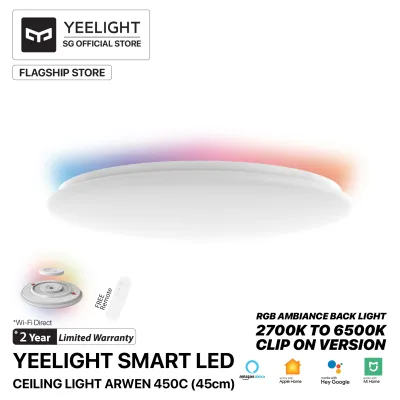
The Yeelight Arwen 450C is generally well-suited for standard 2.6-meter Housing & Development Board (HDB) ceilings in Singapore, provided you verify its physical dimensions and your room’s specific layout before purchasing. Because a 2.6-meter ceiling height leaves limited vertical clearance compared to private properties with higher ceilings, choosing a low-profile fixture is essential to maintain a comfortable, open living environment. To ensure this 450mm-diameter smart ceiling light fits your home, you must evaluate its physical drop height, confirm its light output matches your room’s square footage, and check your concrete ceiling’s mounting compatibility. Taking these steps prevents common installation pitfalls, such as visual crowding, clearance issues with ceiling fans, or electrical safety hazards.
Evaluating the Physical Fit and Mounting Depth
Standard HDB flats built in recent decades typically feature a floor-to-ceiling height of approximately 2.6 meters. When planning your lighting layout, maintaining a safe and comfortable clearance beneath any ceiling fixture is paramount. Ideally, the bottom of a ceiling light should sit at least 2.1 to 2.3 meters above the finished floor level. This clearance ensures that tall family members can walk freely without the risk of bumping their heads and allows for normal daily activities, such as changing bedsheets or raising your arms, without accidentally striking the fixture.
To determine if the Yeelight Arwen 450C meets these clearance guidelines, you must check the manufacturer’s official product label or specification sheet for its exact mounting depth, canopy thickness, and total drop height. Because this model is designed as a relatively low-profile, surface-mounted ceiling light, its physical protrusion is typically minimal compared to suspended pendant lights or semi-flush fixtures with long downrods. However, you should always measure the exact distance from the concrete ceiling slab to the lowest point of the fixture’s diffuser to calculate the precise remaining headroom in your specific room.
Products mentioned in this guide
Prices are valid at publication and may change. Please refer to the product page for the latest price.
Calculating the remaining headroom is a straightforward process: subtract the fixture’s total drop height from your measured ceiling height of 2.6 meters. For example, if a fixture has a total depth of 10 centimeters (0.1 meters), the remaining headroom will be 2.5 meters, which is well above the recommended safety threshold. In a spacious HDB living room, this minor reduction in vertical space is barely noticeable. However, in a smaller common bedroom or a study, a 450mm-diameter fixture can visually lower the ceiling if it is not balanced correctly, making the room feel slightly more enclosed. You must weigh this visual impact against the practical benefits of having a broad, even source of ambient light.
Matching Light Output to HDB Room Sizes
Typical HDB rooms vary significantly in floor area, with common bedrooms usually measuring around 9 to 11 square meters, master bedrooms ranging from 12 to 15 square meters, and living rooms often exceeding 20 square meters. When selecting a ceiling light, you must match its light output to the spatial volume of the room rather than relying solely on the physical diameter of the fixture. A larger room requires more lumens—the measure of total visible light emitted by a source—to achieve adequate brightness, especially if the room has dark walls, heavy curtains, or minimal natural light.

Before finalizing your purchase, check the official packaging or the manufacturer’s user manual for the exact lumen output and wattage specifications of the Yeelight Arwen 450C. Do not assume that a 450mm fixture will automatically provide sufficient illumination for a large living room or, conversely, that it will be overwhelmingly bright for a small bedroom. For a standard HDB common bedroom, a light source emitting around 2,000 to 3,000 lumens is generally sufficient for general ambient lighting. If you plan to install this fixture in a larger living area, you may need to supplement it with secondary light sources, such as track lights, downlights, or floor lamps, to eliminate dark corners.
One of the primary advantages of modern smart ceiling lights is their adjustable color temperature and dimming capabilities, which you should verify on the product’s specification sheet. The ability to transition from a cool white light (around 6500K) for daytime tasks to a warm, cozy yellow light (around 2700K) for evening relaxation is highly beneficial in multi-functional HDB spaces. Dimming capabilities allow you to customize the perceived brightness of the room dynamically, ensuring that a 450mm fixture can be dialed back in a smaller bedroom to prevent glare, or run at full capacity when you need maximum visibility for cleaning or working.
Installation Requirements and HDB Ceiling Constraints
Mounting any ceiling light in an HDB flat requires careful consideration of the structural and electrical environment. HDB ceilings are constructed from solid concrete slabs, which behave differently than plasterboard or drywall ceilings found in some private properties. You must verify that your existing ceiling junction box is compatible with the mounting bracket of the fixture and that the concrete slab can securely support the weight of the light. While surface-mounted LED fixtures are generally lightweight, securing them properly requires appropriate masonry wall plugs and screws designed for concrete.
Electrical safety is the most critical aspect of any lighting installation. Before attempting to mount or replace a fixture, you must turn off the main power supply at your home’s distribution board (DB box) by switching off the corresponding circuit breaker. Verify that the power is completely off using a reliable voltage tester at the ceiling wires. In Singapore, electrical installations must comply with local safety standards, such as SS 638. If you are replacing an older fixture, check the condition of the existing wiring; older flats may have degraded insulation or lack a dedicated earth (ground) wire, which is essential for safety when installing fixtures with metal components.
If your installation requires drilling new holes into the concrete ceiling, running new wiring trunking, or modifying the existing electrical layout, you should consult a licensed electrical worker (LEW) or a qualified professional electrician. Attempting to drill into HDB concrete slabs without proper tools or knowledge can damage embedded electrical conduits or structural reinforcement bars. While professional installation services in Singapore typically range from S$50 to S$120 per fixture, hiring a qualified professional ensures that the fixture is mounted flush against the concrete, that all wire connections are secure and properly insulated, and that the installation complies fully with local housing and electrical regulations.
Common Sizing and Placement Mistakes to Avoid
A frequent mistake when installing a 450mm ceiling light in an HDB room is centering the fixture based purely on the room’s physical walls without considering the furniture layout. In a bedroom, the bed often occupies a significant portion of the floor space, shifting the visual center of the room. If the light is centered on the ceiling but sits directly over the pillows, it can create uncomfortable glare when you are lying down. Instead, plan the placement so the light distributes evenly over the active walking areas or aligns with the functional center of the room, keeping wardrobe doors and cabinet clearances in mind.
The visual weight of a 450mm fixture must also be balanced against the room’s proportions and color scheme. In a compact HDB common bedroom, a wide, dark-rimmed, or thick ceiling light can dominate the ceiling plane, making the room feel smaller than it is. To mitigate this, consider how the fixture’s design integrates with your wall colors and ceiling paint. A white or pastel ceiling paint combined with a slim, white-framed fixture helps the light blend seamlessly into the background, reducing its visual impact when turned off and creating a cleaner, more spacious aesthetic.
Finally, always inspect your ceiling for physical obstructions before purchasing or installing the fixture. Standard HDB rooms often feature structural beams, air-conditioning trunking, or existing ceiling fans that can interfere with both the physical mounting and the light distribution. A ceiling fan, in particular, poses a double challenge: a ceiling light placed too close to a fan’s rotating blades will create a highly distracting strobing effect as the blades repeatedly block the light. Ensure there is adequate horizontal clearance between the outer edge of the 450mm fixture and the tips of any ceiling fan blades to maintain a safe, flicker-free environment.
Frequently Asked Questions (FAQ)
Can the Yeelight Arwen 450C be flush-mounted if the ceiling is too low?
To determine if the Yeelight Arwen 450C supports a true flush-mount configuration, you must consult the official product manual or installation guide provided by the manufacturer. Some smart ceiling lights feature a quick-change base that mounts directly to the ceiling junction box, allowing the main body of the light to sit flush against the concrete surface. You must never attempt to modify the mounting bracket, cut the internal wiring, or alter the fixture’s housing to force a flush fit if it is not designed to do so. Unauthorized modifications can compromise the electrical insulation, void the manufacturer’s warranty, and create severe safety hazards, including electrical short circuits or fire risks.
Is a 450mm light too large for a standard HDB common bedroom?
A 450mm-diameter ceiling light is generally not too large for a standard HDB common bedroom, which typically measures around 9 to 11 square meters, but its suitability depends on your room’s layout. A common interior design guideline suggests that the diameter of a ceiling fixture in inches should roughly equal the sum of the room’s length and width in feet; for a 3m by 3m room (approximately 10ft by 10ft), this guideline suggests a fixture diameter of around 20 inches (approximately 500mm). Therefore, a 450mm fixture fits well within these visual proportions. However, you must compare this footprint against your actual ceiling space to ensure it does not physically conflict with wardrobe doors, air-conditioning units, or the sweep of a ceiling fan.

Community discussion
Share your experience or ask a question. Comments are reviewed before publication.