
Standard HDB flats in Singapore typically feature a floor-to-ceiling height of 2.6 meters. When planning a smart home upgrade, this vertical constraint plays a massive role in your lighting choices. Installing a bulky, hanging fixture can instantly make a room feel cramped, reduce clearance for daily activities, and disrupt the visual flow of your living space. To maintain an open, airy atmosphere while enjoying the benefits of smart automation, choosing a low-profile Zigbee ceiling light is essential. These slim, surface-mounted fixtures provide ample illumination, offer dynamic color temperature control, and integrate into your smart home ecosystem without sacrificing precious headroom. By focusing on physical thickness, proper lumen output, and local electrical safety standards, you can successfully transform your HDB flat into a modern, well-lit smart home.
Why Fixture Thickness Matters for 2.6m Ceilings
In a 2.6m space, every centimeter counts. Traditional pendant lights or thick surface-mounted fixtures that protrude 10cm or more from the ceiling draw the eye downward. This visual weight creates an illusion of a lower ceiling, making standard HDB rooms feel smaller than they actually are. By contrast, ultra-slim flush-mount lights—ideally those with a thickness of 2cm to 5cm—blend into the ceiling plane, allowing the eye to travel across the room unobstructed. This design choice helps maintain the original spatial proportions of the flat, making the living areas feel more expansive.
Beyond aesthetics, physical clearance is a practical safety consideration. Standard HDB flats often have structural beams or pre-installed ceiling fan hooks that limit where you can place fixtures. If you have tall family members or frequently perform tasks like changing bedsheets, lifting storage boxes, or exercising indoors, a protruding light fixture becomes a physical hazard. Keeping the fixture as close to the ceiling as possible minimizes the risk of accidental contact and ensures a safer living environment.
Products mentioned in this guide
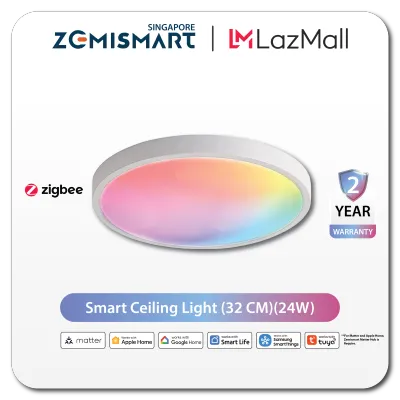
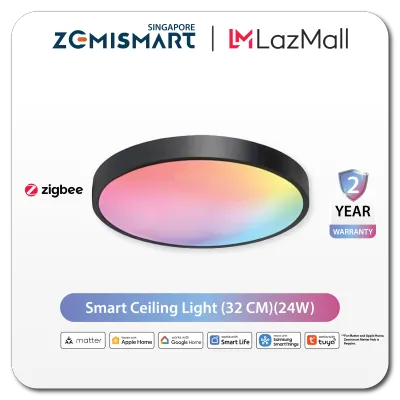
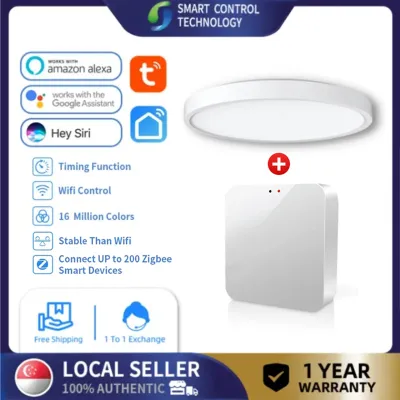
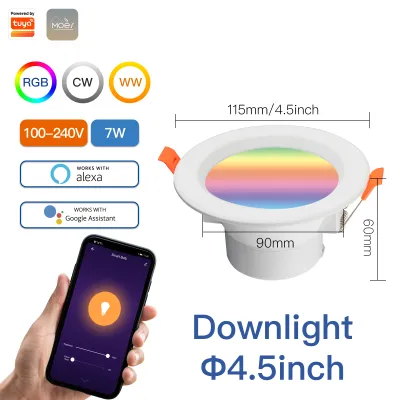
Prices are valid at publication and may change. Please refer to the product page for the latest price.
It is also important to distinguish between surface-mounted and recessed profiles. While recessed downlights offer a completely flush look, they require a false ceiling to conceal the drivers and wiring. Installing a false ceiling in a 2.6m HDB flat typically reduces the clearance height by another 10cm to 15cm, leaving you with a ceiling height of around 2.45m or less. For many homeowners, this trade-off is undesirable as it can make the entire flat feel claustrophobic. Surface-mounted slim Zigbee ceiling lights offer a practical middle ground: they mount directly to the existing concrete slab, preserving the maximum possible ceiling height while delivering a clean, modern aesthetic.
Essential Specs to Compare for Zigbee Ceiling Lights
When shopping for Zigbee ceiling lights, technical specifications should guide your decision rather than aesthetic appeal alone. The first critical metric to evaluate is lumen output, which measures the actual brightness of the light, rather than wattage, which only measures power consumption. Because modern LED technology is highly efficient, a lower-wattage light can often produce the same brightness as an older, high-wattage model. To determine the required lumens for your space, consider the room’s function and size. For a standard HDB master bedroom of about 12 square meters, a light output of 2,000 to 2,500 lumens is generally sufficient for general illumination. For a larger living room of 20 square meters, you should target 3,500 to 4,500 lumens. A helpful guideline is to aim for approximately 150 to 200 lumens per square meter for general living spaces, and up to 300 lumens per square meter for task-oriented areas like kitchens or study rooms.

Adjustable color temperature (CCT) is another vital feature of smart ceiling lights. Look for fixtures that offer a wide, continuous spectrum, typically ranging from a warm 2700K (ideal for winding down in the evening) to a crisp 6500K (suitable for daytime productivity or detailed tasks). The ability to automate these transitions via Zigbee allows your lighting to mimic natural circadian rhythms, gradually shifting from cool daylight in the morning to warm, dim tones at night. Ensure the product specifications state “stepless dimming and color tuning” to avoid jarring, stepped transitions when adjusting the light.
Physical housing dimensions must also be carefully matched to the room. A fixture’s diameter affects both light distribution and visual proportion. For small hallways or bomb shelters, a compact fixture of 20cm to 30cm in diameter is appropriate. For bedrooms, a diameter of 40cm to 50cm strikes the right balance, while spacious living rooms can accommodate fixtures up to 60cm wide. Always cross-reference the fixture’s diameter with its thickness; a wider light that is ultra-thin (under 3cm) distributes light more evenly across a low ceiling, reducing harsh shadows in the corners of the room.
Finally, verify the Zigbee protocol version and compatibility. Most modern smart lighting fixtures utilize the Zigbee 3.0 standard, which offers improved energy efficiency, better security, and wider compatibility across different brands. Check whether the light requires a proprietary manufacturer hub to access its full feature set, or if it can integrate directly with open-source coordinators or universal smart home hubs. Choosing a standard Zigbee 3.0 device ensures that your lighting remains functional and customizable even if you decide to switch your smart home platform in the future.
Installation Safety and HDB Electrical Boundaries
Upgrading to smart ceiling lights involves working with fixed electrical wiring, which carries inherent safety risks and strict regulatory boundaries in Singapore. The standard domestic electrical supply in Singapore is 230V AC at 50Hz. Before purchasing any Zigbee ceiling light, especially from international online marketplaces, you must verify that the driver is rated for this voltage range. Using a fixture designed solely for 110V markets will cause immediate electrical failure and poses a severe fire hazard.
Another common point of confusion for HDB homeowners is the presence of a neutral wire. While smart wall switches often require a neutral wire to remain powered when the light is turned off, smart ceiling lights are connected directly to the ceiling’s terminal block, where both live and neutral wires are always present. This means you do not need to worry about rewiring your walls to install a smart ceiling light. However, because the smart light requires constant electrical power to receive Zigbee signals, your physical wall switch must remain in the “on” position at all times. If someone accidentally flips the wall switch off, the light will lose power and go offline, rendering smart automations useless. To prevent this, you can install physical switch guards or replace the traditional switch with a smart wireless scene controller.
You must also consider the load limits of your home’s lighting circuits. Standard HDB lighting circuits are typically rated for 6A or 10A, which is more than enough for modern LED fixtures that draw minimal current. However, if you are planning a whole-home upgrade with multiple smart lights, smart drivers, and sensors, it is wise to calculate the cumulative wattage to ensure you do not overload the circuit.
In Singapore, structural safety and electrical compliance are strictly regulated. Any installation, modification, or replacement of fixed electrical wiring must be carried out by a Licensed Electrical Worker (LEW) certified by the Energy Market Authority (EMA). Attempting to wire a new ceiling fixture yourself not only poses a risk of electrocution but can also void your home insurance policy and violate local housing regulations. A professional installer will ensure that the fixture is securely anchored to the concrete ceiling slab, preventing the risk of a falling hazard, and that all electrical connections are properly insulated and grounded.
Before any inspection, cleaning, or professional installation takes place, the primary safety step is to isolate the power supply. Do not rely on the wall switch to cut the power, as some older or improperly wired systems may still have a live current running to the ceiling point even when the switch is off. Always locate your home’s main Distribution Board (DB box) and switch off the specific miniature circuit breaker (MCB) labeled for lighting. Verify that the power is truly off by using a reliable voltage tester at the ceiling wires before proceeding.
How to Filter and Verify Models on Online Retailers
Navigating online marketplaces for smart lighting requires a critical eye, as product listings can often be misleading. When filtering for slim Zigbee ceiling lights, never rely solely on the main product images. Manufacturers frequently use digital rendering and clever angles to make their fixtures appear paper-thin. Instead, scroll down to the detailed product description and locate the technical dimension diagram. Verify the exact thickness in millimeters. For a 2.6m HDB ceiling, look for fixtures with a total depth of 50mm or less, with the most optimal models sitting between 20mm and 35mm.
Electrical safety compliance is another non-negotiable factor when buying online. In Singapore, controlled electrical appliances must carry the Enterprise Singapore Safety Mark, which indicates that the product has been tested and certified to meet local safety standards. If you are purchasing a light from an overseas seller, check if the product has recognized international certifications such as CE, RoHS, or CB scheme certification. Avoid unbranded or extremely cheap fixtures that lack clear safety labeling, as their internal LED drivers may use substandard components prone to overheating or premature failure.
Because smart home devices rely on wireless communication, compatibility issues can occasionally arise. Before finalizing your purchase, carefully review the retailer’s return policy. Look for sellers that offer a hassle-free return window of at least 7 to 14 days. This gives you the opportunity to unbox the fixture, connect it to your Zigbee coordinator on a test bench, and verify that it pairs correctly and responds to commands before permanently mounting it to your ceiling.
Additionally, pay close attention to the warranty terms. Unlike traditional light fixtures where you can simply swap out a blown bulb, modern slim ceiling lights feature integrated LED strips and built-in Zigbee drivers. If either of these components fails, the entire fixture must usually be replaced. Ensure the product comes with a comprehensive warranty of at least one to two years. Verify whether the warranty is covered by a local distributor or if you would need to ship the item back overseas for a replacement, as local warranty support offers significantly more convenience and peace of mind.
Frequently Asked Questions (FAQ)
Do Zigbee ceiling lights work without a dedicated smart hub?
No, Zigbee ceiling lights cannot connect directly to your home’s Wi-Fi router or smartphone without a dedicated smart hub or coordinator. Zigbee is a low-power, local mesh networking protocol designed specifically for smart home devices. To control the light via an app, set schedules, or link it to other smart devices, you must have a compatible Zigbee hub (such as a universal smart home hub, a compatible smart speaker with a built-in Zigbee radio, or a dedicated USB coordinator connected to a home automation server). While some Zigbee lights can pair directly with a physical Zigbee remote control using a protocol called Touchlink, this setup only allows basic dimming and on/off control from the remote itself, completely bypassing the smart automation features that make Zigbee lighting so beneficial.
Will a smart ceiling light interfere with an existing HDB ceiling fan?
Combining a smart ceiling light with a ceiling fan in a 2.6m HDB room requires careful spatial planning. First, consider the physical clearance. If a surface-mounted light is placed too close to a ceiling fan, the rotating blades will periodically block the light beam, creating a highly distracting strobe or flickering effect across the room. To prevent this, ensure the light fixture is installed well outside the sweep radius of the fan blades. Second, consider wireless signal interference. Large metal fan motors and rotating blades can occasionally obstruct or degrade wireless signals. Fortunately, because Zigbee operates as a mesh network, each mains-powered Zigbee device acts as a signal repeater. Having other smart plugs, switches, or lights nearby will help route the signal around the fan, ensuring a stable and responsive connection regardless of the fan’s operation.
Community discussion
Share your experience or ask a question. Comments are reviewed before publication.