
Finding the most energy-efficient CCT (Correlated Color Temperature) COB (Chip-on-Board) LED strip in Singapore does not come down to a single brand name. Instead, it requires evaluating the luminous efficacy—measured in lumens per watt (lm/W)—of individual products alongside the efficiency of their accompanying LED drivers. Because Singapore’s tropical climate and typical residential layouts, such as false ceilings in HDB flats and condominiums, can trap heat, choosing a strip with high thermal efficiency and verified specifications is key to securing long-term energy savings.
To make an informed decision, you must look past marketing claims on online marketplaces and focus on verifiable technical data. By comparing the rated power consumption against the actual light output, understanding how color tuning affects power draw, and selecting compatible, high-efficiency drivers, you can design a lighting system that minimizes electricity consumption while delivering excellent illumination. This guide provides the technical framework needed to evaluate and compare different brands available in the local market.
Understanding Energy Efficiency in CCT COB LED Strips
Luminous efficacy is the primary metric used to measure the energy efficiency of any light source. Expressed in lumens per watt (lm/W), this value tells you how much visible light a strip produces for every watt of electricity it consumes. To calculate this from a manufacturer’s specification sheet, divide the total luminous flux (lumens per meter) by the rated power consumption (watts per meter). A higher lm/W rating means more light and less wasted energy, which directly translates to lower electricity bills.
Products mentioned in this guide
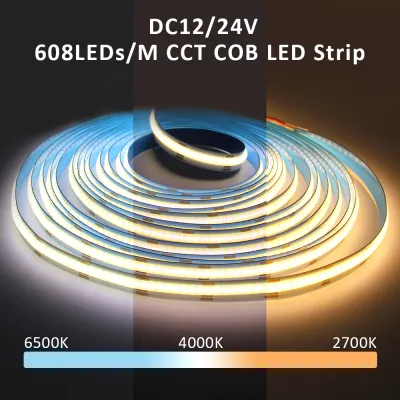
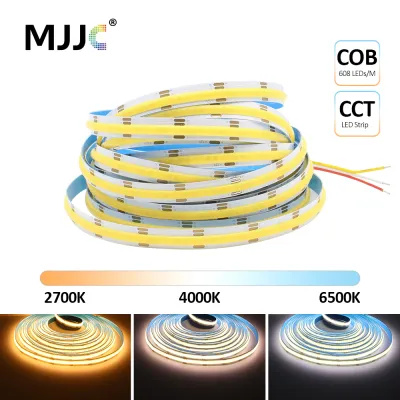
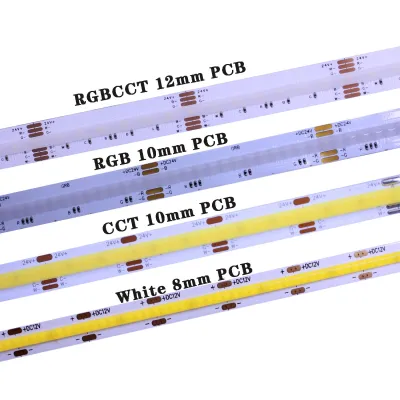
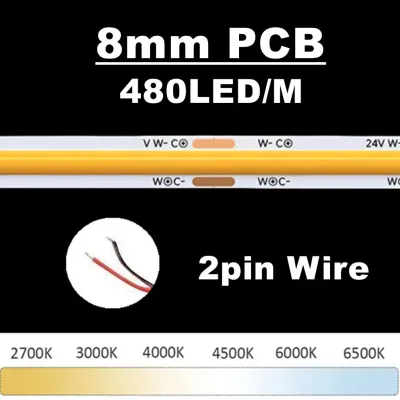
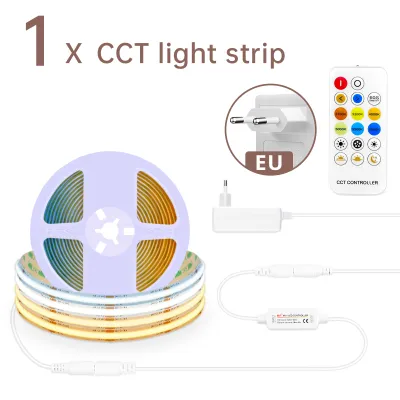
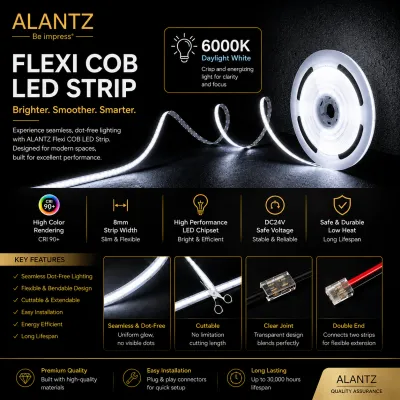
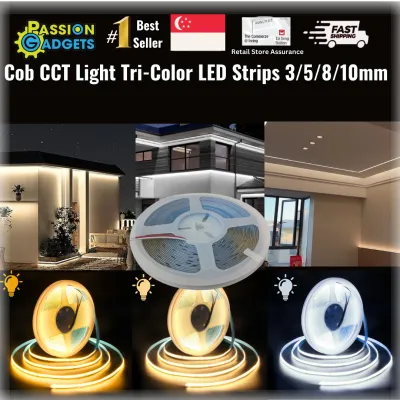
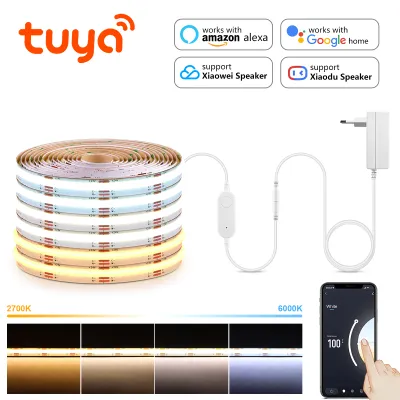
Prices are valid at publication and may change. Please refer to the product page for the latest price.
COB technology offers distinct thermal and structural differences compared to traditional Surface Mounted Diode (SMD) strips. While SMD strips feature individual, spaced-out diodes, COB strips place hundreds of tiny LED chips directly onto a flexible printed circuit board (FPCB) under a continuous phosphor coating. This dense arrangement eliminates visible dark spots and creates a seamless line of light. However, packing diodes so closely together concentrates heat. In Singapore’s warm, humid climate, efficient heat dissipation is critical; if a strip runs too hot, its luminous efficacy drops, and the diodes degrade prematurely.
Dual-chip CCT strips, which allow you to tune the light from warm white to cool white, use two sets of diodes with different color temperatures. When you adjust the color temperature, the controller balances the power between these warm and cool channels. If both channels run at full capacity simultaneously, the power draw reaches its peak. High-quality brands design their controllers and strips to limit the maximum combined wattage, ensuring that tuning the color temperature does not lead to unexpected spikes in energy consumption or overload the power supply.
Key Specifications to Compare Across Brands
When evaluating different brands, the first specification to verify is the relationship between rated power consumption (W/m) and luminous flux (lm/m) at both color extremes. Many strips are highly efficient at a cool 6500K but lose efficacy at a warm 2700K because warm white phosphors inherently absorb more light. A premium brand will provide detailed photometric reports showing the lumen output for both warm and cool settings, allowing you to calculate the true efficacy across the entire tuning spectrum.

Another critical factor is the trade-off between the Color Rendering Index (CRI) and energy efficiency. A high CRI (such as Ra 90 or Ra 95) is desirable for residential spaces because it makes colors appear vibrant and true to life. However, achieving high color fidelity requires a broader spectrum of light, which often necessitates denser phosphor coatings that reduce overall light output. If energy savings are your absolute priority, you may need to balance your needs, choosing a slightly lower CRI (such as Ra 80) for general utility areas and reserving high-CRI strips for task lighting or feature walls.
The electrical design of the strip also plays a major role in long-term efficiency. Constant Voltage (CV) strips are common and affordable, but they suffer from voltage drop over long runs, leading to dimmer light at the far end of the strip and wasted energy in the form of heat. In contrast, Constant Current (IC) strips feature small integrated circuits along the tape that regulate the current flowing to each section. This design ensures uniform brightness from start to finish, prevents power waste, and protects the diodes from electrical stress.
Finally, examine the physical construction of the FPCB, specifically the copper thickness. High-quality brands use double-sided FPCBs with copper weights of 2oz or 3oz. Thicker copper acts as an internal heat sink, drawing thermal energy away from the LED chips and distributing it evenly along the strip. This superior thermal management keeps the diodes running at their optimal, most efficient operating temperature, preserving both brightness and energy efficiency over years of daily use.
Evaluating Long-Term Savings and System Efficiency
An energy-efficient LED strip is only as good as the power supply, or LED driver, that runs it. The driver converts high-voltage alternating current (AC) from your home’s mains into the low-voltage direct current (DC) required by the strip. Cheap, unbranded drivers often have low conversion efficiency, meaning they waste a significant portion of incoming electricity as heat before it even reaches the LEDs. When comparing systems, look for drivers with a verified efficiency rating of 90% or higher.
In Singapore, safety and compliance are paramount when selecting electrical components. Any LED driver connected to fixed wiring must carry the Singapore Safety Mark, which indicates that the product has been tested and certified to meet local safety standards. Using a certified driver not only ensures compliance with local regulations but also guarantees that the device operates within safe electrical parameters, reducing the risk of short circuits, overheating, and unnecessary power loss.
To assess the long-term value of your investment, look for lumen maintenance ratings, typically expressed as L70 or L80. An L70 rating of 50,000 hours means that after 50,000 hours of use, the strip will still produce at least 70% of its original light output. Brands that provide clear, third-party tested lumen maintenance data and offer robust warranties are generally more reliable. Investing in a durable, high-efficacy strip prevents the need for premature replacements, saving you money on both hardware and installation labor.
Decision Framework: Choosing the Right Brand for Your Setup
To select the ideal CCT COB LED strip for your home, you must match the product’s specifications to your specific installation environment. If you plan to install the strips inside slim, enclosed aluminum profiles—a popular choice for modern Singaporean interiors—heat buildup will be rapid. In these restricted spaces, prioritize lower-wattage, high-efficacy strips (such as 8W/m to 10W/m) that deliver sufficient brightness without generating excessive heat that could damage the adhesive or degrade the diodes.
For large-scale installations, such as continuous cove lighting around a living room ceiling, focus on brands that offer constant-current IC designs and thick copper bases. These features allow you to run longer continuous lengths without experiencing voltage drop or uneven illumination. Pairing these runs with a single, highly efficient, centrally located driver simplifies the wiring layout and ensures that the entire system operates at peak electrical efficiency.
Before finalizing your purchase, verify the compatibility between your LED strip, driver, and control system. If you plan to dim your lights, ensure that the driver supports your preferred dimming protocol, whether it is phase-cut, 0-10V, or a smart protocol like DALI. Incompatible components can cause persistent flickering, buzzing, or incomplete dimming, all of which subject the system to electrical stress and lead to unnecessary energy loss.
Always prioritize safety during installation. Before mounting your strips or connecting any wiring, isolate the mains power at the distribution board. If your project involves fixed electrical wiring, working at heights, or integrating complex smart home automation systems, stop and consult a licensed electrical worker (LEW) in Singapore. Professional installation ensures that your energy-efficient lighting system is configured safely, complies with local building codes, and operates reliably for years to come.
Frequently Asked Questions (FAQ)
Does adjusting the color temperature (CCT) change the energy consumption?
Yes, adjusting the color temperature can change the energy consumption, depending on how the controller manages the power distribution. In a dual-chip CCT strip, warm white and cool white diodes are mounted side-by-side. If you set the strip to a neutral white (usually around 4000K), both sets of diodes light up to blend the colors, which can increase power draw. However, many high-quality controllers are programmed to limit the total power output so that the combined wattage never exceeds the strip’s maximum rated limit, keeping energy consumption stable across different color temperatures.
Are COB LED strips inherently more energy-efficient than standard SMD strips?
COB LED strips are not automatically more energy-efficient than standard SMD strips. While COB technology provides a more uniform, dot-free light output and better heat distribution across the circuit board, the actual energy efficiency (lm/W) depends on the quality of the individual LED chips, the phosphor blend, and the driver used. A high-quality SMD strip can sometimes achieve higher luminous efficacy than a lower-grade COB strip. When shopping, always compare the specific lumens-per-watt rating on the product datasheet rather than assuming one packaging format is superior.
How do I calculate the total power requirement for my LED strip setup?
To calculate the total power requirement, multiply the rated wattage per meter of the LED strip by the total length of the run. For example, if you are installing 5 meters of a strip rated at 12W/m, the base power requirement is 60 watts. To ensure safe and efficient operation, you must add a 20% safety headroom to prevent the power supply from running at its absolute limit. Multiplying 60 watts by 1.2 gives you a target of 72 watts, meaning you should select an LED driver rated for at least 75 to 80 watts.

Community discussion
Share your experience or ask a question. Comments are reviewed before publication.