
Selecting a reliable motion sensor LED flood light for outdoor security in Singapore requires looking beyond basic marketing claims to verify electrical compliance, build quality, and sensor accuracy. Because Singapore’s tropical climate subjects outdoor fixtures to intense heat, high humidity, and heavy monsoon downpours, choosing a brand that offers robust weatherproofing and local warranty support is essential. While established global brands like Philips, Ledvance, and Steinel are widely available and trusted for their engineering standards, your final decision should depend on verifying specific model certifications, ingress protection ratings, and sensor technologies suitable for your property’s layout.
By focusing on verifiable technical specifications and local compliance rather than generic brand popularity, you can ensure your security lighting remains operational year-round. This guide outlines the core criteria for evaluating outdoor lighting brands, explains the technical specifications that dictate long-term durability, and provides a structured framework to help you build a reliable shortlist for your home or commercial property.
Core Criteria for Evaluating Outdoor Lighting Brands
When evaluating motion sensor LED flood light brands, the first and most critical step is verifying electrical safety certifications and compliance marks. In Singapore, electrical appliances connected to the mains grid must meet strict safety standards to prevent short circuits, electrical fires, and shocks. Look for brands that clearly document compliance with international standards such as IEC 60598 for luminaires. Reputable brands will readily provide technical datasheets and certification labels on their packaging, giving you confidence that the internal circuitry is designed to handle local voltage standards safely.
Products mentioned in this guide
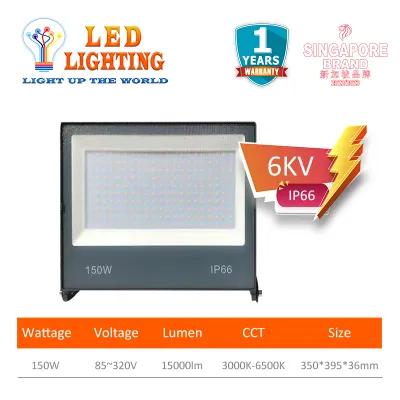
![Very Bright IP67 LED Flood Light | LED Light | LED 30W 50W 100W 150W 200W [Rainproof] *2 YEAR WARRANTY*](https://img.lazcdn.com/g/p/a94f935be2c8201b20af86a112c95844.jpg_400x400q80.jpg_.webp)
![LEDVANCE Floodlight ECO LED 20W [830/840/865]](https://img.lazcdn.com/g/p/ce55bf604dd2a9e2d7a62b2a3a4d084b.jpg_400x400q80.jpg_.webp)
![LEDVANCE Floodlight ECO LED 30W [830/840/865]](https://img.lazcdn.com/g/p/a66ce7dc9889045ff871e841fedbb108.jpg_400x400q80.jpg_.webp)
Prices are valid at publication and may change. Please refer to the product page for the latest price.
Warranty terms and the availability of local after-sales support are equally important indicators of a brand’s reliability. Outdoor lighting is constantly exposed to harsh environmental stressors, making component failures more common than with indoor fixtures. A trustworthy brand should offer a comprehensive local warranty, typically ranging from one to three years, backed by an authorized distributor or service center in Singapore. This ensures that if a driver fails or a sensor stops responding, you can easily obtain a replacement or repair without dealing with the high shipping costs and long wait times associated with parallel imports.
Material quality plays a decisive role in how well a flood light withstands Singapore’s weather. Reliable brands construct their flood light housings from high-grade die-cast aluminum rather than cheap plastics. Aluminum acts as an efficient heat sink, drawing heat away from the LED chips to prevent premature degradation and maintain consistent light output over time. Additionally, the motion sensor housing should be made of UV-stabilized polycarbonate to prevent the plastic from becoming brittle, yellowing, or cracking under constant exposure to intense tropical sunlight, which would otherwise allow water to seep into the electronics.
Essential Specifications for Motion Sensor Flood Lights
To ensure your chosen LED flood light can survive heavy downpours and high humidity, you must verify its Ingress Protection (IP) rating. The IP rating consists of two digits: the first indicates protection against solid particles like dust, and the second indicates protection against liquids. For outdoor security lighting in Singapore, an IP65 rating is the recommended minimum, meaning the fixture is completely dust-tight and protected against water jets from any direction. For highly exposed areas that lack the protection of roof eaves or awnings, upgrading to an IP66-rated fixture provides superior resistance against torrential rains.

Understanding the difference between sensor technologies is also vital for preventing false triggers and ensuring accurate detection. Passive Infrared (PIR) sensors are the most common technology used in outdoor security lights. They work by detecting changes in infrared radiation, or heat signatures, within their field of view, making them highly effective at identifying humans and vehicles while ignoring wind-blown leaves or rain. Microwave sensors, on the other hand, emit high-frequency radio waves and measure the reflection off moving objects. While microwave sensors are incredibly sensitive and can detect motion through thin walls or glass, they are often too sensitive for outdoor residential use in Singapore, as they can be easily triggered by heavy rain, birds, or nearby traffic.
Finally, you must match the light’s performance specifications to your specific security needs. Lumen output determines the brightness of the flood light; for standard residential driveways, backyards, or side pathways, a range of 1,000 to 3,000 lumens (approximately 10W to 30W LED) is generally sufficient to illuminate the area without causing glare issues for neighbors. Color temperature is another key consideration, with cool white (4000K) or daylight (6500K) being the preferred choices for security lighting because they provide crisp, high-contrast visibility that enhances the clarity of security camera footage. A wide beam angle of 100 to 120 degrees ensures broad coverage, minimizing dark corners and blind spots around your property.
Installation and Environmental Considerations
Before purchasing any outdoor flood light, you must confirm its electrical compatibility with Singapore’s power grid. The standard mains voltage in Singapore is 230V AC at a frequency of 50Hz. Ensure that the product specifications explicitly state compatibility with this voltage range. Furthermore, because outdoor fixtures are exposed to moisture, proper grounding (earthing) is non-negotiable for safety. The fixture must be connected to a grounded circuit to ensure that any electrical faults are safely directed to the earth rather than posing a shock hazard to occupants.
Mounting height and sensor positioning are critical to maximizing the effectiveness of your motion sensor. To achieve the optimal balance between detection range and tamper resistance, mount the flood light at a height of 2.2 to 2.5 meters. At this height, the sensor can project its detection zone effectively across the target area while remaining out of reach of potential intruders. Angle the sensor slightly downward to focus its field of view on your immediate property boundaries, which helps prevent the light from being triggered by passing pedestrians or vehicles on the public street.
It is important to establish a clear boundary between simple adjustments and tasks that require professional expertise. While adjusting the sensor’s physical angle or changing user settings can be done safely by the homeowner, any fixed-wiring installation or modification to your home’s electrical system must be performed by a Licensed Electrical Worker (LEW) in Singapore. This is a legal and safety requirement under local regulations, ensuring that all outdoor wiring, junction boxes, and conduits are installed to meet the rigorous SS 638 electrical wiring standards. Always isolate the power supply at the main distribution board before attempting any physical inspection or maintenance on the fixture.
Building Your Conditional Shortlist
To simplify your buying decision, compile a structured comparison matrix of potential models from reputable brands available through local retailers. Your matrix should list the specific model number, verified IP rating, sensor type, wattage, lumen output, and the length of the manufacturer’s warranty. By organizing this information side by side, you can easily identify which models offer the best balance of durability and performance for your specific installation site, rather than relying on vague brand reputations.
When sourcing your flood light, cross-reference product listings on local online marketplaces with the official technical specifications published on the manufacturer’s website. Counterfeit or mislabeled lighting products are common on unregulated online platforms, often boasting inflated lumen outputs or fake IP ratings. Verifying that the model number listed by the seller matches the official manufacturer documentation is an effective way to ensure you are purchasing a genuine, high-quality product designed for the Singapore market.
As a final filter, eliminate any options that lack clear technical documentation, comprehensive user manuals, or verifiable safety marks. A reliable manufacturer will always provide detailed installation instructions, wiring diagrams, and clear guidelines on how to adjust the sensor settings. If a brand or seller cannot provide these basic resources, or if their warranty terms are vague and lack local contact information, it is best to remove them from your shortlist and focus on established brands that prioritize transparency and customer support.
Maintenance and Long-Term Performance
To keep your motion sensor LED flood light operating at peak efficiency, establish a simple routine for regular maintenance. Over time, Singapore’s high humidity and ambient dust can lead to a buildup of dirt, mold, or water spots on both the LED lens and the motion sensor cover. Every few months, gently wipe down the exterior of the fixture with a soft, damp cloth. Avoid using harsh chemical cleaners or abrasive scrubbers, as these can scratch the optical lens or damage the sensitive plastic cover of the PIR sensor, reducing its detection range and accuracy.
During your cleaning routine, take a moment to inspect the fixture for early signs of wear or environmental damage. Look closely for any condensation or water droplets trapped inside the LED housing, which indicates that the weatherproof seals have degraded. Check for flickering light output or erratic sensor behavior, such as the light staying on indefinitely or failing to trigger when motion occurs. Identifying these issues early allows you to address them under warranty before a complete electrical failure occurs.
Finally, be prepared to adjust your sensor’s sensitivity and time-delay settings as your outdoor environment changes. Over several months, growing garden vegetation, hanging branches, or new outdoor furniture can enter the sensor’s detection zone, leading to frequent false triggers. Most reliable motion sensor flood lights feature manual dials on the sensor body labeled “SENS” (sensitivity) and “TIME” (duration). Periodically fine-tuning these settings ensures that the light only activates when genuine movement is detected, preserving the lifespan of the LED driver and minimizing energy consumption.
Frequently Asked Questions (FAQ)
Can solar-powered motion sensor flood lights replace wired models for security?
While solar-powered motion sensor flood lights offer the convenience of wireless installation, they are generally less reliable than wired 230V models for critical security applications in Singapore. Solar lights rely entirely on daily sunlight exposure to charge their internal batteries. During Singapore’s monsoon seasons, prolonged overcast skies and heavy rain can severely limit charging efficiency, resulting in dim light output or a complete lack of power during the night. For consistent, high-intensity illumination that remains dependable regardless of weather patterns, wired flood lights connected to the mains power grid are the preferred choice.
How do I prevent false triggers from pets or moving branches?
To minimize false triggers, start by adjusting the physical angle of the sensor downward so that its detection zone is focused strictly on your property’s walkways rather than surrounding trees or public paths. Many PIR sensors also come with plastic masking stickers or shutters that allow you to physically block out specific sections of the lens, effectively blinding the sensor to areas with heavy foliage or pet activity. Additionally, you can use the sensitivity dial on the sensor housing to lower the detection threshold, ensuring the light only activates in response to larger heat signatures, such as an approaching human, rather than smaller animals or wind-blown debris.

Community discussion
Share your experience or ask a question. Comments are reviewed before publication.