
Switching to Chip-on-Board (COB) LED strips from older lighting technologies like fluorescent tubes or standard Surface Mounted Device (SMD) strips can significantly lower your electricity consumption, but the exact savings depend on how you configure and run your system. While COB technology is highly praised for its seamless, dot-free light output, its energy efficiency is not a universal constant. To understand your actual savings, you must look beyond marketing claims and calculate the real-world power draw of your specific setup.
By evaluating the electrical specifications of each option, factoring in driver efficiency, and applying your local utility rates, you can determine whether upgrading to COB LED strips makes financial sense for your home. This guide provides the exact formulas and steps needed to compare these lighting systems and calculate your potential return on investment.
Comparing Power Consumption: COB, SMD, and Fluorescent Tubes
When comparing COB LED strips, SMD strips, and fluorescent tubes, look past physical length and focus on electrical specifications. Power consumption is determined by the rated wattage (W) per meter or per fixture, while the actual light output is determined by luminous efficacy, measured in lumens per watt (lm/W).
Products mentioned in this guide
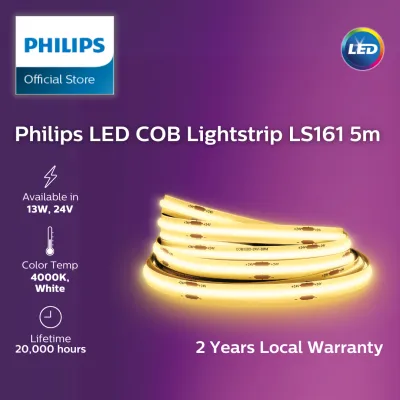
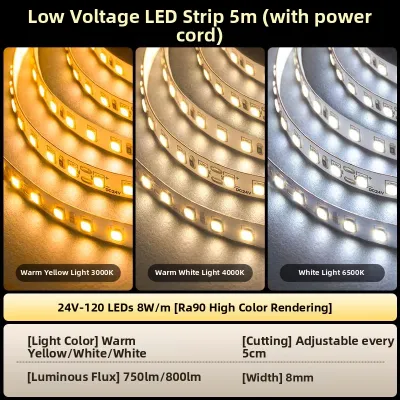
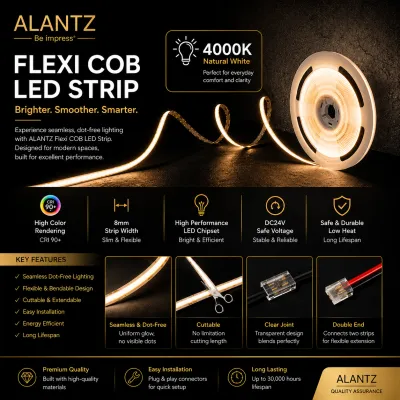
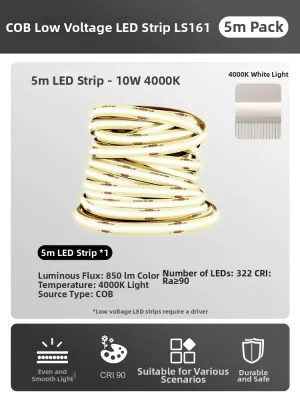
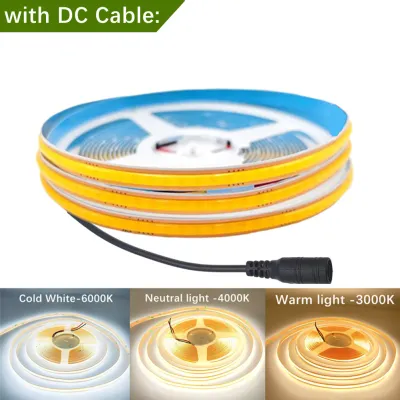
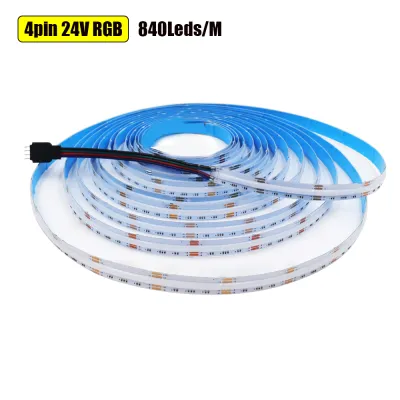
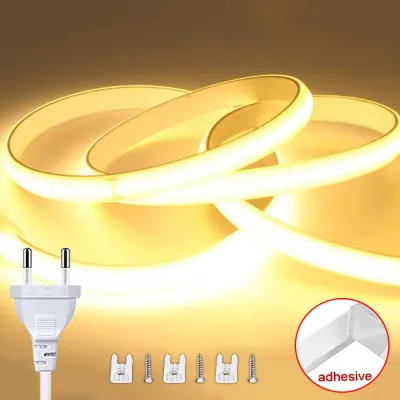
Prices are valid at publication and may change. Please refer to the product page for the latest price.
Luminous efficacy tells you how efficiently a light source converts electricity into visible light. Check the manufacturer’s specification sheet for each lighting type. A high-quality COB LED strip might deliver a similar efficacy to a standard SMD strip, but its primary advantage is aesthetic uniformity. Fluorescent tubes generally have lower efficacy and lose significant light output over their lifespan.
To make an accurate comparison, compare setups that deliver equivalent brightness (total lumens). For example, if replacing a traditional 1.2-meter fluorescent tube that outputs 2,400 lumens, do not simply buy any 1.2-meter COB LED strip. Instead, find a COB strip configuration that matches that 2,400-lumen output, and then compare the total wattage required to achieve it.
Step-by-Step Guide to Calculating Energy Savings
To find out how much electricity you will save by upgrading, you can use a straightforward mathematical framework. This calculation requires knowing the total wattage of your existing lighting system and the projected wattage of your new COB LED strip system.

The core formula to calculate your energy savings is: (Wattage A – Wattage B) × Hours Used ÷ 1000 = Daily kWh Saved
In this formula, Wattage A represents your current lighting setup, and Wattage B represents the new COB LED strip setup. To find the monthly or annual savings, multiply the daily kilowatt-hour (kWh) savings by 30 or 365 days, respectively.
Select realistic daily usage hours. For continuous applications like cove lighting in a living room or under-cabinet lighting in a kitchen, a typical household might run the lights for 5 to 8 hours per day.
Additionally, account for the entire system’s power draw, not just the LED strip. Low-voltage LED strips require an external power supply, or LED driver, to convert household AC power to low-voltage DC power. Because these drivers are not 100% efficient, they lose some energy as heat. If your LED driver has an efficiency rating of 85%, a strip that draws 40 watts will actually pull approximately 47 watts from your wall socket (40W ÷ 0.85 = 47W). Always use this total wall-plug draw in your calculations.
Translating kWh Savings into Actual Cost Reductions
Once you have calculated your total kilowatt-hour savings, convert this figure into actual monetary savings using your local utility rates.
Locate your current electricity rate per kWh on your latest utility bill. In Singapore, residential electricity tariffs can vary depending on whether you are on a regulated tariff or a fixed-price plan with an independent retailer. Use the exact rate, including any prevailing taxes or surcharges, to ensure your calculation is accurate.
Multiply your calculated monthly or annual kWh savings by your electricity rate to find your financial savings in S$. For example, if your upgrade saves you 30 kWh per month and your electricity rate is S$0.30 per kWh, your monthly savings will be S$9.00.
To determine if the upgrade is financially viable, calculate the payback period using this simple template: Payback Period (Months) = Initial Hardware & Installation Cost (S$) ÷ Monthly Savings (S$)
The initial cost should include the price of the COB LED strips, compatible LED drivers, aluminum profiles for heat dissipation, and any professional installation fees. If you are mounting lights at height or modifying fixed electrical wiring, hire a licensed electrician to ensure safety and compliance with local electrical standards. Factoring in these professional costs gives you a realistic timeline for when the system will pay for itself.
Real-World Variables That Impact Efficiency
While theoretical calculations provide an excellent baseline, several real-world operational factors can alter the actual energy efficiency of your COB LED strip installation over time.
Thermal management is critical. LEDs become less efficient and draw more current as their operating temperature rises. If a COB LED strip is installed without proper heat sinking, such as being stuck directly onto wood or drywall without an aluminum profile, the heat buildup will degrade the chips. This degradation permanently reduces their luminous efficacy, meaning you get less light for the same amount of power.
The choice of control systems also plays a role in overall energy consumption. Adding smart controllers, dimmers, or motion sensors introduces a small, continuous standby power draw. While dimming the lights does reduce the active power consumption of the strip, the standby power of the controller runs 24 hours a day. Check the standby specifications of your smart home controllers to ensure they do not offset your active energy savings.
Finally, account for voltage drop in long continuous runs of LED strips. As electricity travels down a low-voltage strip, resistance in the copper traces causes the voltage to drop, resulting in dimmer light at the far end of the run. Properly managing voltage drop ensures uniform brightness and prevents your LED driver from working harder than necessary, preserving the system’s overall efficiency.
Frequently Asked Questions (FAQ)
Do COB LED strips consume less power when dimmed?
Yes, COB LED strips draw less power when dimmed. Most modern LED controllers use Pulse Width Modulation (PWM) to dim the lights by rapidly turning the current on and off, which directly reduces the total energy consumed. However, the exact power reduction depends on the efficiency of your dimmer controller, which may still draw a small amount of standby power even when the LEDs are completely off.
Is the power supply included in the LED strip's rated wattage?
No, the rated wattage printed on an LED strip’s packaging only accounts for the power consumed by the LED chips themselves. To find the total wall-plug consumption, you must factor in the energy loss of the LED driver. Choosing a high-efficiency driver, typically rated at 85% to 90% efficiency, minimizes this extra power draw and maximizes your overall energy savings.

Community discussion
Share your experience or ask a question. Comments are reviewed before publication.