
Using a boba wall light—a fixture characterized by its spherical, bubble-like glass or acrylic globe—is an exceptionally effective way to illuminate narrow, transitional spaces like corridors and hallways. These fixtures provide soft, multi-directional ambient light that eliminates harsh shadows while acting as sculptural design elements on otherwise bare walls. Achieving this balance requires careful planning of layout, mounting heights, spacing, and electrical specifications tailored to your home’s structural layout.
Why Boba Wall Lights Work Well in Corridors
Corridors and hallways are often treated as purely functional pathways, frequently suffering from a lack of natural light and limited floor space. Traditional lighting solutions, such as low-hanging pendant lights, can make narrow passages feel cramped and present a physical hazard in low-ceiling homes. Recessed downlights, while functional, often cast harsh downward shadows that make a corridor feel sterile or clinical.
A spherical wall light solves these spatial and aesthetic challenges by projecting diffused light outward in a 360-degree radius. The rounded, organic shape of a boba fixture softens the rigid, linear lines of a long hallway, breaking up the monotony of flat walls. Because these fixtures mount directly to the wall, they keep the ceiling line clean and preserve precious vertical clearance.
Products mentioned in this guide
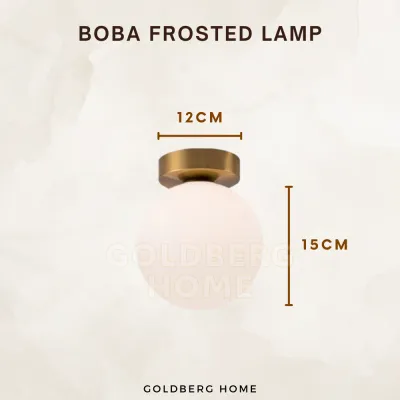
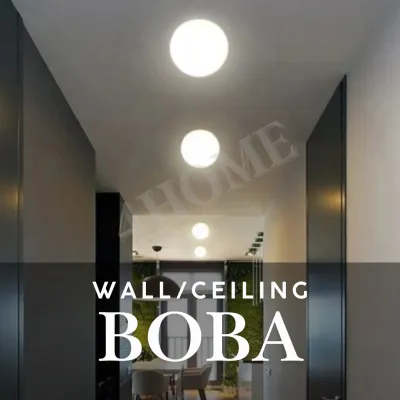
Prices are valid at publication and may change. Please refer to the product page for the latest price.
Beyond their functional light distribution, boba wall lights serve as sculptural wall art. When turned off, their clean geometric forms add visual interest to transitional zones. When illuminated, they cast a gentle, welcoming glow that draws the eye forward, transforming a simple walkway into a curated gallery-like experience.
The visual weight of a sphere is naturally balanced and calming to the human eye. In tight, enclosed spaces, sharp corners and boxy fixtures can make the walls feel like they are closing in. The soft curves of a spherical globe counteract this effect, visually expanding the perceived width of the corridor by drawing attention to the gentle wash of light along the vertical surfaces.
Calculating Spacing and Quantity for Your Boba Wall Light Layout
Determining how many fixtures you need and where to place them requires balancing the length of your corridor with the light output of your chosen bulbs. A standard planning guideline is to space wall sconces approximately 1.8 to 2.4 meters (6 to 8 feet) apart. However, this spacing is not a universal rule and must be adjusted based on your corridor’s specific dimensions, ceiling height, and the verified lumen output stated on the product label.

To calculate the spacing for a straight corridor, begin by measuring the total length of the wall. If you have a 6-meter hallway and decide on a 2-meter spacing interval, you will need to position the fixtures so that the distance from the end walls is half the distance of the interval between the lights. In this scenario, placing the first light 1 meter from the entrance, the second light 3 meters from the entrance, and the third light 5 meters from the entrance ensures a perfectly balanced, symmetrical distribution.
For shorter hallways, such as those measuring 3 meters or less, a single, well-placed boba wall light is often sufficient. Overcrowding a short passage with multiple fixtures can create visual clutter and produce excessive glare. Conversely, in very long corridors, failing to install enough fixtures results in dark, uninviting pockets of shadow between the lights, which can make the space feel disjointed and unsafe to navigate.
Strategic placement is crucial near architectural features, doorways, and corners. Avoid placing a boba wall light directly in a tight corner where the spherical globe might interfere with door swings or create a concentrated hotspot of light. Instead, position fixtures at least 30 centimeters away from door frames and corners to allow the diffused light to wash evenly across the wall surface.
For wide or open-concept hallways, an alternating, asymmetrical arrangement on opposing walls can create a dynamic, winding path of light that guides visitors through the home. For narrow, traditional corridors, keeping all fixtures on a single wall is generally preferred. This single-wall approach prevents the space from feeling cramped or visually overwhelming, while ensuring a clear, unobstructed path of travel.
If your corridor features an L-junction or a T-junction, treat each segment of the hallway as an independent zone for spacing calculations. Place a fixture near the junction point to illuminate the transition safely, ensuring that the light globe does not protrude so far that it risks being bumped by residents carrying laundry or moving furniture around the corner.
Finding the Right Mounting Height for Spherical Lights
The vertical placement of a boba wall light directly influences both visual comfort and physical safety. The industry standard is to mount wall sconces so that the center of the fixture is approximately 150 to 167 centimeters (60 to 66 inches) above the finished floor. This height positions the light source near eye level for most adults, creating a natural and comfortable line of sight.
However, you must adjust this mounting height based on your specific home environment. If your home has exceptionally high ceilings (above 2.8 meters), mounting the fixtures slightly higher—around 170 to 175 centimeters—can help bridge the visual gap between the floor and ceiling. Conversely, if you are installing very large boba globes, mounting them slightly lower can prevent the top of the spheres from visually crowding the ceiling line.
Physical clearance is another critical consideration, particularly in narrow hallways. The profile depth—how far the spherical globe juts out from the wall—must be verified before installation. For corridors narrower than 1 meter, select low-profile boba fixtures that protrude no more than 10 to 15 centimeters from the wall to ensure residents can walk past comfortably without accidentally knocking into them.
Preventing direct glare is a primary consideration when positioning spherical lights. Because boba lights project light in all directions, walking past them can expose your eyes to the bare bulb if the glass globe is highly transparent. Ensure that the center of the sphere sits at a height where the internal light source is shielded from your direct downward or upward gaze as you move through the corridor.
To maintain visual harmony, use a laser level or a traditional spirit level during installation to ensure all fixtures are perfectly aligned. If your corridor features prominent door frames or artwork, align the horizontal centerline of the boba lights with the upper third of the door frames or the midpoint of the adjacent frames to establish a cohesive architectural connection.
In households with a wide variation in family member heights, aim for a conservative mounting height of 160 centimeters. This compromise ensures that taller individuals do not look directly down into an exposed bulb, while shorter family members still receive excellent ambient illumination without the fixture casting long, upward shadows.
Creating Balanced, Glare-Free Ambient Lighting
Achieving a comfortable lighting environment depends heavily on how the light is diffused and layered. Spherical fixtures excel at ambient lighting because of their shape, but the material of the globe plays a decisive role. Frosted, opal, or textured glass and acrylic spheres are highly recommended for corridors because they scatter light evenly, eliminating harsh glare and reducing the stark, high-contrast shadows common in narrow spaces.
If your corridor is entirely devoid of natural light, relying solely on wall-mounted boba lights might not provide sufficient illumination for tasks like cleaning or searching for items. In these scenarios, layer your lighting by combining your boba wall lights with recessed ceiling downlights or subtle track lighting. Use the ceiling lights for high-visibility tasks and the boba lights independently for a soft, low-glare evening ambiance.
When selecting bulbs, always check the fixture’s maximum wattage limit and electrical specifications on the manufacturer’s label. For residential corridors, a warm white color temperature between 2700K and 3000K is typically preferred to create a cozy, inviting atmosphere. Ensure the bulb’s lumen output is appropriate for the space—typically 300 to 500 lumens per fixture is sufficient for accent and ambient corridor lighting.
Pay close attention to the Color Rendering Index (CRI) of the bulbs you choose. A high CRI of 90 or above is beneficial in hallways where family photos, artwork, or decorative wall finishes are displayed, as it allows colors to appear vibrant and true to life under artificial light.
To maximize flexibility, install compatible dimming systems. Verify the dimming method of your boba wall light—whether it utilizes triac, trailing-edge, or smart dimming protocols—and ensure that the bulb, fixture driver, and wall dimmer switch are fully compatible. Dimming your corridor lights in the evening provides a gentle path-finding light that does not disrupt your household’s sleep cycles.
Integrating smart home technology can further elevate your hallway lighting. Pairing dimmable boba wall lights with motion sensors allows the system to automatically turn on at a low, dimmed level during the night, providing hands-free, glare-free navigation for late-night trips to the bathroom or kitchen without waking the rest of the household.
Electrical Safety and Installation Boundaries
Before purchasing or installing any wall-mounted fixtures, you must assess your home’s existing electrical infrastructure. In Singapore, many residential units, particularly HDB flats and concrete condominiums, feature solid concrete structural walls. Drilling into concrete requires specialized rotary hammer drills and appropriate masonry wall plugs, whereas drywall installations require toggle bolts or heavy-duty hollow-wall anchors to support the fixture’s weight.
Always verify that the boba wall light is compatible with Singapore’s standard electrical supply of 230V at 50Hz. Look for the Enterprise Singapore SAFETY Mark on the product’s driver or electrical components to ensure compliance with local safety standards. Additionally, check the base or interface type (such as E27 or G9) to ensure you can easily source replacement bulbs locally.
For retrofitted installations where routing cables inside the wall is not feasible, surface-mounted wiring housed in neat plastic casing or decorative metal conduits can be used. If you prefer a seamless, minimalist look, concealing the wiring requires chasing the concrete walls, which involves professional plastering, sanding, and repainting to restore the wall surface.
If your boba wall light utilizes low-voltage LED technology, it will require an external driver or transformer. Ensure that this driver is housed in a well-ventilated, accessible location—such as a ceiling access hatch or a recessed wall box—so that it can be easily serviced or replaced in the future without damaging your walls.
Installing fixed wiring, chasing concrete walls to hide cables, or altering fixed electrical circuits must be performed by a licensed electrical worker (EMA-licensed electrician) to comply with local regulations and prevent fire hazards. Before any installation or maintenance work begins, ensure that the main power supply at the distribution board (DB box) is completely isolated.
If your corridor is located near an open balcony, patio, or semi-outdoor area exposed to high humidity or occasional wind-driven rain, verify the fixture’s Ingress Protection (IP) rating. Standard dry-rated indoor fixtures are not suitable for damp environments; look for an IP44 rating or higher if the installation environment is subject to moisture. Always read and strictly follow the manufacturer’s provided installation instructions, and if any conflict arises, consult a qualified professional immediately.
Frequently Asked Questions (FAQ)
Can I install boba wall lights in the public corridor outside my HDB or condo unit?
Public corridors, lift lobbies, and common stairwells are shared spaces managed by Town Councils (for HDB estates) or Management Corporation Strata Titles (MCST, for private condominiums). You must not drill, wire, or install any personal lighting fixtures in these shared areas without explicit written approval from your respective management body. Unauthorized installations often violate strict Singapore Civil Defence Force (SCDF) fire safety and escape route regulations, which require common pathways to remain clear of obstructions and non-compliant electrical hazards.
Do spherical wall lights provide enough illumination for a very dark hallway?
Spherical wall lights are designed primarily to provide diffused ambient and accent lighting rather than high-intensity task lighting. While they are highly effective at softening shadows and creating a welcoming glow, a single boba wall light may not provide sufficient illumination for a long, pitch-black corridor. To ensure adequate visibility, you should verify the lumen output of the fixture or supplement the layout with additional low-profile ceiling lights or step lights.

Community discussion
Share your experience or ask a question. Comments are reviewed before publication.