
To create the perfect living room ambience with an RGB lamp, prioritise colour mixing quality (specifically RGBW or RGBWW), deep dimming capabilities, and effective light diffusion over raw brightness or complex smart features. While basic RGB lamps can produce vibrant colours, they often struggle to emit the warm, natural white light needed for a relaxing evening. Focusing on how the light is softened and controlled ensures your living room feels inviting rather than clinical.
Colour Quality and Mixing: Beyond Basic RGB
Standard RGB lamps combine red, green, and blue diodes to create white light, which often looks cold, bluish, or unnatural. Choosing an RGBW lamp adds a dedicated cool white diode, while an RGBWW lamp includes both cool and warm white diodes. This addition allows the fixture to produce a spectrum of soft, golden tones that mimic traditional incandescent bulbs, making it far more suitable for living room relaxation.
When using the lamp for general illumination, check the Colour Rendering Index (CRI). A higher CRI (typically 80 or above) ensures that the colours of your furniture, decor, and skin tones look natural and vibrant under the white light setting. Low-CRI lighting can make a beautifully decorated living room look dull or greyish.
Products mentioned in this guide
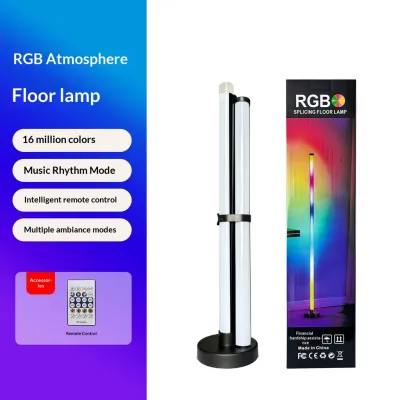
Prices are valid at publication and may change. Please refer to the product page for the latest price.
Look closely at the physical construction of the light source. High-quality RGB lamps use advanced diffusion covers or closely spaced surface-mounted diodes (SMDs) to blend the colours before they reach your eyes. This prevents the “rainbow effect” or visible, separated red, green, and blue dots on your walls, resulting in a seamless, uniform wash of light.
Brightness and Dimming Range for Mood Lighting
True mood lighting relies on the lower end of the brightness scale. Many entry-level lamps only dim down to 10% or 20%, which can still feel too bright in a dark room. Prioritise lamps that specify a deep dimming range down to 1% or 5%, allowing you to transition smoothly from a brightly lit room to a low-glare, cinema-like environment for evening wind-downs.

While maximum brightness is secondary for ambience, the lamp should still offer enough output to complement your existing overhead lights. For a standard living room, a lamp emitting around 800 to 1,500 lumens is generally sufficient to serve as an accent or secondary light source without overpowering the space.
Verify the dimming mechanism used by the lamp. Pulse-width modulation (PWM) is common in LED lamps, but low-quality drivers can cause visible or invisible flickering, leading to eye strain. Ensure the lamp’s dimming is rated as flicker-free, and check whether it requires a dedicated remote, a compatible smart app, or if it can be integrated with external dimmer switches.
Control Interfaces and Smart Home Integration
Consider how you prefer to interact with your lighting daily. Physical controls, such as foot switches, inline buttons, or dedicated remote controls, offer instant access without needing a smartphone. On the other hand, app-based controls and voice assistant integration provide hands-free convenience, allowing you to adjust settings from the comfort of your sofa.
If you opt for a smart-enabled RGB lamp, verify its wireless protocol. Many smart lamps operate on 2.4 GHz Wi-Fi networks, which may require adjusting your home router settings if you use a single 5 GHz band. Alternatively, models utilizing Bluetooth, Zigbee, or the Matter standard may require a compatible smart home hub to unlock their full automation potential.
While pre-programmed scene modes (like “Sunset” or “Forest”) are convenient for quick setups, the ability to customise and save your own colour palettes is highly valuable. Look for companion apps that allow you to fine-tune individual colour channels and save custom presets, ensuring you can match the lighting to your specific living room decor and personal preferences.
Physical Design and Light Diffusion
The material surrounding the LEDs determines how the light behaves in your space. Frosted acrylic, opal glass, or fabric shades act as excellent diffusers, scattering the light rays to eliminate harsh glare and hot spots. If you plan to place the lamp in a corner to bounce light off the walls, a frosted silicone or acrylic diffuser will provide the smoothest gradient.
A stable floor lamp requires a heavy, well-balanced base to prevent tipping, especially in high-traffic living areas or homes with pets and children. Check the physical dimensions and weight specifications of the base. Additionally, integrated cord management or a discreetly routed power cable helps maintain a clean, clutter-free aesthetic.
Before purchasing, verify that the lamp’s voltage is compatible with your local electrical grid (such as 230V). Ensure the plug type matches your wall outlets without requiring unsafe adapters. Look for recognized electrical safety certifications, such as the Safety Mark, to guarantee the power adapter and internal wiring meet local safety standards.
Frequently Asked Questions (FAQ)
Do RGB floor lamps consume more electricity than standard white lamps?
The power consumption of an RGB lamp depends primarily on its total wattage and brightness settings rather than the specific colour selected. Modern LED technology is highly efficient, but running all colour channels (red, green, and blue) simultaneously at 100% brightness to create a cool white light will draw more power than running a single, dedicated warm white channel. Dimming the lamp to lower levels significantly reduces its energy consumption, making ambient settings highly cost-effective.
Can I use an RGB floor lamp as my primary reading light?
While an RGBWW lamp can produce functional white light, it is generally not recommended as a primary reading light. Dedicated reading lamps are designed with focused beam angles, adjustable necks, and high-CRI white light to reduce eye strain during prolonged reading. If you require a multi-purpose lamp, ensure the model you choose has a dedicated, high-lumen white LED mode and allows you to direct the light beam precisely onto your reading material.

Community discussion
Share your experience or ask a question. Comments are reviewed before publication.