
Selecting a hiking headlight that performs reliably on dark outdoor trails while serving as an effective emergency backup light for your HDB flat in Singapore requires a careful balance of optical features and power configurations. On the trail, you need a focused, long-distance beam to spot obstacles, roots, and wet patches in humid nature reserves like MacRitchie or Bukit Timah. Indoors, however, that same intense spotlight can cause blinding glare and harsh shadows against close-up concrete walls, making a wide, diffused floodlight mode essential. The ideal dual-use headlamp is one that offers adjustable beam profiles, multiple brightness levels, and a hybrid power system that can run on both rechargeable packs and standard disposable batteries. By focusing on versatile designs that can transition from your forehead to a tabletop, you can secure a single, dependable lighting tool that keeps you safe during outdoor adventures and comfortable during rare domestic power outages.
Balancing Trail Performance with Indoor Emergency Needs
To understand why a standard flashlight or a dedicated tactical light often falls short in a dual-use scenario, one must examine how light behaves in different environments. When navigating outdoor trails at night, your eyes must adapt to a vast, unlit space where hazards can appear several meters ahead. A hiking headlight designed for this purpose utilizes a concentrated spot beam, projecting a narrow cone of high-intensity light over a long distance. This long-throw capability is vital for route-finding and safety on uneven terrain, but it becomes highly impractical when brought inside the confined layout of a typical HDB flat.
Inside a home, particularly in smaller rooms like kitchens, bathrooms, or household shelters, a highly focused spot beam strikes light-colored walls and reflective surfaces, bouncing intense glare directly back into your eyes. This concentrated light creates deep, dark shadows in the rest of the room, forcing your pupils to constantly adjust between extreme brightness and pitch darkness, which rapidly leads to eye strain and headaches. For indoor emergency use, the priority shifts from distance projection to uniform, low-intensity ambient light. A wide flood beam disperses light evenly across a broad area, softening shadows and allowing household members to move around safely without being blinded by direct glare.
Products mentioned in this guide
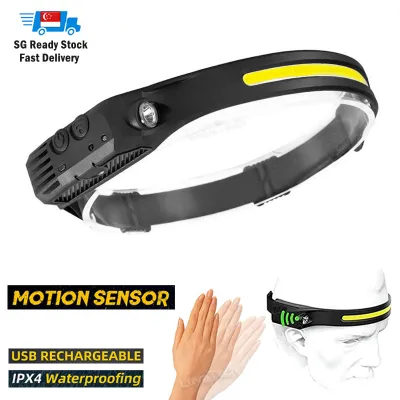
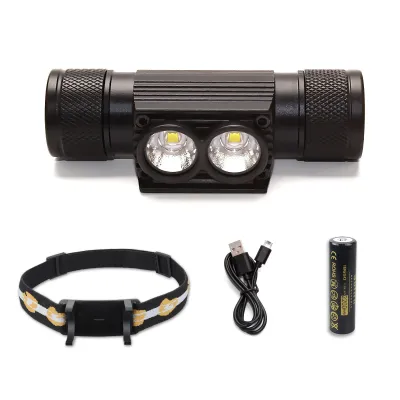
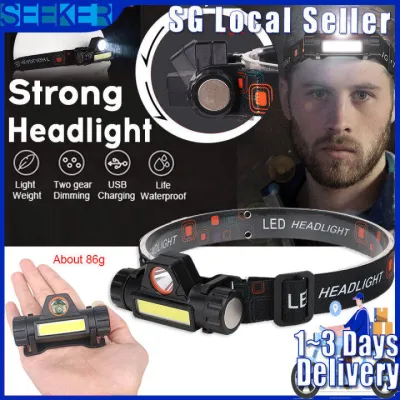
![[SG SELLER] Outdoor Headlight Camping USB Rechargeable Waterproof Head-Mount Outdoors sensor Led Light 4-MODES](https://img.lazcdn.com/g/p/e9e8b179f962b86f3fdd0e3242e3c41c.jpg_400x400q80.jpg_.webp)
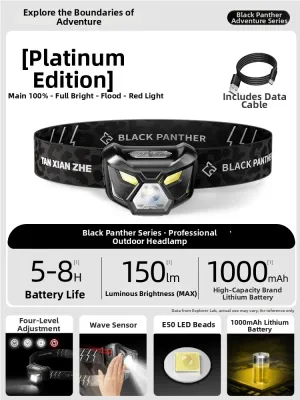
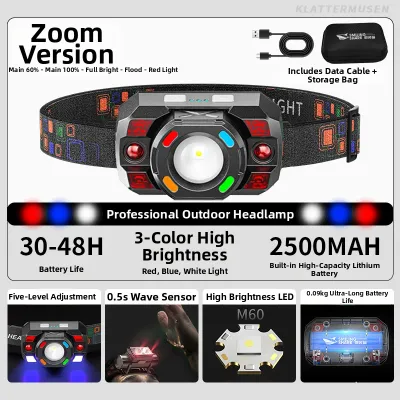
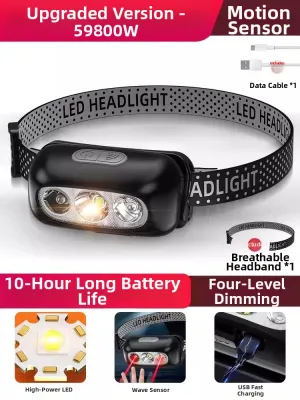
Prices are valid at publication and may change. Please refer to the product page for the latest price.
Furthermore, the physical utility of the light changes when transitioning from the trail to the home. While a headlamp is primarily worn on the head during a hike to keep your hands free for balance or trekking poles, wearing a headlamp continuously indoors can be uncomfortable and socially awkward when interacting with family members. If you look directly at someone while wearing a bright headlamp, you will temporarily blind them. Therefore, an effective dual-use headlamp must feature a physical design that allows it to be easily detached from its strap, stood upright on a flat surface like a dining table, or hung from a hook or drying rack to act as a stationary lantern.
Key Specifications to Evaluate for Dual-Use Headlamps
When evaluating different hiking headlight options in Singapore’s retail stores or online marketplaces, you should look closely at the technical specifications listed on the packaging. The first metric to analyze is the lumen output and its adjustability. While manufacturers often highlight maximum outputs of 400 to 900 lumens, these high settings are rarely needed for extended periods and will quickly drain your battery. For trail hiking, a medium setting of 150 to 250 lumens is generally sufficient for clear visibility. For indoor emergency use, you want a headlamp that can dial down to a low-lumen mode—ideally between 5 and 30 lumens. This low output is perfect for reading, preparing food, or navigating a dark hallway without disturbing others, while dramatically extending the battery runtime to dozens of hours.

The beam pattern and color temperature are equally critical. Look for headlamps that feature independent LEDs or adjustable lenses that allow you to switch between a spot beam, a flood beam, or a mixed beam. Some advanced models use a diffuser plate that flips over the lens to instantly soften the light. Additionally, pay attention to the color temperature of the light. While cool white light (above 5000K) is excellent for high-contrast detail on the trail, it can feel clinical and harsh indoors. A neutral or warm white light (around 3000K to 4000K) is much gentler on the eyes during a blackout. A dedicated red-light mode is another invaluable feature; red light preserves your natural night vision outdoors and allows you to navigate your home at night without waking sleeping family members.
Finally, consider the build quality and environmental protection ratings, denoted by the Ingress Protection (IP) scale. Singapore’s tropical climate demands a headlamp with a minimum rating of IPX4, which protects against splashing water from any direction—essential for sudden downpours on outdoor trails or heavy sweat. If you plan to hike in severe weather or near water bodies, upgrading to an IPX7 rating ensures the device can withstand temporary submersion. However, keep in mind that extreme ruggedness often requires heavy aluminum housings or thick rubber armor. For a dual-use light, look for a balanced construction that pairs a durable, impact-resistant polycarbonate body with a lightweight profile, ensuring it remains comfortable to wear for hours and easy to pack in an emergency kit.
Practical Setup Strategies for HDB Power Outages
When a power outage occurs in an HDB flat, simply wearing your hiking headlight is rarely the most efficient way to illuminate your living space. Instead, you can employ simple optical techniques to transform your headlamp into a highly effective stationary ambient light source. One of the most reliable methods is light bouncing. By setting the headlamp to a high-output flood mode and pointing it directly at a white or light-colored ceiling, the plaster acts as a massive natural reflector. This bounces a soft, even glow down into the entire room, mimicking the effect of a standard ceiling fixture and eliminating harsh shadows and direct glare.
To execute these techniques successfully, the physical design of the headlamp housing must support stationary placement. When shopping, check if the headlamp body can pivot smoothly on its bracket. A wide angle of tilt—ideally up to 90 degrees—allows you to place the unit flat on a table and angle the beam straight up at the ceiling. Some models feature flat bases that allow them to stand upright independently once detached from the headband. Others include integrated clips or carabiner loops, which make it easy to hang the light from a kitchen cabinet handle, a door frame, or an indoor laundry drying rack, casting light downward over a wide area.
The placement of the battery pack also plays a major role in how stable the headlamp is when used as a stationary light. Headlamps generally fall into two design categories: front-heavy units where the lamp and batteries are integrated into a single forehead piece, and split units where the battery pack is positioned at the back of the head strap. Front-heavy designs are typically easier to set down on a flat surface because the center of gravity is concentrated in one compact housing. Split-battery designs, while offering excellent weight distribution on your head during a long hike, can be awkward to balance on a table and may require you to wrap the elastic strap around a heavy object, like a water bottle, to keep the light pointed in the desired direction.
Power Source Selection and Blackout Readiness
The battery architecture of your hiking headlight determines both its operational readiness during a sudden household blackout and its ongoing running costs. USB-rechargeable lithium-ion battery packs have become the industry standard due to their high energy density, consistent voltage output, and the convenience of recharging via standard USB-C cables. For regular hikers, a rechargeable system is highly economical, eliminating the recurring cost and environmental waste of disposable batteries. However, lithium-ion batteries slowly lose their charge over time when left sitting in a drawer, and if a blackout lasts for several days, you cannot easily recharge them without a backup power bank.
Conversely, standard alkaline or lithium AA and AAA disposable batteries offer an exceptional shelf life, often retaining their charge for up to ten years when stored properly. This makes them ideal for emergency backup kits, as you can simply insert fresh batteries and achieve instant full power without waiting for a charge. The drawback is their lower energy density, susceptibility to voltage drops under high loads, and the risk of chemical leakage over time. To get the best of both worlds, look for hybrid power systems. Many reputable outdoor brands now design headlamps that accept either a proprietary rechargeable lithium pack or standard AAA batteries, providing the ultimate fallback option when the grid goes down.
Maintaining your headlamp’s power source is essential to ensure it functions when you need it most. If you choose a model that uses disposable batteries, never store the headlamp with the batteries installed. Over months of inactivity, alkaline batteries can leak corrosive acid, permanently damaging the electrical contacts of your headlamp. Instead, store the fresh batteries in their original packaging alongside the headlamp in a dedicated emergency dry box. For rechargeable lithium-ion headlamps, establish a bi-annual maintenance routine where you discharge the battery partially and recharge it to around 50% to 80% for long-term storage, preventing capacity degradation and ensuring the cell remains healthy.
Pre-Purchase Checklist and Operational Safety
Before purchasing a hiking headlight, it is crucial to look past marketing claims and verify the actual operational limits of the device. First, learn to interpret manufacturer runtime specifications critically. Many brands advertise impressive runtimes of 100 hours or more, but a closer look at the fine print often reveals that this measurement is taken on the lowest, barely usable brightness setting. On high or turbo modes, the runtime is usually limited to a few hours or even minutes. Furthermore, modern high-output headlamps feature thermal regulation sensors that automatically step down the brightness after a few minutes to prevent the LED from overheating, meaning you will not get sustained maximum output for the duration of your hike or emergency.
This thermal management is also a critical safety consideration when using the headlamp indoors. High-power LEDs generate a significant amount of heat at the bezel. If you leave a headlamp running on its highest setting while it is resting face-down on a bed, a wooden table, or near flammable papers, the accumulated heat can scorch surfaces or even pose a fire hazard. Always ensure the light has adequate ventilation when in use, and stick to low or medium modes when using it as a stationary indoor light. Additionally, check the physical lock-out feature of the headlamp; a physical switch lock or a digital button-press sequence prevents the light from accidentally turning on inside your backpack or storage drawer, which would leave you with a dead battery when you need it.
Finally, verify the availability of replacement parts and local warranty support in Singapore. A high-quality headlamp is an investment, and its lifespan can be significantly extended if you can easily source replacement elastic headbands, silicone O-rings, and spare battery cartridges. Check if the brand has an authorized local distributor or a physical retail partner where you can seek assistance if the charging port fails or the housing cracks. Investing in a brand with established local support ensures that your dual-use headlamp remains a reliable safety tool for both the rugged trails of Singapore’s nature parks and the quiet security of your home.
Frequently Asked Questions (FAQ)
Can I use a hiking headlight as a primary reading light during a blackout?
Yes, a hiking headlight can serve as an excellent reading light during a blackout, provided you use the correct settings to prevent eye strain. You should avoid using a highly focused spot beam for close-up reading, as the intense light reflecting off white book pages or screen glass creates high contrast and harsh glare that quickly fatigues your eyes. Instead, switch the headlamp to its widest flood beam setting and select a low brightness level, ideally under 30 lumens. If your headlamp allows, tilting the beam slightly downward so it illuminates the page indirectly, or using a warm white light mode, will provide a much more comfortable and natural reading experience.
How often should I test my emergency headlamp?
You should test your emergency headlamp at least twice a year to guarantee it is fully operational when needed. During this bi-annual check, insert the batteries or turn on the rechargeable unit to verify that all light modes, including the low-lumen and red-light settings, function correctly. Take this opportunity to inspect the physical components: check the battery compartment for any signs of white powdery corrosion, examine the elastic head strap to ensure it has not lost its stretch or become brittle in Singapore’s humid climate, and inspect the rubber O-rings for cracks, applying a tiny amount of silicone grease if necessary to maintain water resistance.

Community discussion
Share your experience or ask a question. Comments are reviewed before publication.